

 1 day ago
11
The history of the Philippines is a story of ancient communities, international trade, colonial rule, revolution, war, independence, and the continuing struggle for democracy. Across centuries, the people of the archipelago developed distinct cultures, resisted foreign domination, built political institutions, and responded to challenges that reshaped their society.
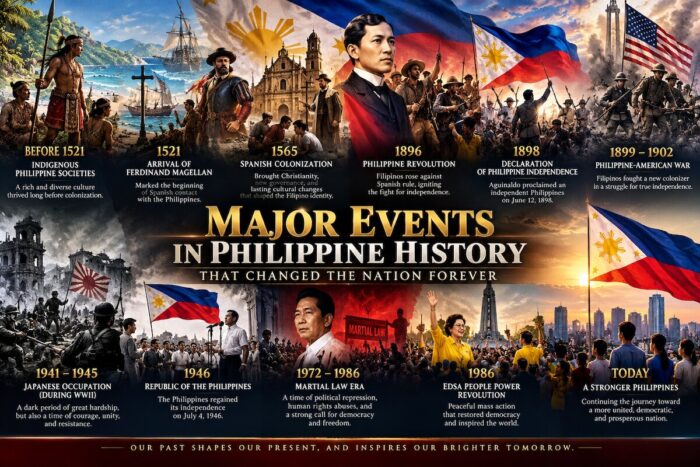
Major Events in Philippine History That Changed the Nation Forever
From the trading communities that flourished before European colonization to the establishment of the Philippine Republic, the country experienced major transformations that continue to influence Filipino identity. Spanish rule introduced new religious and political institutions, American colonization changed education and government, and the Japanese occupation during World War II brought widespread destruction and suffering.
The postwar period presented a different set of challenges. The newly independent republic confronted poverty, political instability, armed conflict, and questions about national development. The 1972 declaration of Martial Law and the 1986 EDSA People Power Revolution became defining moments in the country’s modern political history.
More recent developments, including natural disasters, the COVID-19 pandemic, landmark international rulings, and changing electoral politics, have also shaped how Filipinos understand their nation and its place in the world.
This chronological guide examines 25 major events in Philippine history, explaining what happened, who played important roles, and why each event continues to matter. While no list can capture every community’s experience, these milestones provide a broad overview of the forces that transformed the Philippines from a collection of diverse societies into the modern nation.
25 Major Events in Philippine History
1. The Rise of Pre-Colonial Communities and Trade Networks
Period: Before the 10th century
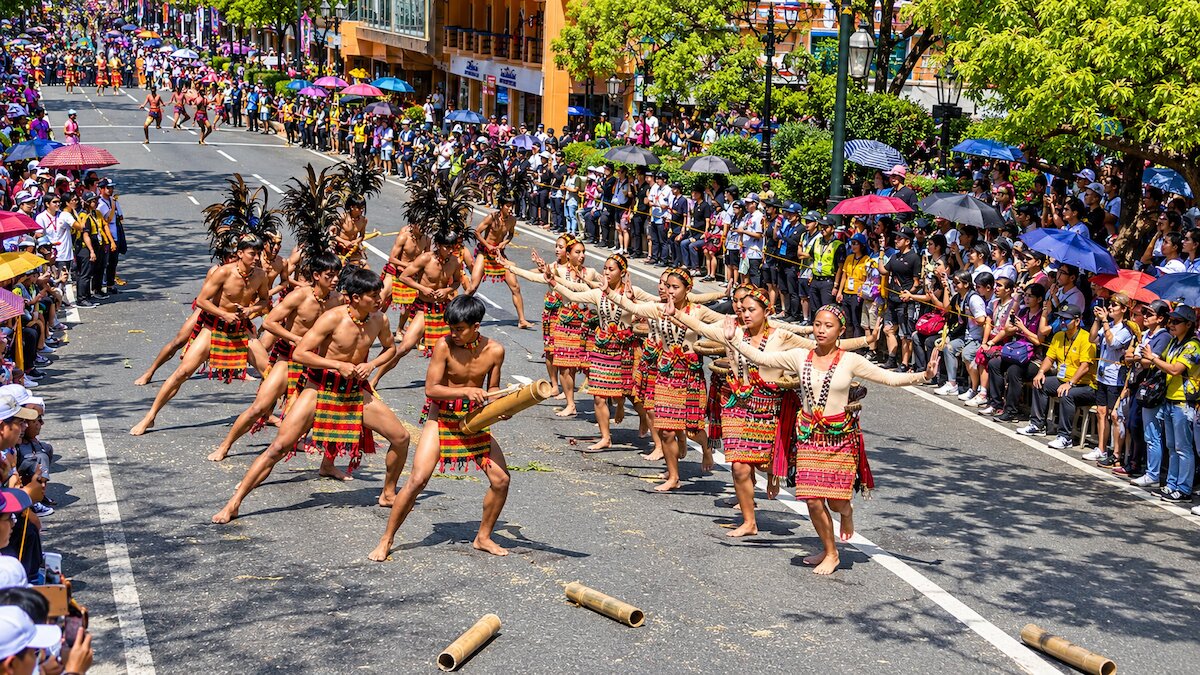
Long before Spanish explorers arrived, the Philippine archipelago was home to diverse communities with established systems of leadership, agriculture, fishing, craftsmanship, and maritime trade. These societies were not organized under a single national government. Instead, they consisted of numerous settlements, chiefdoms, and other political communities with distinct customs and traditions.
Many communities maintained connections with neighboring parts of Southeast Asia. Traders exchanged goods, technologies, and cultural practices along maritime routes that linked the islands to China, Borneo, the Malay Peninsula, and other regions.
Local leaders, often called datus in several communities, exercised authority through relationships involving kinship, trade, warfare, and alliances. Social structures varied considerably by region. Indigenous spiritual traditions also differed, reflecting the archipelago’s cultural diversity.
These early societies established foundations for the Philippines’ later development. They demonstrate that the islands had their own political systems, economic networks, and cultural achievements before European colonization.
Understanding pre-colonial history is important because Philippine history did not begin with the arrival of foreign explorers. The archipelago already had rich, interconnected societies whose influence remains visible in local languages, customs, crafts, and traditions.
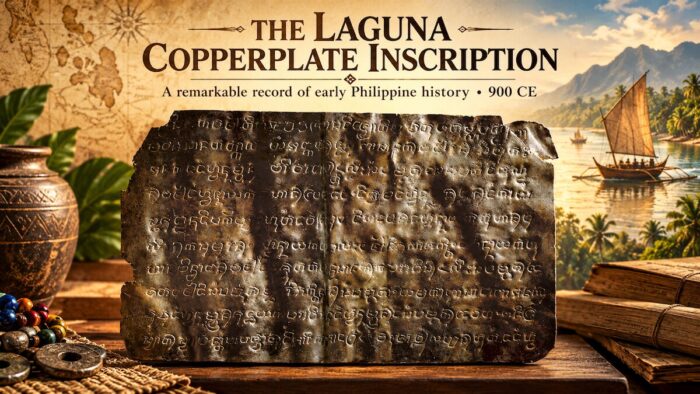 The Laguna Copperplate Inscription
2. The Laguna Copperplate Inscription
Date: 900 CE
The Laguna Copperplate Inscription is one of the most important surviving written records from early Philippine history. Discovered in Laguna in 1989, the inscription dates to 900 CE and contains a legal document concerning the settlement of a debt and the release of a person and their family from an obligation.
Written in a script using a language influenced by Sanskrit and Old Malay, the inscription reflects the cultural and commercial connections between communities in the Philippines and other parts of maritime Southeast Asia.
Its language, terminology, and references to places and titles provide evidence of organized political and social relationships. The document also challenges the outdated idea that Philippine societies lacked complex institutions before Spanish rule.
The inscription is particularly significant because written records from this early period are rare. It offers direct evidence that communities in the archipelago participated in broader regional networks and possessed systems for recording transactions and obligations.
Today, the Laguna Copperplate Inscription remains a crucial artifact for understanding early Philippine literacy, governance, and international connections. It reminds historians that the country’s recorded history extends well beyond the colonial period.
3. The Spread of Islam in the Southern Philippines
Period: Approximately the 14th to 15th centuries
Islam spread into parts of the southern Philippines through maritime trade, religious scholarship, migration, and political relationships with Muslim communities elsewhere in Southeast Asia. Its development was gradual and varied across different islands and communities.
Muslim traders and teachers helped establish religious and commercial connections, particularly in Sulu and parts of Mindanao. Over time, political institutions developed around Muslim rulers and their communities.
The Sultanate of Sulu emerged as an important regional power, while the Sultanate of Maguindanao later became influential in Mindanao. These political entities maintained diplomatic and commercial relationships with neighboring states and played significant roles in regional affairs.
Islam influenced local law, education, architecture, leadership, and cultural traditions. Muslim communities developed distinctive identities that continue to shape the country’s religious and cultural landscape.
The arrival and expansion of Islam also complicate the idea that Philippine history followed a single path. While Spanish colonization brought Christianity to much of the archipelago, Muslim communities in the south maintained their religious traditions and political identities.
Islam’s history in the Philippines remains central to discussions of cultural diversity, regional autonomy, peacebuilding, and the rights of Bangsamoro communities.
4. Ferdinand Magellan’s Expedition Reaches the Philippines
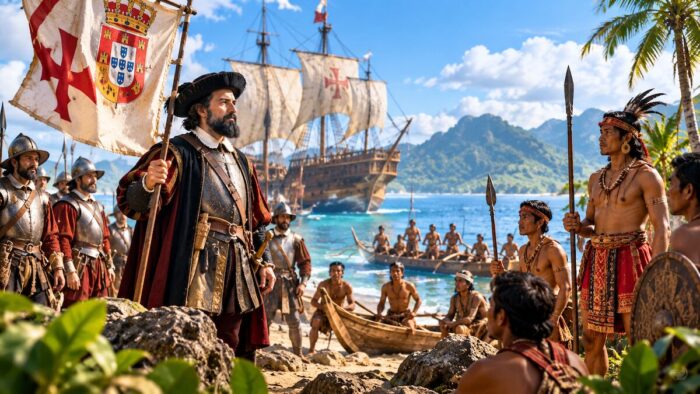 Ferdinand Magellan’s Expedition Reaches the Philippines
Date: March 16, 1521
The expedition, led by Portuguese navigator Ferdinand Magellan and sailing under the Spanish crown, reached the Philippine archipelago in March 1521. Its arrival marked the beginning of sustained European encounters that would eventually lead to Spanish colonial rule.
Magellan and his crew encountered communities with established leaders, trading relationships, and political interests. Their arrival did not mean the islands were empty or undiscovered. Rather, it brought European expansion into contact with existing societies.
Magellan joined local alliances, particularly in Cebu, where he sought to build relationships with local leaders and promote Christianity. His intervention in the conflict involving Lapulapu of Mactan and the ruler of Cebu led to the Battle of Mactan on April 27, 1521.
Magellan was killed during the battle, demonstrating that local communities could resist foreign military intervention. The expedition continued under other commanders, and its surviving crew eventually completed the first circumnavigation of the globe.
The expedition became a major turning point because it connected the archipelago more directly to European imperial ambitions. However, Spanish colonial rule did not begin immediately in 1521. It took decades of subsequent expeditions and military campaigns before Spain established a lasting colonial foothold.
5. The Establishment of Spanish Colonial Rule
Date: 1565
Spanish colonial rule became firmly established when Miguel López de Legazpi founded a permanent Spanish settlement in Cebu in 1565. This settlement followed earlier expeditions and marked a more sustained effort to control the archipelago.
In 1571, Spanish forces and their allies established Manila as the colonial capital. Its strategic position helped transform the city into a center of administration, religion, commerce, and military power.
Spanish authorities introduced new systems of government, taxation, landholding, and religious organization. Catholic missionaries played a major role in converting many communities, while colonial officials and religious institutions became influential in local affairs.
Spanish rule also connected the Philippines to global trade networks. The Manila-Acapulco Galleon Trade, which operated from 1565 to 1815, linked Asia and the Americas through the exchange of goods, silver, and people.
Colonization brought profound changes, but it also involved coercion, resistance, economic exploitation, and conflicts over land and authority. Spanish control was never uniform across all regions, and many communities continued to resist colonial expansion.
The Spanish period profoundly influenced Philippine language, religion, architecture, festivals, food, and institutions. It also helped create the historical conditions that eventually encouraged the growth of Filipino nationalism.
6. The Cavite Mutiny and the Execution of Gomburza
Date: January to February 1872
The Cavite Mutiny began on January 20, 1872, when Filipino workers and soldiers at the Cavite arsenal revolted against Spanish colonial authorities. The colonial government suppressed the uprising but used it to intensify its response to perceived opposition.
Three Filipino secular priests, Mariano Gomez, José Burgos, and Jacinto Zamora, collectively known as Gomburza, were accused of involvement in the alleged conspiracy. They were executed by garrote on February 17, 1872.
The accusations and proceedings remain subjects of historical discussion. Many historians view the executions as an example of colonial repression and the use of political accusations to weaken reformist movements. The exact extent of the priests’ involvement in the mutiny has long been disputed.
Their deaths had consequences far beyond the original uprising. Filipino intellectuals and reform advocates came to regard Gomburza as symbols of injustice and the unequal treatment of Filipinos under Spanish rule.
José Rizal later dedicated his novel El Filibusterismo to the three priests, helping preserve their memory in the national consciousness.
The execution of Gomburza became a catalyst for the growth of Filipino nationalism. It strengthened reformists’ belief that colonial authorities would not easily accept demands for equality, representation, and justice.
7. The Propaganda Movement
Period: Approximately 1872 to 1892
The Propaganda Movement was a reform campaign led largely by educated Filipinos who sought changes in Spanish colonial rule. Many of its prominent members lived in Europe, where they used newspapers, essays, books, and political advocacy to expose colonial abuses and argue for equal rights.
Important figures included José Rizal, Marcelo H. del Pilar, and Graciano López Jaena. They demanded representation in the Spanish Cortes, equality before the law, greater freedom of expression, and reforms in colonial administration.
The movement’s publication La Solidaridad became an important platform for reformist ideas. Rizal’s novels, particularly Noli Me Tangere and El Filibusterismo, criticized abuses by colonial officials and religious authorities while examining social inequality and the consequences of oppression.
The reformists did not all share identical political goals. Many initially sought reforms within the Spanish system rather than immediate independence. Nevertheless, their writings encouraged readers to question colonial authority and imagine a political community based on shared interests and identity.
The Propaganda Movement helped develop the intellectual foundations of Filipino nationalism. Although its reform campaign failed to secure its main objectives, its influence extended into the revolutionary movement that emerged in the 1890s.
8. The Founding of the Katipunan and the Philippine Revolution
Date: 1892 to 1896
Andrés Bonifacio and other Filipino patriots founded the Katipunan in July 1892, following the arrest and exile of José Rizal. The organization sought independence from Spain through a revolutionary struggle rather than relying solely on peaceful reform.
The Katipunan developed a network of members committed to ending Spanish colonial rule. It attracted support from different sectors of society, including workers, artisans, and other Filipinos who were dissatisfied with colonial conditions.
In August 1896, Spanish authorities discovered the organization, triggering the Philippine Revolution. The Cry of Pugad Lawin, commonly dated August 23, 1896, symbolizes the revolutionaries’ decision to reject Spanish authority. Historical accounts differ on the event’s precise location, date, and details.
Bonifacio became a leading figure in the early revolutionary struggle. Emilio Aguinaldo emerged as another influential revolutionary leader, particularly in Cavite. Rivalries within the movement eventually produced serious divisions, culminating in Bonifacio’s trial and execution in 1897.
The revolution marked a decisive shift from reformist demands to an organized campaign for independence. It also revealed the difficulties of building a unified national movement amid regional interests, military pressures, and competing political ambitions.
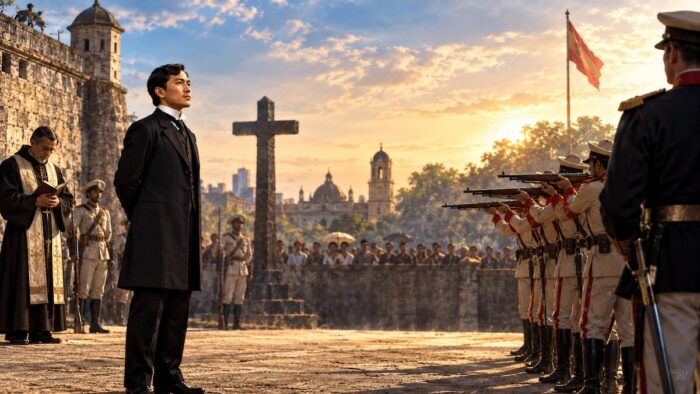 The Execution of José Rizal
9. The Execution of José Rizal
Date: December 30, 1896
José Rizal was executed by firing squad at Bagumbayan, now part of Rizal Park in Manila, on December 30, 1896. Spanish authorities had convicted him of rebellion, sedition, and conspiracy during the early months of the Philippine Revolution.
Rizal was a physician, writer, and reform advocate whose novels and essays exposed social injustice under colonial rule. Although he opposed abuses and called for political reforms, he did not advocate the immediate armed revolution pursued by the Katipunan.
His execution intensified public anger against the Spanish colonial government. Rather than suppressing nationalist sentiment, it strengthened Rizal’s status as a martyr and symbol of the Filipino struggle for dignity and freedom.
His writings continued to circulate and influence discussions about education, citizenship, national identity, and colonial power. Rizal’s life also showed how intellectual activism could shape society, even when political dissent could lead to imprisonment or death.
The execution became one of the most enduring events in Philippine history. Rizal is commemorated as a national hero, and December 30 is observed as Rizal Day.
His legacy also encourages discussion about the relationship between peaceful reform, revolutionary action, and the different ways people contribute to national liberation.
10. The Declaration of Philippine Independence
Date: June 12, 1898
On June 12, 1898, Emilio Aguinaldo proclaimed Philippine independence from Spain in Kawit, Cavite. The declaration took place during the Philippine Revolution, as Spanish authority weakened amid the Spanish-American War.
The ceremony included the presentation of the Philippine flag, designed by Emilio Aguinaldo and sewn in Hong Kong by Marcela Agoncillo, Lorenza Agoncillo, and Delfina Herbosa de Natividad. The group also performed the original composition of the national anthem, associated with Julián Felipe.
The declaration represented a major achievement for the revolutionary movement. It expressed Filipinos’ aspiration to establish an independent political community after more than three centuries of Spanish colonial rule.
However, independence was not immediately secured. Spain and the United States signed the Treaty of Paris on December 10, 1898, transferring the Philippines to American control in exchange for payment. Filipino representatives were excluded from the negotiations.
The United States did not recognize the independence proclaimed by Aguinaldo’s government. This sovereignty dispute contributed directly to the Philippine-American War.
June 12 remains Philippine Independence Day. The date reminds us that declaring independence and achieving internationally recognized sovereignty are separate challenges, and that the country’s struggle for self-government continued beyond 1898.
11. The First Philippine Republic and the Philippine-American War
Date: 1899
The First Philippine Republic was inaugurated in Malolos, Bulacan, on January 23, 1899, with Emilio Aguinaldo as president. The Malolos Congress drafted a constitution for the new republic.
The government represented an important attempt to build independent political institutions after Spanish rule. Its constitution, legislative structure, and national ambitions reflected the revolutionary movement’s desire for sovereignty.
However, tensions with the United States escalated into open warfare near Manila on February 4, 1899. The Philippine-American War followed as Filipino forces resisted American control of the archipelago.
The conflict involved conventional battles, guerrilla warfare, civilian displacement, disease, and widespread suffering. Both sides faced difficult military conditions, and the consequences for Filipino communities were severe.
American forces captured Aguinaldo in 1901, weakening the organized revolutionary government. Although major military operations declined, resistance continued in various regions.
The war marked a tragic turning point. The country had proclaimed independence from Spain, yet another foreign power sought to establish control. The conflict also shaped Filipino nationalism and the long-term debate over colonialism, sovereignty, and self-determination.
12. American Colonial Rule and the Expansion of Public Education
Period: 1901 onward
American colonial administration introduced major changes to Philippine government, education, infrastructure, and public institutions. After suppressing the First Philippine Republic, the United States established a civil government, with William Howard Taft becoming the first civil governor in 1901.
One of the most influential changes was expanding public education. English became an important language of instruction, and the colonial government established schools across many parts of the archipelago. American teachers, including the group later known as the Thomasites, helped expand the education system.
The government also introduced institutional changes in public health, transportation, local administration, and the legal system. These developments expanded access to certain public services and created new opportunities for education and employment.
However, American rule remained colonial rule. Political power was limited, and the benefits of economic development were unevenly distributed. The colonial government also used military force to suppress resistance and faced opposition from communities seeking independence.
American influence left a lasting mark on Philippine society. English remains widely used in education, government, business, and media. The country’s political institutions, popular culture, and educational system also reflect aspects of the American period.
This era shaped the transition toward self-government, but full independence would not come until after World War II.
13. The Establishment of the Philippine Commonwealth
Date: November 15, 1935
The Philippine Commonwealth was inaugurated on November 15, 1935, with Manuel L. Quezon as president and Sergio Osmeña as vice president. The Tydings-McDuffie Act of 1934 created it and established a transition period leading toward Philippine independence.
The Commonwealth government was designed to prepare the country for self-government. It operated under the 1935 Constitution and introduced institutions intended to support an independent republic.
Quezon’s administration pursued reforms involving national language development, public administration, social policy, and defense. The government also faced challenges related to land inequality, labor conditions, political competition, and the need to strengthen national institutions.
The Commonwealth represented an important stage in the development of Philippine sovereignty. Filipinos exercised greater control over domestic affairs, although the United States retained authority over certain matters during the transition.
The planned path toward independence was disrupted by World War II and the Japanese invasion. The Commonwealth government operated in exile during much of the occupation, with its leaders continuing to represent the Philippines internationally.
Despite the interruption, the Commonwealth established a framework that helped shape the postwar republic. Its experience also demonstrated how difficult it could be to build a stable nation while still operating under a foreign power’s authority.
14. The Japanese Invasion and Occupation During World War II
Period: 1941 to 1945
Japan invaded the Philippines shortly after the attack on Pearl Harbor in December 1941. Japanese forces advanced rapidly, and Manila fell in January 1942. American and Filipino troops continued resisting, particularly in Bataan and Corregidor.
The surrender of Bataan in April 1942 was followed by the forced movement of thousands of Filipino and American prisoners of war in what became known as the Bataan Death March. Prisoners suffered from violence, exhaustion, dehydration, and disease.
During the occupation, Japanese authorities established a Philippine government under their supervision. Resistance movements developed throughout the country, with Filipino guerrillas conducting intelligence operations and military attacks against occupying forces.
Civilians endured shortages, forced labor, violence, displacement, and widespread insecurity. The Battle of Manila in 1945 caused catastrophic destruction and the deaths of large numbers of civilians.
The occupation also strengthened resistance networks and deepened the public’s desire for national self-determination. Filipino soldiers and guerrillas played significant roles alongside Allied forces in the liberation campaign.
World War II transformed the country’s political and economic landscape. It destroyed infrastructure, disrupted livelihoods, and left communities struggling to recover. The war also shaped postwar relations with the United States and the rebuilding of the Philippine state.
15. Philippine Independence and the Birth of the Third Republic
Date: July 4, 1946
The Philippines formally gained independence from the United States on July 4, 1946. The transfer of sovereignty established the independent Republic of the Philippines, with Manuel Roxas serving as its first president.
Independence fulfilled a long-standing national objective delayed by Spanish colonial rule, the Philippine-American War, and World War II. It also marked the beginning of a new period in which Filipino leaders had primary responsibility for national governance.
However, independence did not automatically resolve the country’s problems. The Philippines faced the enormous task of rebuilding cities, roads, farms, and industries damaged during the war. Many families had lost homes, livelihoods, and relatives.
The new republic also had to manage economic dependence, social inequality, political competition, and armed insurgencies. Agreements with the United States continued to influence economic relations and defense policy.
The Philippines initially observed July 4 as Independence Day. In 1962, President Diosdado Macapagal moved the official celebration to June 12 to commemorate Aguinaldo’s 1898 declaration of independence.
The change emphasized the revolutionary origins of Filipino nationhood rather than the later transfer of sovereignty. The 1946 milestone nevertheless remains essential because it established the Philippines as an independent republic recognized in international relations.
16. The Huk Rebellion and Postwar Rural Unrest
Period: Late 1940s to the 1950s
The Huk movement emerged from wartime resistance against Japanese occupation and developed into a major postwar insurgency rooted partly in rural inequality, labor disputes, and dissatisfaction with the government.
The Hukbalahap, originally organized as an anti-Japanese guerrilla movement, became involved in armed conflict with the postwar Philippine government. Many supporters came from agricultural communities, particularly in Central Luzon, where land tenancy arrangements and unequal access to resources contributed to social tension.
The government responded with military operations, along with political and economic measures. Defense Secretary and later President Ramon Magsaysay played an important role in weakening the insurgency during the early 1950s, partly through military reforms and efforts to improve government engagement with rural communities.
The rebellion reflected problems that independence alone could not resolve. Land concentration, poverty, limited opportunities, and distrust of political institutions remained significant concerns in many parts of the country.
The conflict also influenced the development of the Philippine military and security institutions during the Cold War. The government’s success in suppressing the Huk rebellion became a prominent example of counterinsurgency strategy in the region.
Its legacy continues to inform debates about agrarian reform, rural development, political participation, and the relationship between inequality and armed conflict.
17. The Declaration of Martial Law
Date: September 21, 1972; publicly announced September 23, 1972
President Ferdinand Marcos declared Martial Law in 1972, citing threats from communist insurgency, political violence, and instability. Proclamation No. 1081 was dated September 21, although the public announcement came on September 23.
The declaration fundamentally changed Philippine political life. The government arrested opposition figures, restricted civil liberties, closed media organizations, and expanded military authority. Congress was eventually shut down, while Marcos governed through a centralized system of power.
Supporters of the administration pointed to infrastructure projects, public order, and economic programs as achievements of the period. However, the era was also marked by documented human rights violations, including arbitrary detention, torture, enforced disappearances, and extrajudicial killings.
The economic consequences were complex. The country experienced periods of growth, but heavy borrowing, corruption, cronyism, and financial instability contributed to serious economic problems. Inequality and political repression also intensified public dissatisfaction.
Martial Law formally ended in 1981, but authoritarian rule and restrictions on political competition continued until the regime’s collapse in 1986.
The period remains one of the most contested chapters in Philippine history. It raises enduring questions about national security, democratic institutions, accountability, historical memory, and the dangers of concentrating political power.
18. The Assassination of Benigno “Ninoy” Aquino Jr.
Date: August 21, 1983
Benigno “Ninoy” Aquino Jr., a leading opposition figure and former senator, was assassinated at Manila International Airport, now Ninoy Aquino International Airport, on August 21, 1983, shortly after returning from exile in the United States.
Aquino had become one of Ferdinand Marcos’s most prominent critics. He returned during a period of economic difficulty and growing opposition to authoritarian rule.
The government initially identified a gunman who was killed at the scene, but the circumstances of the assassination and questions about responsibility generated widespread controversy. Subsequent investigations and legal proceedings implicated military personnel, although the full political context and accountability surrounding the killing remained subjects of public debate.
Aquino’s assassination triggered mass demonstrations and intensified opposition to the Marcos administration. His funeral drew enormous crowds, while his widow, Corazon Aquino, gradually emerged as a major political figure.
The event helped unite different groups dissatisfied with the government, including religious leaders, business communities, students, workers, and opposition politicians.
The assassination is widely regarded as a turning point in the movement that eventually led to the EDSA People Power Revolution. It demonstrated how a single political event could transform public sentiment and accelerate a broader struggle for democratic change.
19. The EDSA People Power Revolution
Date: February 22 to 25, 1986
The EDSA People Power Revolution was a mass mobilization that ended Ferdinand Marcos’s rule and led to Corazon Aquino assuming the presidency.
The immediate background included the disputed February 1986 snap election, in which Marcos and Aquino claimed victory. Allegations of electoral fraud, defections within the military, and growing public opposition intensified the political crisis.
On February 22, Defense Minister Juan Ponce Enrile and Armed Forces Vice Chief of Staff Fidel V. Ramos withdrew their support for Marcos and called on the public to back them. Thousands of civilians gathered along Epifanio de los Santos Avenue, or EDSA, to protect the breakaway military leaders and demand political change.
Religious leaders, including Cardinal Jaime Sin, encouraged people to support the movement. Ordinary Filipinos provided food, assistance, and a visible civilian presence, while military members defected from the administration.
Marcos left the Philippines on February 25, and Corazon Aquino assumed the presidency.
The revolution became an international symbol of largely peaceful resistance to authoritarian rule. It restored democratic institutions and helped inspire similar movements elsewhere.
However, the transition did not eliminate poverty, corruption, political dynasties, or human rights concerns. The revolution remains both a celebrated democratic achievement and a reminder that restoring elections is only one part of building accountable government.
20. The 1987 Constitution and the Restoration of Democratic Institutions
Date: February 2, 1987
Following the EDSA Revolution, the government under Corazon Aquino pursued constitutional reforms intended to prevent the return of authoritarian rule. A constitutional commission drafted a new charter, which voters approved in a national plebiscite on February 2, 1987.
The Constitution restored a presidential system with a bicameral Congress and an independent judiciary. It established safeguards intended to limit executive power and strengthen checks and balances.
The charter also included provisions on human rights, civil liberties, social justice, local autonomy, and the role of constitutional commissions. It limited the president to a single six-year term and restricted the declaration of martial law.
The Constitution became the legal foundation of the country’s post-authoritarian democratic system. It provided mechanisms for elections, judicial review, legislative oversight, and the protection of individual rights.
Nevertheless, constitutional safeguards cannot operate effectively without independent institutions, public accountability, and respect for the rule of law. Political dynasties, corruption, disinformation, and unequal access to power have continued to challenge democratic governance.
The 1987 Constitution remains central to political debate in the Philippines, particularly discussions about constitutional amendments, federalism, electoral reform, and the balance of powers among government branches.
Its significance lies not only in the text itself but also in the continuing effort to ensure that public authority remains accountable to the Filipino people.
21. The 1991 Eruption of Mount Pinatubo and the Closure of U.S. Military Bases
Date: 1991
Two developments in 1991 changed the Philippines’ environmental and strategic landscape: the eruption of Mount Pinatubo and the Senate’s rejection of a treaty that would have extended the presence of major American military bases.
Mount Pinatubo erupted catastrophically in June 1991 after centuries of relative dormancy. Scientific monitoring and evacuations helped save lives, although communities suffered severe losses and displacement. Ashfall, lahars, and long-term environmental changes affected Central Luzon for years.
The disaster demonstrated the importance of scientific monitoring, disaster preparedness, and cooperation between local communities and government agencies. It also reshaped landscapes and livelihoods, particularly among Aeta communities and residents living near the volcano.
In September 1991, the Philippine Senate rejected a proposed treaty extending the U.S. military bases agreement. The decision led to the eventual closure of major American installations, including Clark Air Base and Subic Bay Naval Base.
The two events had different causes, but both had lasting effects. Pinatubo transformed disaster management and environmental policy, while the bases’ decision marked a significant change in Philippine foreign and defense policy.
Together, they illustrate how natural hazards and national political decisions can reshape communities, economic activity, and the country’s relationship with foreign powers.
22. The EDSA II Uprising and the Removal of Joseph Estrada
Date: January 17 to 20, 2001
EDSA II was a series of demonstrations and political developments that resulted in President Joseph Estrada leaving office in January 2001. Estrada faced allegations of corruption, including accusations related to illegal gambling operations.
The political crisis intensified during his impeachment trial. On January 16, 2001, senators voted against opening an envelope containing evidence opponents believed could damage the president. The decision prompted protesters to gather at EDSA and other locations.
Demonstrators included religious groups, civic organizations, students, and political opponents. Senior military and police officials withdrew support for Estrada, contributing to his administration’s collapse.
Vice President Gloria Macapagal Arroyo took the oath of office as president on January 20, 2001. Estrada challenged the legality of his removal, but the Supreme Court later upheld Arroyo’s assumption of the presidency.
EDSA II demonstrated the continuing influence of mass mobilization in Philippine politics. It also exposed divisions over constitutional succession, the role of street protests, and the influence of powerful political and economic groups.
Unlike the 1986 revolution, EDSA II did not produce the same broad consensus about its legitimacy. Supporters viewed it as a response to corruption, while critics argued that political pressure had undermined the electoral mandate.
The episode remains important to discussions about accountability, impeachment, constitutional government, and the limits of popular protest.
23. Super Typhoon Yolanda and the National Disaster Response
Date: November 8, 2013
Super Typhoon Yolanda, internationally known as Haiyan, struck the central Philippines on November 8, 2013. It became one of the country’s most destructive tropical cyclones, causing widespread devastation across Eastern Visayas and other affected regions.
The storm produced powerful winds and destructive storm surges that overwhelmed coastal communities. Tacloban City and many municipalities in Leyte and Samar experienced catastrophic damage to homes, roads, hospitals, schools, and public infrastructure.
Thousands of people died, and millions were affected by the disaster. Families lost homes and livelihoods, while survivors faced shortages of food, water, shelter, electricity, and medical services.
The response involved Philippine government agencies, local communities, civil society organizations, international aid groups, and foreign governments. However, the scale of destruction exposed weaknesses in emergency coordination, infrastructure resilience, communication systems, and the protection of vulnerable communities.
Yolanda became a defining event in Philippine disaster management. It encouraged greater attention to early-warning systems, evacuation planning, resilient construction, and climate adaptation.
The disaster also highlighted the country’s vulnerability to extreme weather and rising sea levels. Its lessons remain relevant as the Philippines continues to experience powerful typhoons and other climate-related hazards.
Yolanda’s legacy extends beyond destruction. Survivors, volunteers, and local communities demonstrated the importance of solidarity and long-term recovery planning.
24. The 2016 South China Sea Arbitration Ruling
Date: July 12, 2016
On July 12, 2016, an arbitral tribunal constituted under the United Nations Convention on the Law of the Sea issued a landmark ruling in the Philippines’ case against China concerning maritime rights in the South China Sea.
The Philippines initiated arbitration in 2013 under President Benigno Aquino III. The case challenged aspects of China’s expansive maritime claims and addressed states’ rights and obligations under international maritime law.
The tribunal concluded that the convention provided no legal basis for China’s claim to historic rights within the so-called nine-dash line insofar as those rights exceeded the maritime entitlements the convention provides. It also addressed the legal status of maritime features and certain activities in the disputed waters.
China rejected the arbitration and maintained its position that the tribunal lacked jurisdiction and that the ruling was invalid. The dispute has continued to influence diplomatic relations, maritime security, fisheries, and access to resources.
The decision was significant because it provided a legal framework for evaluating aspects of the maritime dispute. It also strengthened the Philippines’ position in discussions about its rights under international law.
The ruling did not resolve every territorial dispute or end tensions at sea. Its long-term importance depends on diplomacy, legal advocacy, regional cooperation, and the practical protection of the Philippines’ maritime interests.
25. The COVID-19 Pandemic and the Transformation of Philippine Society
Date: 2020 onward
The COVID-19 pandemic became one of the most consequential events in recent Philippine history. The country confirmed its first cases in early 2020, and the government imposed extensive restrictions as infections spread.
On March 16, 2020, President Rodrigo Duterte placed Luzon under an enhanced community quarantine. Restrictions affected travel, public transportation, businesses, schools, religious gatherings, and many forms of social interaction. Other parts of the country also implemented varying levels of quarantine.
The pandemic placed enormous pressure on hospitals and health workers. Many families experienced illness, bereavement, job losses, reduced incomes, and prolonged separation from relatives. Students shifted to remote or modular learning, exposing inequalities in access to devices, internet connections, and suitable study spaces.
Businesses, tourism operators, transport workers, and informal-sector earners faced serious disruptions. Government assistance programs, vaccination campaigns, and public health measures helped address parts of the crisis, although implementation and access varied.
The pandemic accelerated changes in digital payments, online shopping, remote work, telemedicine, and distance education. It also revealed weaknesses in healthcare capacity, social protection, disaster preparedness, and public communication.
COVID-19 changed how Filipinos worked, learned, traveled, and interacted with government services. Its lasting consequences include economic losses, educational gaps, changing workplace practices, and continuing questions about how institutions should respond to future public health emergencies.
What These 25 Events Reveal About Philippine History
The major events in Philippine history show that nation-building has never been straightforward. Before Spanish colonization, communities across the archipelago developed their own political and cultural systems. Later, colonial rule, foreign occupation, and war changed the institutions Filipinos used to govern themselves.
The revolution against Spain demonstrated the power of organized resistance, while the First Philippine Republic represented an early effort to establish independent government. American rule brought lasting changes to education and public administration, but it also delayed full sovereignty. World War II then devastated the country and reshaped its postwar priorities.
Independence in 1946 created opportunities for self-government, yet political instability, inequality, and armed conflict remained difficult challenges. Martial Law and the EDSA People Power Revolution showed how political institutions could be weakened and how collective action could help restore democratic rule.
More recent events have expanded the historical conversation beyond colonialism and national politics. Natural disasters, maritime disputes, and the COVID-19 pandemic demonstrate that the nation’s future is also shaped by environmental vulnerability, international law, public health, and global economic connections.
These events raise recurring questions: Who holds power? How should leaders be held accountable? How can different communities protect their rights? What responsibilities does the government have toward its citizens?
Understanding Philippine history means examining both national achievements and painful experiences. It requires recognizing the contributions of famous leaders alongside the experiences of ordinary Filipinos, Indigenous peoples, workers, farmers, women, soldiers, and communities whose stories are not always fully represented in traditional historical accounts.
The past continues to influence the present. Historical knowledge helps citizens evaluate political claims, understand national institutions, appreciate cultural diversity, and make informed decisions about the country’s future.
Frequently Asked Questions About Philippine History
What is the most important event in Philippine history?
No single event can objectively be considered the most important in Philippine history because different milestones shaped the nation in different ways. The declaration of independence on June 12, 1898, represented the revolutionary movement’s rejection of Spanish colonial rule. The formal establishment of the independent republic in 1946 secured sovereignty after American rule and World War II. The EDSA People Power Revolution in 1986 helped restore democratic institutions after the Marcos dictatorship. Each event changed the country’s political development, but their importance becomes clearer when considered together.
When did the Philippines gain independence?
The Philippines proclaimed independence from Spain on June 12, 1898, in Kawit, Cavite, under Emilio Aguinaldo’s leadership. However, Spain later transferred the archipelago to the United States under the Treaty of Paris in December 1898, and the United States did not recognize the revolutionary government’s proclaimed independence. The Philippines formally gained independence from the United States on July 4, 1946. In 1962, President Diosdado Macapagal moved the official Independence Day observance to June 12 to honor the 1898 declaration and the revolutionary struggle for freedom.
Why did the Philippine Revolution begin in 1896?
The Philippine Revolution began after decades of growing dissatisfaction with Spanish colonial rule. Many Filipinos opposed discrimination, abuses by colonial authorities, unequal access to political power, and restrictions on reform. The Propaganda Movement called for greater equality and representation, while the Katipunan, founded in 1892, pursued independence through revolution. Spanish authorities discovered the Katipunan in 1896, prompting arrests and the outbreak of armed resistance. The execution of José Rizal in December 1896 further intensified nationalist sentiment. The revolution emerged from multiple causes rather than a single incident, reflecting widespread demands for political change and self-determination.
Who were Gomburza, and why are they important?
Gomburza refers to the Filipino secular priests Mariano Gomez, José Burgos, and Jacinto Zamora, who were executed by Spanish colonial authorities on February 17, 1872, following the Cavite Mutiny. They were accused of involvement in the alleged conspiracy, although the extent of their participation has long been disputed. Their deaths became symbols of colonial injustice and the unequal treatment of Filipinos. The executions influenced the growth of Filipino nationalism and inspired later reform advocates, including José Rizal, who dedicated El Filibusterismo to the three priests. Their legacy remains central to discussions about religious reform, colonial repression, and national identity.
What happened during Martial Law in the Philippines?
President Ferdinand Marcos declared Martial Law in 1972, citing threats to national security and political stability. The period saw expanded executive and military power, arrests of opposition figures, restrictions on the media, and the closure of Congress. Documented human rights violations included arbitrary detention, torture, enforced disappearances, and extrajudicial killings. The government also pursued infrastructure and economic programs, but the era was marked by corruption, cronyism, heavy borrowing, and serious economic problems. Although Martial Law formally ended in 1981, authoritarian rule continued until Marcos left office in 1986. The period remains central to debates about human rights, democracy, accountability, and historical memory.
What caused the EDSA People Power Revolution in 1986?
The EDSA People Power Revolution resulted from years of opposition to Ferdinand Marcos, growing economic difficulties, documented human rights abuses, and declining public confidence in the government. The assassination of opposition leader Benigno Aquino Jr. in 1983 intensified protests and helped unite different groups against the administration. The disputed February 1986 snap election immediately triggered a political crisis. When senior military figures withdrew their support for Marcos, civilians gathered along EDSA to protect them and demand political change. Marcos left the country on February 25, and Corazon Aquino assumed the presidency. The revolution helped restore democratic institutions, although many structural problems remained unresolved.
How did Spanish colonization change the Philippines?
Spanish colonization, established permanently in the 16th century, transformed religion, government, settlement patterns, trade, and cultural life across much of the archipelago. Catholicism became the dominant religion in many regions, while Spanish authorities introduced colonial administrative systems and new forms of taxation and landholding. Manila developed into an important center of regional and international trade through the Manila-Acapulco Galleon Trade. Spanish influence also shaped architecture, festivals, food, and vocabulary. However, colonization involved coercion, unequal power, economic exploitation, and resistance. Its effects were not uniform because different communities responded differently, and many Indigenous and Muslim societies maintained distinct traditions and political identities.
Why was the Philippine-American War important?
The Philippine-American War began in February 1899, after tensions between Filipino revolutionaries and American forces escalated into open conflict. The First Philippine Republic, led by Emilio Aguinaldo, sought to defend the independence proclaimed in 1898, while the United States asserted control over the archipelago following the Treaty of Paris. The war caused widespread casualties, civilian displacement, and destruction. Aguinaldo’s capture in 1901 weakened the organized revolutionary government, although resistance continued in several regions. The conflict mattered because it showed that ending Spanish rule did not immediately bring recognized sovereignty. It also shaped Filipino nationalism and debates about colonialism and self-determination.
What was the significance of the 1987 Philippine Constitution?
Voters approved the 1987 Constitution on February 2, 1987, after the EDSA People Power Revolution. It established the constitutional framework of the country’s post-authoritarian democratic system, including a presidential government, a bicameral Congress, an independent judiciary, and constitutional commissions. It also strengthened protections for civil liberties, human rights, and social justice. Limits on presidential terms and safeguards on martial law were intended to reduce the risk of concentrated executive power. The Constitution did not eliminate corruption, political dynasties, or inequality, but it created mechanisms for elections, oversight, and legal accountability. It remains central to discussions about constitutional reform and democratic governance.
How does Philippine history influence the country today?
Philippine history continues to shape the country’s institutions, languages, religious traditions, political debates, and international relationships. Pre-colonial societies demonstrate the archipelago’s longstanding cultural diversity, while Spanish and American rule influenced religion, education, law, and government. The independence movement helped establish national identity, and World War II shaped postwar reconstruction and defense policy. Martial Law and EDSA continue to influence debates about human rights, democratic accountability, and political leadership. More recent experiences, including natural disasters, maritime disputes, and the COVID-19 pandemic, highlight the importance of resilience and public institutions. Studying these events helps Filipinos understand current challenges and evaluate decisions that may shape future generations.
Want more updates about our recommended list of Best Binondo Restaurants? Please follow #TeamOutofTown on Facebook, Twitter, Instagram, and Pinterest for more travel ideas.
Read:


















 English (US) ·
 French (CA) ·