

PROTECT YOUR DNA WITH QUANTUM TECHNOLOGY
Orgo-Life the new way to the future Advertising by AdpathwayA newly described microraptor species may explain the avian carnage at a Chinese fossil site
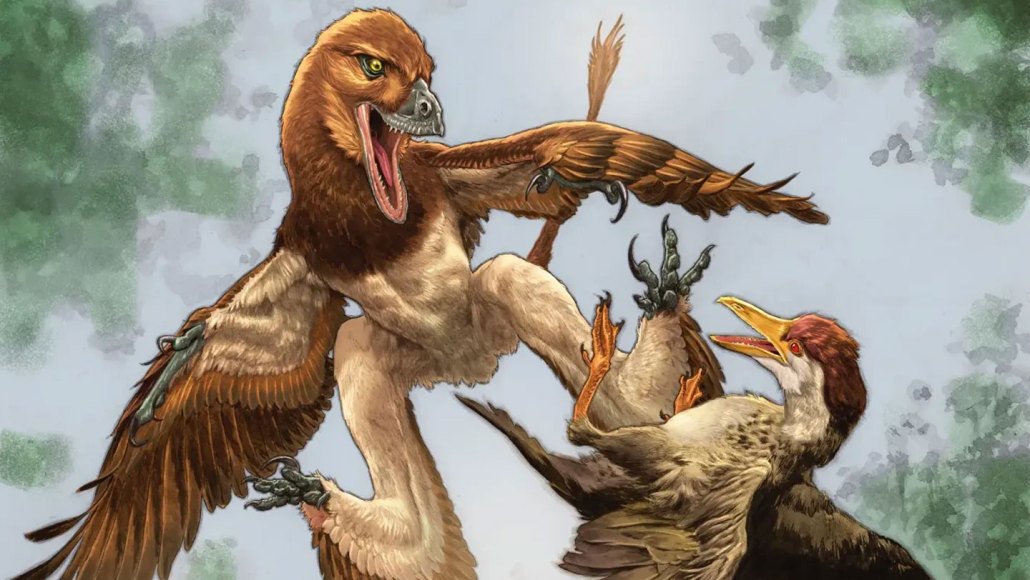
In this illustration, the newly-described dinosaur, Jian changmaensis, ambushes an early Cretaceous bird, Gansus yumenensus. How capable this gliding predator was at snagging prey in the air remains a mystery.
Illustration by Lewis LaRosa, colorized by Jão Canola.
The arm and shoulder bones of a gliding dinosaur might have just revealed the culprit behind a gruesome whodunit that took place some 120 million years ago.
Since 2002, researchers have unearthed more than a hundred prehistoric bird remains in the Changma Basin of northwestern China. Some consist of broken bones embedded in regurgitated pellets, similar to those coughed up by today’s owls. Paleontologists long assumed a carnivorous dinosaur was to blame. But fossil evidence of the predator has remained elusive.
That is, until now. A new species of dinosaur sporting wing feathers on its arms and legs may be behind the carnage, researchers report June 4 in the Annals of Carnegie Museum. Using preserved shoulder and upper arm bones, the team determined that the new species, dubbed Jian changmaensis, belonged to a group of dinosaurs known as microraptors. These small, speedy dinosaurs were cousins to the famed velociraptor.
Like other more well-known microraptors, this dino likely used its “wings” to take to the air. This would have helped the predator glide like a flying squirrel, the researchers report. Though they were close relatives, microraptors weren’t birds. But several other birdlike features may have allowed this particular reptile to glide better than its microraptor relatives could, says Jingmai O’Connor, a vertebrate paleontologist at the Field Museum in Chicago.
One distinction can be seen in rounded protrusions found on the humerus. Called condyles, they help form the elbow and formed differently in J. changmaensis than in other microraptors. A structure found in the shoulder girdle called the coracoid was also proportionally longer in J. changmaensis “These features are very birdlike,” she says.
This predator would have dwarfed the early birds it feasted on, the team says. Among the largest microraptor specimens found so far, J. changmaensis had a 1.22 meter wingspan, the team estimates. That’s about as large as a barn owl.
The find isn’t just a smoking gun in a 120-million-year-old murder mystery. It marks the first nonavian dinosaur specimen found in the region. “It’s a new record from that particular ancient ecosystem, which is exciting,” says Michael Pittman, a paleontologist at the Chinese University of Hong Kong who was not involved in the new research. Before this discovery, all microraptors from the same era had been found at sites in northeastern China.
Teasing out how capable this new predator was at ambushing prey on the wing is a bit tricky, O’Connor says. The birds it feasted on would’ve been more agile flyers that relied on powered flight. But the new fossil can help researchers better understand how flight evolved. Specimens like J. changmaensis show that birds weren’t exceptional in getting airborne, says Pittman. The discovery offers a glimpse into what roles microraptors took on in other ecosystems, he says. “It’s such a special ability to be able to fly,” Pittman says. “But there’s still a lot we don’t understand.”



















 English (US) ·
  French (CA) ·