

PROTECT YOUR DNA WITH QUANTUM TECHNOLOGY
Orgo-Life the new way to the future Advertising by AdpathwayAirborne Wind Turbine Market: Harnessing the Power of High-Altitude Winds for a Sustainable Future
The Airborne Wind Turbine Market is projected to reach USD 320.7 Million by 2032, driven by demand for clean, high-altitude wind power. Advancements in automation, lightweight materials, and offshore deployment are accelerating growth across Europe, Asia-Pacific, and North America.
How Fast Is the Airborne Wind Turbine Market Growing by 2032?
Access the full industry report:
Airborne Wind Turbine Market Report — Acumen Research and Consulting
By Acumen Research and Consulting — Market Forecast and Analysis (2024-2032)
The airborne wind turbine (AWT) market is rapidly emerging as a frontier in renewable energy. By capturing stronger, consistent winds available at higher altitudes, airborne systems — including tethered kites and drone-based platforms — offer efficient power generation with lower infrastructure costs. According to
Acumen Research and Consulting,
the global market was valued at USD 125.3 million in 2023 and is projected to reach USD 320.7 million by 2032, expanding at a strong CAGR of 11.2% during 2024-2032.
2023 Market SizeUSD 125.3 Million
2032 ForecastUSD 320.7 Million
CAGR (2024-2032)11.2%
Leading RegionEurope
What Is an Airborne Wind Turbine?
An airborne wind turbine is a high-altitude wind energy system that captures wind power using a flying device tethered to the ground. Operating at altitudes from 200 to 2,000 meters, these systems exploit stronger and steadier wind resources than those accessible by tower-based turbines.
Unlike traditional wind towers, AWTs can access superior wind speeds while minimizing materials, land use, and environmental disruption.
Airborne Wind Turbine Market Overview and Key Statistics
The Airborne Wind Turbine market's growth is driven by advances in lightweight materials, automation, and renewable energy investments. Key 2023-2032 insights include:
- Airborne Wind Turbine Market Size (2023): USD 125.3 Million
- Airborne Wind Turbine Market Forecast (2032): USD 320.7 Million
- Airborne Wind Turbine Market CAGR (2024-2032): 11.2%
- Applications: Wind power generation, off-grid supply, remote monitoring, and hybrid renewables
Key Factors Driving Airborne Wind Turbine Market Growth
- Global Renewable Transition: Governments worldwide are investing in alternative clean energy solutions to achieve carbon neutrality.
- High-Altitude Efficiency: Winds above 300 meters are up to 8x stronger than surface winds, delivering better yield per turbine.
- Reduced Infrastructure Costs: No towers or heavy foundations required; systems can be quickly deployed offshore or on land.
- Automation & AI Integration: Autonomous flight control ensures operational stability and optimized power generation.
How Do Airborne Wind Turbines Generate Power?
AWTs operate under two primary mechanisms:
- Onboard Generation: Power is produced aloft and transmitted to the ground via a conductive tether.
- Ground-Based Generation: The motion of the tether drives a ground generator to produce electricity.
Challenges and Commercialization Barriers
- Airspace and aviation regulations are still developing to accommodate large-scale airborne systems.
- Prototype development and testing require high upfront investment.
- Public awareness and acceptance must improve through safety and environmental validation.
- Durability of tethers and control reliability remain ongoing research priorities.
Airborne Wind Turbine Market Regional Insights
Europe leads the market with strong R&D funding and offshore wind integration. Asia-Pacific follows with the fastest CAGR, driven by clean energy expansion in China, Japan, and India. North America remains the global innovation hub, with several pilot projects validating AWT commercial potential.
Frequently Asked Questions
What makes airborne wind turbines different from traditional turbines?
They operate at higher altitudes with stronger, more consistent winds, using lightweight airborne systems rather than static towers.
How much energy can airborne wind systems produce?
Depending on the design and altitude, airborne turbines can produce up to twice the energy of conventional systems of similar capacity.
Are airborne wind turbines environmentally friendly?
Yes. They minimize land impact, reduce materials, and operate with low noise emissions, aligning with sustainability goals.
When will airborne wind turbines become commercially mainstream?
Commercial deployments are emerging, with broader adoption expected by 2030 as technology and regulations advance.
Featured Product
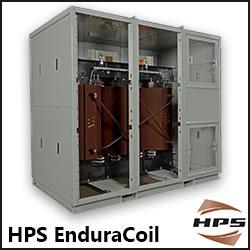
HPS EnduraCoilTM Cast Resin Medium Voltage Transformer
HPS EnduraCoil is a high-performance cast resin transformer designed for many demanding and diverse applications while minimizing both installation and maintenance costs. Coils are formed with mineral-filled epoxy, reinforced with fiberglass and cast to provide complete void-free resin impregnation throughout the entire insulation system. HPS EnduraCoil complies with the new NRCan 2019 and DOE 2016 efficiency regulations and is approved by both UL and CSA standards. It is also seismic qualified per IBC 2012/ASCE 7-10/CBC 2013. Cast resin transformers are self-extinguishing in the unlikely event of fire, environmentally friendly and offer greater resistance to short circuits. HPS also offers wide range of accessories for transformer protection and monitoring requirements.





















 English (US) ·
  French (CA) ·