

 8 months ago
183
8 months ago
183
PROTECT YOUR DNA WITH QUANTUM TECHNOLOGY
Orgo-Life the new way to the future Advertising by AdpathwayImage of the Day for February 23, 2026
A cold snap in the southern U.S. stirred up a dazzling display of sediment in coastal waters.
Feb 23, 2026
View more Images of the Day:
In late January and early February 2026, surges of Arctic air funneled into eastern North America, causing cold and wintry conditions across much of the United States. Snow and ice blanketed large swaths of the country, stretching as far south as Georgia, in a layer of white. Meanwhile, waters off the west coast of Florida lit up in brilliant shades of blue.
In this rare outbreak of intense winter weather, cold air infiltrated Florida and drove temperatures below freezing in several counties at the start of February. This frigid intrusion not only caused beautiful phenomena in the atmosphere, forming cloud streets, but it also produced a colorful display in the shallow marine waters below, stirring up carbonate sediment from the seafloor.
On February 3, the MODIS (Moderate Resolution Imaging Spectroradiometer) on NASA’s Terra satellite captured this image (right) of brightened waters over the West Florida Shelf, a broad and shallow continental shelf region known as a carbonate ramp. The blue color comes from suspended calcium carbonate (CaCO3) mud, which consists primarily of remnants of marine organisms that live on the shelf. For comparison, the left image shows the area on January 24, before the cold air arrived.
The mud was mostly kicked up by wind-stirred ocean waters during the cold air event, said James Acker, a data support scientist at the NASA Goddard Earth Sciences Data and Information Services Center. Sediment suspension events like this are more typically associated with hurricane winds that churn the water, as with Melissa in 2025, but the winds brought by strong cold fronts can have a similar, if less dramatic, effect.
“Another interesting aspect of these events is that the cold air cools off the shallow water on the banks and makes it denser than the surrounding warmer open ocean water,” Acker said. When this dense water sinks and flows offshore with the tides, it can carry some of the sediment out toward the shelf’s edge.
The detailed images above, acquired with the OLI (Operational Land Imager) on Landsat 9, offer a closer look at that process playing out. “Hammerhead” eddy features appeared along the slope of the West Florida Shelf, Acker noted. These can form when narrow streams of denser chilled seawater carry sediment offshore, encounter slower-moving Gulf waters, and curl into pairs of counterrotating eddies, he said. These types of features have been observed in other natural events—dust storms, for example—both on Earth and on Mars.
Other dynamics were at work near the Dry Tortugas on the southwestern side of the shelf, where the patch of bright water ends abruptly along a straight, sharp edge. Here, sediment-laden water exited the shelf area through channels to the south, said sedimentologist Jude Wilber, and was immediately swept east by the Loop Current. After Hurricane Ian stirred up sediment off Florida in 2022, Wilber and Acker noted a similar interaction between suspended material and the Loop Current. The researchers used that event to improve satellite-based methods for estimating sediment concentrations in these plumes.
Scientists are interested in studying carbonate sediment suspension events because of their role in the planet’s carbon cycle. They have shown that tropical cyclones are the primary mechanism by which carbon in shallow-water marine sediments is moved to deeper waters, where it can remain sequestered for a long time. However, the contribution of cold fronts is less well understood. Acker and Wilber hypothesize that they act on a more local scale: they influence ocean color by stirring sediments but do not transport significant amounts of material to the deep ocean.
NASA Earth Observatory images by Michala Garrison, using MODIS data from NASA EOSDIS LANCE and GIBS/Worldview, and Landsat data from the U.S. Geological Survey. Story by Lindsey Doermann.
Landsat, February 3, 2026
Landsat, February 3, 2026
- Acker, J.G. and Wilber, R.J. (2025) The first 25 years of satellite carbonate sedimentology: What have we learned? The Depositional Record, 11(3), 975-997. In: Kump, L.R., Ingalls, M., and Hine, A.C. (eds) Carbonate depositional environments: Past and future questions—A Tribute to the career of E.A. Shinn.
- Acker, J.G. and Wilber, R.J. (2024) Satellite-Derived Estimates of Suspended CaCO3 Mud Concentrations from the West Florida Shelf Induced by Hurricane Ian. Environmental Sciences Proceedings, 29(1), 69.
- NASA Earth Observatory (2026, January 30) Extreme January Cold. Accessed February 20, 2026.
- NASA Earth Observatory (2026, January 13) A Plume of Bright Blue in Melissa’s Wake. Accessed February 20, 2026.
- NASA Earthdata (2026, February 5) Effects of Back-to-Back Winter Storms over Eastern U.S. and the Bahamas. Accessed February 20, 2026.
- NOAA National Centers for Coastal Ocean Science (2018, May 9) West Florida Shelf and Dry Tortugas Impact Gulf of Mexico Loop Current. Accessed February 20, 2026.
- NOAA National Environmental Satellite, Data, and Information Service (2026, February 3) Southern Deep Freeze Creates Mesmerizing “Cloud Streets.” Accessed February 20, 2026.
You may also be interested in:
Stay up-to-date with the latest content from NASA as we explore the universe and discover more about our home planet.
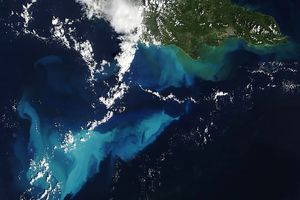
A Plume of Bright Blue in Melissa’s Wake
5 min read
The category 5 hurricane stirred up carbonate sediment near Jamaica in what scientists believe is the largest such event in…
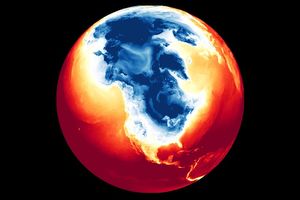
Extreme January Cold
3 min read
Following a significant winter storm, frigid temperatures lingered in late January 2026 across a vast swath of the U.S.

Rokan River Painted by the Tides
2 min read
Tides and sediment form brushstroke-like patterns across the river estuary in eastern Sumatra.
Keep Exploring















 English (US) ·
  French (CA) ·