

 2 weeks ago
38
2 weeks ago
38
PROTECT YOUR DNA WITH QUANTUM TECHNOLOGY
Orgo-Life the new way to the future Advertising by Adpathway Veracruz wren (photo from Wikimedia)
1 October 2026, WINGS at Veracruz: Day 3, quiet beach roads, lowland areas, and savannah hotspots
Today and tomorrow morning we’re visiting hotspots in the lowlands near metro Veracruz. As you can see in this eBird screenshot the best lowland hotspots are near the coast and include beaches, marshes and migratory flyways.
 screenshot of eBird hotspots in the region of Veracruz city and Xalapa, Mexico
In our travels we’re expecting to find three kinds of birds:
- Migrating birds from North America,
- Resident birds who don’t migrate though they have either Caribbean or Central and South American ranges, and
- at least two endemics
The Endemics
The Veracruz wren used to be lumped with the Russet-naped Wren (Campylorhynchus humilis) which is grouped with the larger Rufous-backed Wren (Campylorhynchus capistratus). However, DNA tests indicate these three are separate species.
The wren got its name, Veracruz, because its tiny range is confined to central Veracruz state from sea level to 300m (984 ft). It spans only about 80-90 miles north-to-south. Click here for the wren’s eBird occurrence map.
In 1945 the blue-capped motmot (Momotus coeruliceps) was lumped with other species and called the “blue-crowned motmot.” Then in 2009 he and his fellow motmots were split into 5 species based on a thorough study conducted by Stiles. The split made the newly dubbed blue-capped motmot instantly endemic to Mexico. He inhabits lowland forests, shady second growth and gardens. He was the only one in the group with a Blue Clown.
 Blue-capped motmot, Querétaro, MX, May 2026 (photo by morgoid on iNaturalist )
Migrating birds may include some surprises.
 Adult Mississippi kite eating a bug (photo from Wikimedia Commons)
As I mentioned yesterday we are past the peak of Mississippi kite (Ictinia mississippiensis) migration but I have never seen an adult of this species. Note the red eyes! I’d be thrilled to see one perched above me, pausing on its way to the Pantanal.
Last year this same tour saw flocks of dickcissels (Spiza americana) migrating south across the lowlands. Some dickcissels spend the winter in Mexico and Central America, others migrate to northern South America. Since the most dickcissels I’ve ever seen at the same time is 2, a flock would be fantastic!
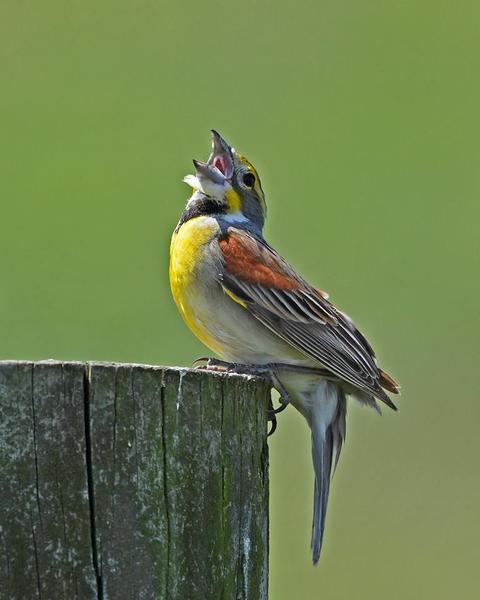 Dickcissel singing in western PA, 10 June 2017 (photo by Anthony Bruno)
Scissor-tailed flycatchers (Tyrannus forficatus) migrate to Central America for the winter after breeding in the southern Great Plains and adjoining states. A few of them wander so I’ve seen one as far east as Ocean City, Maryland. But I’ve never seen more than one at a time. Last year this tour saw flocks of them in migration. Fingers crossed.
 Scissor-tailed flycatcher in flight (photo from Wikimedia Commons)
The Residents
A lot of birds live year round in Mexico because the food supply — especially that of insects, reptiles and amphibians — does not drop for the winter. For most of the residents in this slideshow, Mexico is the northern edge of their range, South America is the southern edge. Three are Caribbean: limpkin, double-striped thick-knee and northern jacana.
I hope to see all 18 birds pictured in this article but it will take some luck. Fingers crossed!



















 English (US) ·
  French (CA) ·