

 2 months ago
68
2 months ago
68
PROTECT YOUR DNA WITH QUANTUM TECHNOLOGY
Orgo-Life the new way to the future Advertising by AdpathwayButterflies, often considered a “sentinel of change”, are on the move across every continent they inhabit, shifting to survive as global heating reshapes their environment.
About one in 10 species have already expanded or contracted their geographic range, or shifted in altitude, according to a global study published in Nature Ecology & Evolution.
Lead author Dr Shawan Chowdhury, head of Monash University’s Global Change Ecology Lab, said the study, which analysed shifts in 1,758 species across 105 countries, revealed the “astonishing” scale of change, largely driven by climate change and extreme weather.
“Butterflies are early‑warning indicators and are signalling a warning across the entire planet. If their ranges shift this dramatically, it signals profound changes across ecosystems.,” he said.
About 80% of butterflies that shifted expanded their ranges, often moving into newly suitable areas as temperatures rise.
Some moved surprisingly fast, he said. The tawny coster butterfly – originally native to India, Bangladesh and Sri Lanka – entered Australia in 2012 and has moved at a rate of 135km per year since. An expanding range wasn’t necessarily good news, he said, particularly if the insect was moving into less suitable habitat and populations were low.
About 27% of species – including Cupido minimus, the United Kingdom’s smallest butterfly – saw their ranges shrink, disappearing from areas they used to occupy. Others moved altitude, shifting to higher or lower elevations.
Range expansions occurred across all continents, particularly in the tropics, while contractions were mainly in Europe and North America, the paper said. Shifts in elevation were almost exclusively in the northern hemisphere.
Climate change and severe weather were the main drivers, although other factors played a role, such as habitat loss and agriculture. In Germany, a species known as the cranberry fritillary (Boloria aquilonaris) has lost much of its original habitat due to bog drainage. In Romania, agricultural intensification drove a contraction for the Danube clouded yellow butterfly (Colias myrmidone). In Brazil, the blue butterfly Godartiana byses has expanded from the states of Rio de Janeiro and Bahia to São Paulo in response to climate warming.
Some species experienced range expansion in one part of their distribution and contraction in another, Chowdhury said, which was “quite concerning”. “You don’t really know what’s going to happen for that species, whether they’re going to be endangered or whether they are going to be least concern in the long term.”
after newsletter promotion
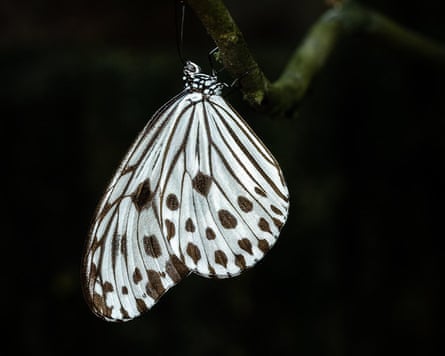
Globally, butterfly conservation plans would need to respond to species on the move, particularly in response to climate change, Chowdhury said.
“We urgently need coordinated global monitoring, especially in the tropics, to understand what species are doing, where they’re going, and how we can protect them,” he said.
In Melbourne, one endangered butterfly has shown promising signs of recovery.
Before its rediscovery in 1986, the Eltham copper butterfly – small, burnished and roughly the size of a coat button – was thought extinct. Its survival depends on an intricate three-way relationship with a native shrub known as sweet bursaria and the Notoncus ant, which lives in the root of the plant.
Following years of replanting and habitat restoration by the local community, the Friends of the Eltham Copper Butterfly, Nillumbik Shire and water company Yarra Valley Water, ecological surveys have recorded nearly a five-fold increase in larvae numbers on native plants.
Chris Farrow, the biodiversity officer at Yarra Valley Water, who was not involved in the global study, said the butterfly had “been making a comeback”. “And that’s mostly due to the impact that the neighbours and the community have [had] in that area.”
It’s invertebrate of the year again! From August 3-12, every day we’ll be profiling one of the thousands of amazing invertebrates that our readers have nominated, and then, when you’ve got to hear about all of them, we’ll open the voting so you can choose your favourites. Don’t hesitate to get in touch with thoughts and ideas: email us at [email protected] with Invertebrate in the subject line.


















 English (US) ·
  French (CA) ·