

 11 months ago
152
11 months ago
152
PROTECT YOUR DNA WITH QUANTUM TECHNOLOGY
Orgo-Life the new way to the future Advertising by AdpathwayThere has already been significant wrangling over the Cop30 agenda, with Simon Evans, a journalist from Carbon Brief, posting on on Bluesky yesterday afternoon that the agenda was already on its fourth iteration.
“Agenda fights have been common in recent years,” Evans reports, citing similar disagreements ahead of Cop29 in Azerbaijan. The negotiations cannot actually get started until the parties agree on what it is they will talk about.
Among the potential items on the agenda are two from the “like-minded developing countries”, a bloc that includes Bolivia, China, India and Saudi Arabia, including one calling for a new, more ambitious finance goal and another for discussion of “unilateral trade-restrictive measures”.
Honduras, Suriname and Papua New Guinea want to discuss deforestation finance. Small island states want space in the agenda to discuss how to “accelerate implementation & drive ambition toward 1.5C”, with the current process “insufficient for addressing the need for accelerated action”, they say.
And the EU, meanwhile, wants to discuss reporting under Article 13, the provision of the UNFCCC which asks countries to report on their emissions.
“Many developing countries have yet to do this as required,” writes Evans. “[I] suspect this a way to put on them in response to calls for more finance…”

Fiona Harvey
Ministers and high-ranking officials from nearly 200 countries have gathered in the Amazonian city of Belem to discuss how to rein in the climate crisis, before catastrophic levels of global heating become inevitable, writes Fiona Harvey, Guardian environment editor.
On Sunday, carpenters and builders were still hard at work in the conference centre where the Cop30 UN climate summit will take place, unpacking boxes and erecting pavilions where countries will show off their commitment to tackling greenhouse gas emissions and shifting to a low-carbon economy.
By Monday, the pomp and ceremony were ready to begin. There is an element of deja vu here – world leaders have already visited Belem, jetting in last week to this same conference centre to join in round tables about climate action, preserving forests, boosting biofuels and ensuring social justice while the climate crisis bites.
More than 50 heads of state and government or their deputies took part in that “leaders’ summit” segment, on 6 and 7 November, including the UK’s Keir Starmer, the EU’s Ursula von der Leyen, and Germany’s Friedrich Merz. (Donald Trump, of course, has withdrawn the US from the Paris climate agreement and did not attend; nor did Russia’s Vladimir Putin; Xi Jinping of China and Narendra Modi of India also skipped the summit but have made friendly overtures to Brazil over Cop30.) They have all now departed and left the stage to their negotiating teams.
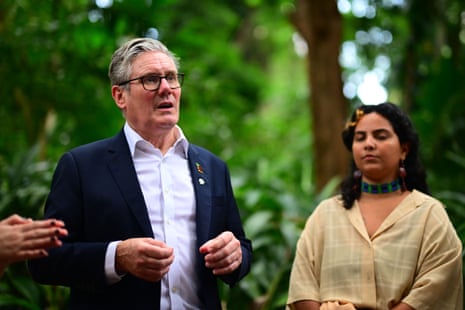
But these are climate talks with a difference. Brazil is refusing to countenance the standard form of tortuous negotiations that have characterised the last 30 years of nearly annual “conferences of the parties” (Cops) under the UN Framework Convention on Climate Change, the parent treaty to the Paris climate agreement, that was signed in 1992 in Rio de Janeiro.
Those were characterised by long and bitter sessions, often stretching late into the night, where negotiators re-stated entrenched positions for days on end before finally – sometimes – reaching a compromise conclusion that some present would frequently seek to back track on immediately afterwards.
Instead, Brazil insists, this will be “the Cop of implementation”. That means the real world impact of measures to combat the climate crisis today will take precedence over longwinged discussions of future promises.
“Negotiations need consensus,” said Andre Correa do Lago, president of Cop30. “But implementation is countries choosing what they want to do and executing what they have said they are going to do.”
The problem with that approach is that countries which chose to do very little may be able to get away with it. How Brazil intends to combat that tendency is yet to be seen.
The main outcomes of this Cop, instead of being a list of pledges as has become usual, are more likely to be a collection of “roadmaps” covering the key issues: a roadmap on finance, which has already been published; a roadmap on how to transition away from fossil fuels; a roadmap on how to scale up low-carbon energy and reduce greenhouse gas emissions in line with the target of limiting global heating to 1.5C above pre-industrial levels.
On some of these issues, it may not be possible to produce the final roadmap at this Cop – in the case of the transition away from fossil fuels, for instance, what is more likely is that a forum could be set up that will continue for several Cops before reporting.
Cop30 will cover enormous ground – from the future of energy, to the future of climate finance, to the need for social justice to accompany climate action. It will involve ministers, diplomats, local government officials, scientists, businesspeople, Indigenous people and representatives of all forms of civil society, from nearly every country in the world. Issues including health, biodiversity, nature, wildlife, water, the oceans, transport, migration, food, gender and technology will all be addressed at some point across the two weeks of talks.
The problem Cop exists to solve could scarcely be more urgent: scientists are warning that, as temperatures rise faster than at any point in at least 24,000 years, the world stands on the brink of a series of “tipping points” that could pitch us into greatly accelerated heating and unstoppable climate catastrophe.
But one question will dominate overall: the question of whether the collective will to solve this problem exists. Can the world come together, despite geopolitical headwinds and open conflict, despite the forces of division fanned by populism, despite the global tide of climate disinformation, despite influential voices claiming the climate somehow matters less than it did before the populists took over – and show the unity, mutual respect and spirit of cooperation that are desperately needed, if we are to face this existential threat?
Welcome to the Cop30 live blog! I’m Guardian environment correspondent Damien Gayle, and I will be taking you through the first few hours of our live coverage of the UN climate summit taking place in Belém, Brazil.
I’ll be collating all the latest dispatches from our reporters on the ground, the files from the news agencies and any bits and pieces that appear on social media to try to give you the best possible picture of the summit as it unfolds.
This morning we will see the opening plenary for Cop30, where the first point of order will be to vote on an agenda, since at the moment it remains unclear what exactly will be under discussion during the two-week summit.
Andre Correa do Lago, the Cop30 president, said countries had been wrangling for months over what to include, a process he described as a healthy exchange of priorities. Brazil’s president Lula has said he hopes countries will consider setting a plan for quitting fossil fuels, and other possible issues for the agenda include deciding how countries will cut emissions further, with their current plans falling short of what’s needed to limit extreme warming.


















 English (US) ·
  French (CA) ·