

 19 minutes ago
1
PROTECT YOUR DNA WITH QUANTUM TECHNOLOGY
Orgo-Life the new way to the future Advertising by AdpathwayDeep divides as second week of talks begin
Fiona Harvey
It is a measure of how difficult a battle the Australian presidency of negotiations and the Turkish hosts of the conference face at Cop31 that, as the second week of talks begins, there are still deep divides not only as to what the outcome of this Cop should be, but even over what form it should take.
Deep into Saturday night, ahead of the official rest day on Sunday, negotiators from around the world were still slugging it out over whether this Cop should have a “cover decision”.
As regular readers of this blog will know, cover decisions are a standard feature of Cops, and have been for more than two decades. They function as a useful negotiating device to capture progress made in the talks that does not fall neatly into the other negotiating strands, such as those on the mitigation work programme (on reductions in greenhouse gas emissions) or on finance.
This has rarely been controversial – cover decisions have included a wide variety of issues that are important without fitting neatly within the other “work programmes”, and have included the state of the oceans, the impact of the climate crisis on food security and health, new science, and clarifications of the outcome of Cop discussions.
One long time Cop participant told the Guardian: “Optimally all items would find a space in the negotiated decisions. If that is not possible, then there has to be enough political goodwill and diplomacy to carry off an ambitious cover decision.”
But after Cop28 in 2023 in Dubai produced a cover decision whose 28th paragraph included the key pledge to “transition away from fossil fuels”, some countries took a harder line. At Cop29 in Baku, the Azerbaijani hosts complied with the wishes of regional allies and announced there would be no cover decision. This stifled further discussion of the “transition away from fossil fuels”, as it could not be incorporated easily into other negotiating strands.
The following year, in Belem, the Brazilian hosts reinstated a cover decision, which allowed for a reference to the Dubai decision (the “UAE consensus”) to be included.
This year, the best way to take forward issues including Brazil’s global roadmap on the transition away from fossil fuels, the global electrification target, and the controversy over whether the work of the Intergovernmental Panel on Climate Change should be delayed, would be a cover decision.
But the Arab Group, Russia, and the Like-Minded Developing Countries (a loose grouping that sometimes includes China and India, but also Saudi Arabia and allies among fossil fuel producers such as Bolivia and Venezuela) are opposed to having any form of cover decision at this year’s Cop. They are claiming there is no legal basis within the UN Framework Convention on Climate Change for having a cover decision, which is an odd stance for countries that have signed up to so many of them over the years.
The row is likely to continue, and could hold up progress in the talks. It is seen by some as a sign of how the absence of the US has affected the talks, as under Joe Biden and Barack Obama, US negotiating teams were known to some as the “Saudi whisperers”.
With the world leaders gone, the negotiations will now hinge on whether countries can find common ground. Simon Stiell, executive secretary of the UNFCCC, called for flexibility in their positions: “There is no collective success without compromise from every party.”
Key events
'Just transition' under threat, campaigners warn

Damien Gayle
Civil society campaigners say that one of the key wins from Cop30 last year is under threat of being rendered impotent by opposition from global north countries at this year’s climate talks.
At last year’s talks in Belém, Brazil, the agreement to create a Just Transition Mechanism – christened the Belem Action Mechanism, or Bam – was lauded as a significant victory, even as many other issues of concern to developing countries and civil society were sidelined.
They expected the agreement would give birth to a new institution that would have responsibility for embedding economic, social and racial justice within the transition away from fossil fuels. They wanted a body capable of giving practical support, including access to finance, capacity building and technical help.
But at Cop31 in Antalya, where the proposal has been redubbed the Belem-Antalya Mechanism, global north countries were accused of attempting to unpick that agreement.
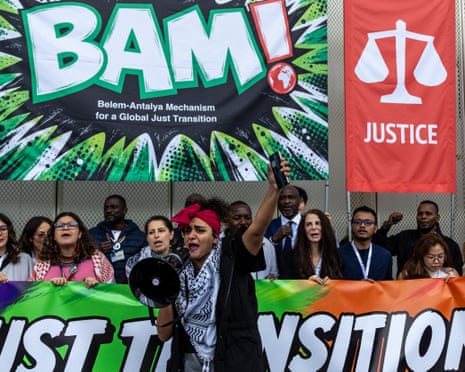
On Friday, a draft text was published by the chairs of the Just Transition Work Programme that campaigners said would not establish a new institution at all, instead giving its functions and responsibilities to the existing UNFCCC secretariat.
“The intention with the Bam proposal was to build something that would scale up and deliver finance and support to advance just transition on the ground,” said Sinéad Magner, the Just Transition lead for the Women and Gender Constituency. It was supposed to be permanent, to give developing countries the security of reliable and consistent support.
“The Bam text we saw last week doesn’t include any of this. Instead, it builds a Bam that merely dialogues, reports and sends messages, which we already do in the JTWP [Just Transition Work Programme], and which we know is not enough, and will not work to meet the need.”
The split over the ambitions for the Just Transition Mechanism is an almost neat north-south divide, said Devina Shah, advocacy manager at Youth and Environment Europe. Global north countries, led by Japan and Norway, were the main barriers, with the central tension around the mechanism’s financing role.
“They’re saying that they’re constrained by finance. That is not true. We know as civil society a lot of finance is going into militarisation in the EU, that they’re framing [it as] security. And so we’re pushing back against that.”
The mechanism was crucial because the transition is taking place, but frequently without any concern over whether it is fair at all to people who are affected, said Shah. She gave the example of the planned Fernando Pessoa Solar Park in Portugal, which when built would be the fifth biggest solar farm in the world. But, she said, the local community were not properly consulted.
“On the ground there is no just transition. People are being impacted but they’re not being supported, they’re not being engaged from the start, their views are not being taken into account.”

Oliver Milman
What happens when the world, as expected, hurtles dangerously past agreed temperature thresholds? At UN climate talks, countries are being urged to turn to technology to reverse this fate by sucking carbon directly from the atmosphere.
A renewed push by proponents of carbon dioxide removal (or CDR), where heat-trapping carbon dioxide is taken from the atmosphere and stored deep underground, in oceans or in products such as carbonated drinks, is seeking to gain recognition in the final text of Cop31, the climate summit currently under way in Antalya, Turkey.
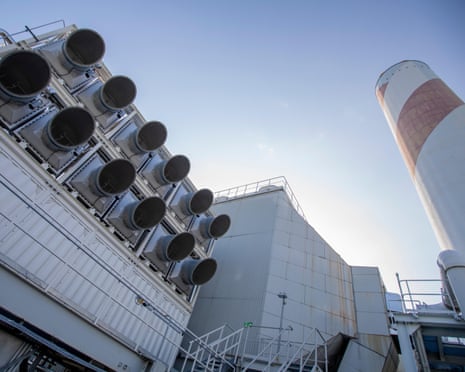
There is a smaller but significant group of CDR promoters who have a pavilion, called Think Negative, at the sprawling summit venue, where plans for a dramatic increase in carbon removal is talked up as a way to help bring back the world from imminent “overshoot” of internationally agreed temperature thresholds.
Meanwhile, a record 700 lobbyists at this Cop are advocating for a distinct but related process called carbon capture and storage (or CCS), where carbon is captured at the source of a polluting facility and put underground, according to the Center for International Environmental Law (CIEL). This is more delegates than the from the smallest 50 national delegations combined.
CCS has less support from environmentalists over its costs, mixed track record, and potential to prolong fossil fuel reliance. But on Friday, for the first time, both CCS and CDR were included in a text that will inform the basis of a final deal at the climate talks.
The UN has acknowledged the world will soon surge past a 1.5C rise in global temperatures since the pre-industrial period, which will unleash ever worsening heatwaves, floods, droughts and other deadly impacts, as countries continue to release greenhouse gases by burning fossil fuels.
Even with reduced emissions the planet’s fever will not fall below this level for thousands of years without the sort of rapid removal of CO2 as envisaged by the CDR advocates, who want to create a new global agency to coordinate carbon removals. They have also pressed Turkey and Australia, which are jointly presiding over the Cop31 talks, to include CDR in the summit’s final outcome.
“CDR still sounds unreal to people but we spent a whole year trying to make it into the agenda of Cop31,” said Göker Avci, a decarbonization strategist at CDR Türkiye. “We spoke with the presidency about making it into the final decision and they have started to realize the potential.”

Graham Readfearn
Bit of a trip hazard on the route to the media centre here in Antalya.

Deep divides as second week of talks begin
Fiona Harvey
It is a measure of how difficult a battle the Australian presidency of negotiations and the Turkish hosts of the conference face at Cop31 that, as the second week of talks begins, there are still deep divides not only as to what the outcome of this Cop should be, but even over what form it should take.
Deep into Saturday night, ahead of the official rest day on Sunday, negotiators from around the world were still slugging it out over whether this Cop should have a “cover decision”.
As regular readers of this blog will know, cover decisions are a standard feature of Cops, and have been for more than two decades. They function as a useful negotiating device to capture progress made in the talks that does not fall neatly into the other negotiating strands, such as those on the mitigation work programme (on reductions in greenhouse gas emissions) or on finance.
This has rarely been controversial – cover decisions have included a wide variety of issues that are important without fitting neatly within the other “work programmes”, and have included the state of the oceans, the impact of the climate crisis on food security and health, new science, and clarifications of the outcome of Cop discussions.
One long time Cop participant told the Guardian: “Optimally all items would find a space in the negotiated decisions. If that is not possible, then there has to be enough political goodwill and diplomacy to carry off an ambitious cover decision.”
But after Cop28 in 2023 in Dubai produced a cover decision whose 28th paragraph included the key pledge to “transition away from fossil fuels”, some countries took a harder line. At Cop29 in Baku, the Azerbaijani hosts complied with the wishes of regional allies and announced there would be no cover decision. This stifled further discussion of the “transition away from fossil fuels”, as it could not be incorporated easily into other negotiating strands.
The following year, in Belem, the Brazilian hosts reinstated a cover decision, which allowed for a reference to the Dubai decision (the “UAE consensus”) to be included.
This year, the best way to take forward issues including Brazil’s global roadmap on the transition away from fossil fuels, the global electrification target, and the controversy over whether the work of the Intergovernmental Panel on Climate Change should be delayed, would be a cover decision.
But the Arab Group, Russia, and the Like-Minded Developing Countries (a loose grouping that sometimes includes China and India, but also Saudi Arabia and allies among fossil fuel producers such as Bolivia and Venezuela) are opposed to having any form of cover decision at this year’s Cop. They are claiming there is no legal basis within the UN Framework Convention on Climate Change for having a cover decision, which is an odd stance for countries that have signed up to so many of them over the years.
The row is likely to continue, and could hold up progress in the talks. It is seen by some as a sign of how the absence of the US has affected the talks, as under Joe Biden and Barack Obama, US negotiating teams were known to some as the “Saudi whisperers”.
With the world leaders gone, the negotiations will now hinge on whether countries can find common ground. Simon Stiell, executive secretary of the UNFCCC, called for flexibility in their positions: “There is no collective success without compromise from every party.”


















 English (US) ·
 French (CA) ·