

 2 months ago
96
2 months ago
96
PROTECT YOUR DNA WITH QUANTUM TECHNOLOGY
Orgo-Life the new way to the future Advertising by AdpathwayMountain gorillas are often celebrated as a conservation success story. Their numbers have increased thanks to long-term protection from conservation organisations, park authorities and local communities. However, the remaining two populations live in small, environmentally constrained habitats and recent veterinary records have documented cases of severe gastritis associated with strongylid nematodes in Virunga Massif. This raised an important question for us: are there changes in parasite dynamics that managers need to be aware of?
In our recent study, we examined strongylid infections across nearly two-thirds of the Virunga mountain gorilla population. We used classical parasitology, high-throughput sequencing, and spatial data to understand which strongylids are present, how abundant they are, and how environmental conditions shape their distribution. Here, we share what we found and what it means for conservation management.
A parasite typical of domestic pigs detected in gorillas
One of the most striking results was the repeated detection of Hyostrongylus in stomach lesions from gorillas that died with severe gastritis. This parasite is well known in domestic pigs and other suids, where it can cause serious gastric damage. Its presence in gorilla lesions, together with the similarity of the pathology to that seen in pigs, strongly suggests that Hyostrongylus plays a key role in the gastritis cases documented in the Virunga Massif.
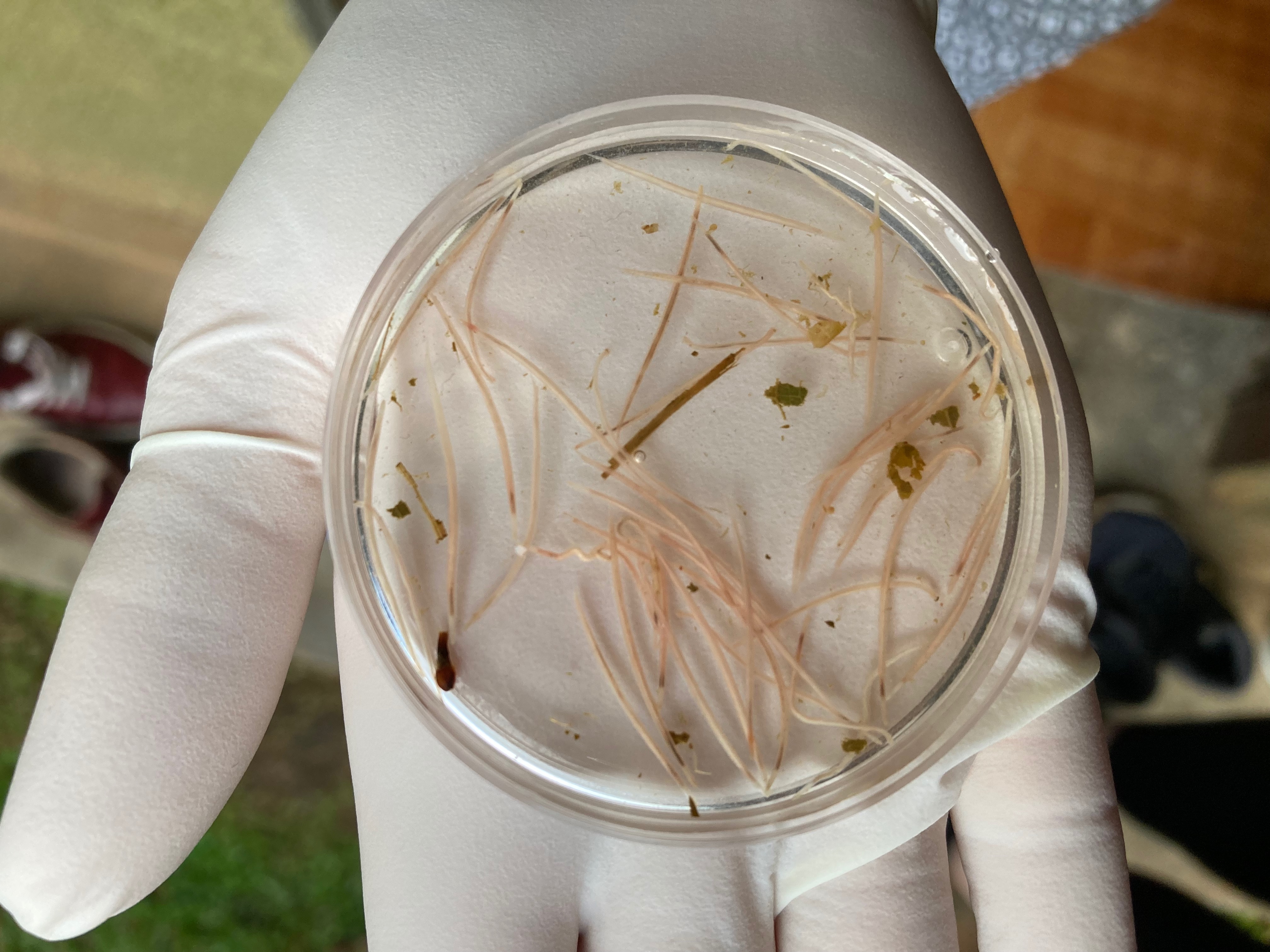 © Bethan Mason
Hyostrongylus has rarely been recorded in primates and is typically associated with domestic pigs and other suids. Around the Virunga Massif, livestock is kept close to the park boundaries, and gorillas occasionally enter agricultural areas. This creates opportunities for indirect contact and possible cross-species transmission.
Where the risk is highest
When we looked at where severe gastritis cases occurred, a clear geographical pattern emerged. Most cases were recorded in gorilla groups living between Mt. Karisimbi and Mt. Bisoke, an area at the highest elevations within the Virunga Massif. Our parasitological data matched this pattern: Hyostrongylus had the highest absolute abundance in these same high-altitude groups. This is a crucial point for wildlife managers. The risk of severe gastric disease is not evenly distributed across the region.
 © Bethan Mason
Instead, it is concentrated in a specific part of the gorillas’ range, where both the environmental conditions and the parasite community structure differ from lower-elevation areas. Several gorilla groups regularly use this high-altitude zone, and the strong overlap between the high absolute abundance of gastric Hyostrongylus and the location of most gastritis cases highlights the importance of continued monitoring in this region.
Environmental patterns shape parasite communities
Environmental gradients across the Virunga Massif strongly influence strongylid community composition. High-elevation areas differ from lower parts of the habitat in temperature, rainfall and vegetation. In our analyses, these gradients were associated with clear differences in strongylid communities, including the higher absolute abundance of Hyostrongylus in the upper elevations. These findings emphasise that environmental variation within a small habitat can have major implications for disease risk. For a species restricted to a limited range with no possibility of dispersal beyond park boundaries, this environmental sensitivity becomes especially important.
A population with limited genetic diversity
Mountain gorillas have extremely low genetic diversity due to a historic population bottleneck. Limited variation may affect their ability to respond to emerging pathogens. This, combined with increasing local densities, strong environmental constraints and the presence of parasites typically associated with livestock, creates conditions under which previously benign parasite communities may become more problematic. Our results show that the current emergence of pathogenic strongylids should be viewed in the context of these long-term ecological and demographic realities.
 © Bethan Mason
What wildlife veterinarians and conservationists can do
Our findings point to several practical recommendations:
- Monitor livestock parasites near the park. Because Hyostrongylus is a common parasite in pigs, regular monitoring of domestic animals around the Virunga Massif would help identify possible sources and pathways of transmission. Understanding the parasite communities in livestock is essential for managing spillover risk.
- Maintain long-term monitoring of gorilla parasite loads. Regular faecal screening, combining classical egg counts with molecular approaches, can detect emerging trends in parasite abundance and composition. This is critical for early intervention and targeted veterinary support.
- Incorporate environmental gradients into health management. Strongylid community structure varies with elevation. Mapping parasite abundance in relation to these gradients can help identify high-risk areas, plan targeted surveillance and prioritise veterinary response.
- Recognise that health risks evolve as populations recover. Population recovery is a conservation success, but it also creates new pressures in a limited habitat. As densities increase, disease dynamics may shift. Management plans need to adapt accordingly.
 © Bethan Mason
Looking forward
Mountain gorillas remain one of conservation’s great success stories, but their recovery also makes it essential to understand emerging health risks. By identifying pathogenic strongylid communities, mapping their distribution and linking them to environmental gradients and severe gastritis cases, our study provides managers with evidence-based tools to reduce future risk. Effective conservation will depend on continued monitoring, close collaboration with local communities and livestock owners, and an integrated understanding of how ecological, environmental and health factors interact within this unique habitat.
Read the full article, ‘Emerging pathogenic strongylid infections in Virunga Massif mountain gorillas: Role of environmental stressors’, in Journal of Applied Ecology.


















 English (US) ·
  French (CA) ·