

PROTECT YOUR DNA WITH QUANTUM TECHNOLOGY
Orgo-Life the new way to the future Advertising by Adpathway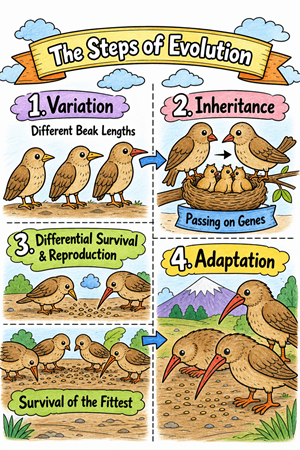
Teaching evolution can be challenging, especially when students are trying to connect abstract concepts to real-world examples. These two engaging coloring worksheets can make evolution more accessible, interactive, and memorable for students.
I designed these as “extra” assignments, to go with the unit on evolution for my freshman biology students. You can access the complete curriculum at Biology 2. Full disclosure, these were made with AI.
Generally, we start with Darwin’s theory of evolution by natural selection which focuses on example organisms, like the finch, elephants, and the rock pocket mouse. In the next chapter, the focus shifts to evolution of populations. In this unit, we learn about species isolating mechanisms and types of selection.
🧬 Worksheet 1: Steps of Evolution (VIDA)
The first worksheet focuses on the four core steps of evolution, often remembered with the acronym VIDA:
- Variation – Individuals in a population have different traits
- Inheritance – Traits are passed from parents to offspring
- Differential Survival & Reproduction – Some individuals survive and reproduce more successfully
- Adaptation – Beneficial traits become more common over time
In this coloring page, students follow a population of birds across four panels:
- Birds with different beak lengths (variation)
- Parent birds feeding chicks (inheritance)
- Some birds successfully eating while others struggle (differential survival)
- A population dominated by long-beaked birds (adaptation)
This visual progression helps students understand how small differences can lead to big changes over time.
🦴 Worksheet 2: Evidence of Evolution
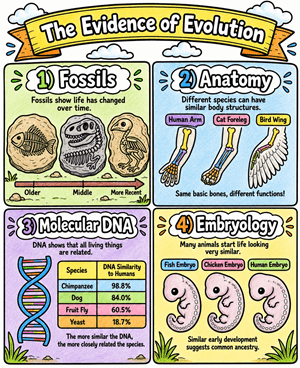
The second worksheet explores the four major lines of evidence that support evolution:
- Fossils – Show how organisms have changed over time
- Anatomy – Reveals similarities in body structures (homologous structures)
- Molecular DNA – Demonstrates genetic similarities between species
- Embryology – Shows how early development is similar across different organisms
Each section includes simple, clear illustrations:
- Fossil layers and preserved organisms
- Comparisons of limbs (human, cat, bird, etc.)
- DNA strands and sequence comparisons
- Embryos of different species at early stages
Download the uncolored versions of these worksheets to give your students a break from notes!
Related Activities
Natural Selection at PHET – use a simulator to explore how wolf and rabbit populations change over time
African Elephant: Change Over Time – examine a graph showing the number of elephants with tusks, showing that the number has changed as a result of poaching
Lizards in a Hurricane – based on a BioInteractive activity that explores the size of lizard toepads on islands where there are hurricanes (slides/guided activity)
Snake Detection Hypothesis – study showing how humans may have evolved the ability to detect snakes
VIDA Chart for Evolution – can be used with any model organism to organize concepts: variation, inheritance, differential survival, and adaptation















 English (US) ·
  French (CA) ·