

PROTECT YOUR DNA WITH QUANTUM TECHNOLOGY
Orgo-Life the new way to the future Advertising by Adpathway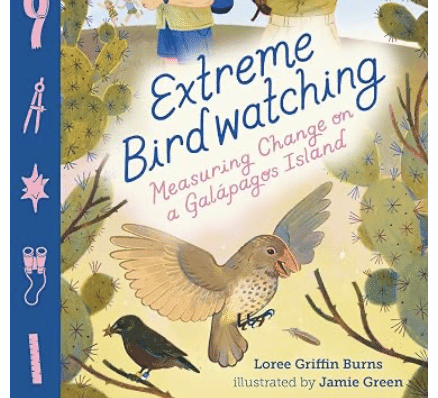
What’s extreme birdwatching? How about getting to know every single one of hundreds of individual birds! Author Loree Griffin Burns tells the story of scientists Rosemary and Peter Grant in her new chapter book for children: Extreme Birdwatching: Measuring Change on a Galápagos Island.
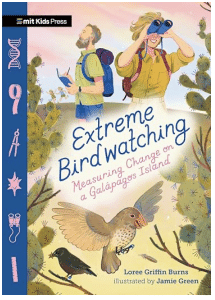
Books cover of EXTREME BIRDWATCHING by Loree Griffin Burns and illustrated by Jamie Green.
For forty years, evolutionary biologist Peter and Rosemary Grant studied the fortis and scandens finches of Daphne Island in the Galápagos—and the path to publication for this book, telling their story to children, was a twenty-year odyssey.
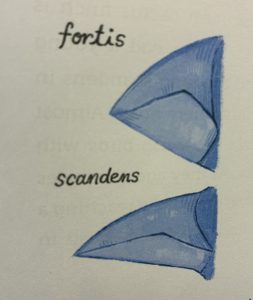
Beak differences between the two types of finches studied by the Grants on Daphne Island.
When Loree was a graduate student in biochemistry back, she read Jonathan Weiner’s The Beak of the Finch (Knopf, 1994). It was the first she’d heard of the work of Peter and Rosemary Grant—and was also the moment she realized that one could tell stories of science that read like novels. She later reached out to Peter Grant to ask if it might be possible to shadow his team on Daphne. Peter rejected the idea. They were extremely busy and spaces on the island were very limited.
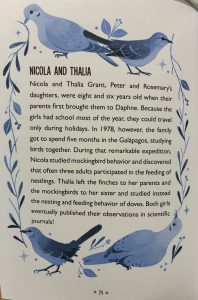
The Grant’s young daughters conducted their own research in the Galápagos, studying mockingbirds and doves.
Loree continued to follow the team’s work. Twenty years later, she had the opportunity to launch a nonfiction chapter book series for young readers with illustrator Jamie Green. Since the series would spotlight stories of science (told like novels!) and since she knew the Grants were now retired from their research and might have the time to talk, she pitched a book on them and their work. This time he and Rosemary both agreed to an interview, and Extreme Birdwatching was finally published in 2026 by MIT Kid’s Press.
The book is part of “The Discovery Chronicles” series, with the first in the series titled One Long Line (MITKids Press, 2024). It shares the story of a French naturalist, Jean Henri Fabre, and his close study of the herds of processionary caterpillars that were living in his backyard pine trees.
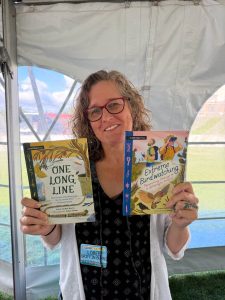
Author Loree Griffin Burns with ONE LONG LINE and EXTREME BIRDWATCHING. Photo by Kate Messner.
As Loree talked with Rosemary and Peter Grant about their decades of studying the finch populations on the island of Daphne, she was “floored by how closely they got to know the families across many generations. Their detailed and relentless observational work (often followed up with blood samples and, eventually, genetic studies) allowed them to follow families of finches across generations. This is astonishing when you realize the finches in question sometimes numbered in the thousands in a given season … and that those thousands of birds looked nearly identical.”
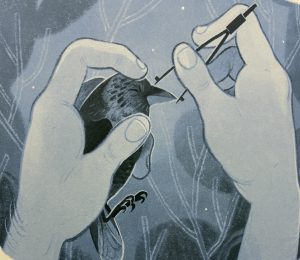
Illustration by Jamie Green in EXTREME BIRDWATCHING of measuring a finch’s beak
For Loree, the main takeaway of her book is “the power of extremely detailed observations, especially when paired with extremely careful record-keeping. In the 1970s, no one believed it was possible to observe the evolution of species over time; instead, everyone thought such changes must require eons. And because of the Grants and their team and the finches of Daphne Major, we know now that we were all wrong!”
Backmatter includes Loree’s Author’s Note, a glossary, source notes and bibliography, and a variety of resources for additional exploration.
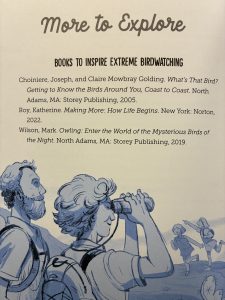
Some of the additional resources for readers in the backmatter of EXTREME BIRDWATCHING.
The format of Extreme Birdwatching is very inviting. Illustrator Jamie Green’s artwork appears on nearly every page, and the blue of the single color illustrations feels welcoming and friendly. This is a book to place in front of a child read to read chapter books on their own. I would also hand it to any upper-elementary student who loves nature and science. The focus on data and observation also makes this a great fit for STEM/STEAM classrooms and lead-ups to science fairs. For read-aloud, it reads smoothly and easily, with delightful touches of humor. It’s a natural fit for school, public and home libraries.
Extreme Birdwatching: Measuring Change on a Galápagos Island, written by Loree Griffin Burns, illustrated by Jamie Green
MIT Kids Press, 2026; ISBN: 978-1-5362-3280-6
$16.99 US; $23.50 CAN; 63 pages, ages 7-10

Written by Susan Wroble
Susan Wroble has always paid attention to the birds around her, perhaps in part because Burd is her middle name! She is always happiest when outside gardening and listening to birdsong. Coming from a family with a strong commitment to service, Susan started volunteering after college with two years in the Peace Corps in the Independent State of Western Samoa, where she taught high school math and science. Currently, she volunteers as leader of the Rocky Mountain Chapter of the Society for Children’s Writers and Illustrators (SCBWI) and at the Colorado Children’s Hospital. She also leads a long-term Denver-area support group for parents of Twice-Exceptional Children. Susan’s degrees are in electrical engineering and foreign affairs, but her great love is children’s books. She writes nonfiction, and tends to focus on stories that share a message of hope in this era of climate change. She has written four children’s books for the school library market. Her book DAWN CHORUS: PROTECTING BIRDSONG AROUND THE WORLD is scheduled for publication with Holiday House in 2026.
















 English (US) ·
  French (CA) ·