

 1 month ago
61
1 month ago
61
PROTECT YOUR DNA WITH QUANTUM TECHNOLOGY
Orgo-Life the new way to the future Advertising by AdpathwayMonday sees the start of what researchers hope will be the latest wildlife watching craze – Fat Marmot Week.
Last winter was tough for marmots living high in the Colorado mountains, where researchers say two-thirds of one population died while hibernating because of insufficient snow cover.
Those that survived are doing well, fattening up in time not just for fall and hibernation season but the very first Fat Marmot Week.
Just like Fat Bear Week, an online contest to vote for Alaskan brown bears plumped up for winter, Fat Marmot Week – beginning Monday – is mostly just for fun.
But it also has a serious side, aimed at raising money for scientists to continue long-running research at the Rocky Mountain Biological Laboratory in Gothic, Colorado, into the rodents, despite federal funding cuts.
A marmot is a cat-sized, furry ground squirrel that lives in burrows in North America, Europe and Asia. The 15 or so species worldwide include groundhogs, which have their own special day, obviously, as 2 February is Groundhog Day in the US and Canada.
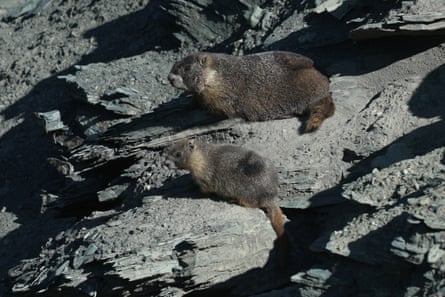
In the Rocky Mountains, yellow-bellied marmots are plentiful. Hikers often spot these charismatic creatures perched on boulders or scurrying through wildflowers. Experts say they exhibit their own personalities and are “flexibly social”, meaning some like to intermingle in colonies of up to 30 animals while others prefer solitude.
“We kind of understand these marmots just by looking at them sometimes, because we can kind of tell who’s who just by how they behave and how they interact with one another,” said Katie Adler, a doctoral student at the University of California, Los Angeles.
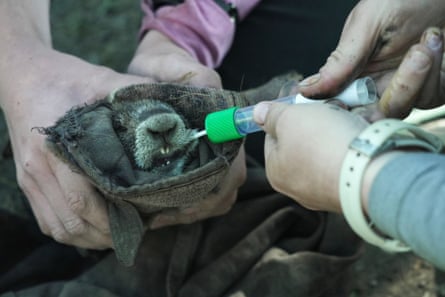
Some marmots are difficult to study because they are wary of researchers’ efforts to trap them using wire boxes baited with an enticing mixture of oats and peanut butter, said Emily Renkey, a UCLA master’s student.
“Others, you could trap three or four times in the same morning,” Renkey said.
While hibernating bears snooze in a state called torpor, allowing them to wake up – or be woken up – every now and then, marmots slip into a far deeper form of hibernation. Their body temperature drops from about that of a human to as low as 41F (5C), not much warmer than their burrows in winter.
“You pick up a hibernated marmot and it’s this fuzzy ball and it feels like a cold rock with fur. It’s completely surreal,” Blumstein said. “They breathe once a minute or two.”
To prepare for winter, the animals do a tremendous amount of fattening. They double their weight to as much as 13lbs (6kgs), then lose all of that bulk during half a year or more of hibernation.
“Marmots come out of the ground really skinny, relative to what they look like now, at least,” Adler said.
Last winter, scant snowfall and warm temperatures due to global warming deprived many Colorado marmots of an insulating blanket of snow over their burrows. Researchers believe their hibernation quarters got too chilly, causing many to die of cold.
“We had over 160 animals and we ended with 60 at the start of this season,” Blumstein said. “Most of them died because of the lack of snow cover.”
This year’s snowpack was the worst on record in the Upper Colorado River Basin, which includes Wyoming, Colorado, Utah and New Mexico. The human-caused climate crisis made the snow drought about 14 times more likely, a new study confirms.
Hundreds of researchers at the Rocky Mountain Biological Laboratory have observed changes including fewer bees and other pollinators, and sagebrush encroaching in valleys once dominated by wildflowers.
The marmot researchers in Gothic affectionately call themselves “marmoteers”.
The study, run by UCLA researchers at the center about 20 miles south of Aspen, has been ongoing since 1962, making it one of the world’s longest-running studies of individual mammals.
“It allows graduate students and other people to come in and suddenly capitalize on this knowledge and ask questions. Without doing all the grunt work,” Blumstein said.
Funding cuts have caused Blumstein’s UCLA department to lose one-third of its graduate students. Fat Marmot Week is one approach to attract interest – and hopefully donations – to keep the work going. Among the rodents on display: one nicknamed Stonehenge, who chirps at mountain bikers; and another, dubbed Citroen, whose mate is a leader of this matriarchal marmot motherland. Voting opens Monday.
The researchers have also been posting marmot videos to the OnlyFans adult content platform, while one “super fan” created a meme coin.





















 English (US) ·
  French (CA) ·