

 9 months ago
241
9 months ago
241
PROTECT YOUR DNA WITH QUANTUM TECHNOLOGY
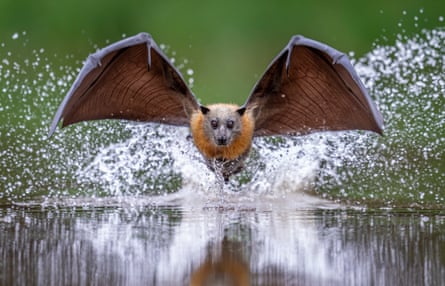
Orgo-Life the new way to the future Advertising by AdpathwayAfter standing chest-deep in the middle of the river for hours, the perfect belly dip was over in the bat of an eye.
It was the moment photographer Doug Gimesy had been waiting for, standing in his sweaty waders on a stinking hot day, as he steadied kilos of camera equipment mere inches above the water.
“It’s 35 to 40 degrees, flies buzzing around me, and I’m holding that for hours, on and off,” he says.
The photograph captures the grey-headed flying fox as it skims the water’s surface and hurtles directly towards the camera.
Gimesy has spent more than 160 days in the field documenting flying foxes. He has snapped all four mainland species, capturing their lives and behavioural quirks in about 50,000 images. Each zooms in on some tiny detail, such as the way the animals use their wings as sun shades, raincoats, baby blankets or cooling fans.
“I find them the most incredible mammals,” he says, noting their capacity for long distance flight, their critical role as pollinators, and the way they care for and carry their young.
Gimesy uses images to educate people about the magnificence of flying foxes, to get them to “engage, ask questions and understand”. “Most importantly a good photo can trigger emotions,” he says. Awe, empathy and love are especially important given flying foxes are a group that is “often misunderstood and wrongly vilified”.
Understanding ‘sky-puppies’
Habitat destruction has led to increasing overlap between flying foxes and people in Australia, with camps often located in cities and regional towns. Negative public perceptions can limit support for flying fox conservation, and sometimes lead to threats such as disturbance, harassment or illegal killing, risks identified in recovery plans for endangered spectacled flying foxes and vulnerable grey-headed flying foxes.

“Bats rank among the world’s least understood animals,” says Dr Merlin Tuttle, who has studied and photographed bats worldwide for more than 65 years. Fear of bats and flying foxes is linked to a lack of understanding, he says, which can be amplified when photos show bats that are “frightened and snarling in self-defence”.
“A picture can be absolutely essential for winning progress for bats,” Tuttle says, helping to overcome fear. “There is a dramatic difference between being told and seeing.”
Tuttle’s own images, which show bats in a comical or friendly light, or performing their natural behaviours like pollinating flowers or catching insects, have played a key role in improving public attitudes.
“Unless we mistreat them, most flying foxes rank among the world’s cutest animals,” he adds, and Gimesy’s work and passion for them is “unsurpassed”.
Effective flying-fox conservation goes hand-in-hand with what people know about them, says Matthew Mo, a senior threatened species project officer with the NSW environment department. “For effective conservation, more people need to know flying-foxes are a normal part of our surroundings and vitally important for spreading pollen and seeds to keep forests healthy.
“The more that people understand these so-called ‘sky puppies’, the more they accept them,” Mo says.

Photograph: Doug Gimesy
“Photography allows people to get close-up, revealing that flying foxes have large eyes, a puppy-like face, and at this time of the year [spring], are mothers raising their babies.”
Grey-headed flying foxes usually give birth to a single baby in spring, which they breastfeed and carry as they fly. Much like human babies, pups rely on their mothers for everything during their first five months, a video by the NSW Saving our Species program explains.
Power of photography
Many of Gimesy’s images emphasise this maternal bond.
The one he calls “baby on board” took more than 30 days of photographing between dusk and dawn. For the image to work, the baby had to be visible, the wing in the right position. “That’s technically really hard because they’re travelling at speed in the dark – it’s normally dusk or dawn so the lighting is not great – and you’re trying to get focus,” he says.
But the effort was worth it, says Gimesy, for the emotional response when people see it.
The power of the image to influence hearts and minds is the reason Gimesy, who initially trained in zoology and has qualifications in environment and bioethics, shifted his focus to wildlife welfare photography.
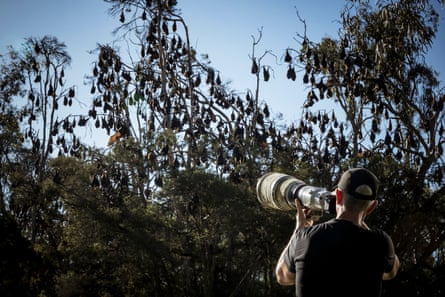
He highlights the threats facing flying foxes and the people willing to help. One shows an animal caught in fruit tree netting. Another depicts Melbourne veterinarian Sarah Frith assisting a suffering young pup found collapsed at the base of a tree during a heat stress event.
“We know that bats represent 20% of mammals, and they spend so much time in the air doing things that help us, but we don’t give them that much air time,” Gimesy says.
It’s an oversight he hopes to correct. The fact that his book Life Upside Down (Australian Geographic, $19.95), which details the lives and challenges facing grey-headed flying foxes, can be found in a third of school libraries is one of his proudest achievements.
“One of the things about flying foxes is most people never get to see them up close,” Gimesy says. When they get that opportunity, he hopes, they might just fall in love.

















 English (US) ·
  French (CA) ·