

 1 month ago
65
1 month ago
65
PROTECT YOUR DNA WITH QUANTUM TECHNOLOGY
Orgo-Life the new way to the future Advertising by AdpathwayGlobal heating will reach at least 1.8C under even the most optimistic future, well beyond the Paris agreement goal of 1.5C, according to a UN report that warns every fraction of temperature rise intensifies destructive extreme weather, glacier melt, ecosystem loss, and island and coastal city submersion.
The report by the Nairobi-based UN Environment Programme confirmed overshooting the 1.5C goal inscribed in the landmark Paris agreement of 2015 was now “unavoidable” and, despite some progress in addressing the human-caused climate crisis driven by burning fossil fuels, likely in the next few years.
It said: “There are no good outcomes above 1.5C”.
Heating of up to 3C above preindustrial levels could lead to glaciers losing more than a quarter of their mass by 2100, raising sea levels by up to 13cm. Global food production could decline by up to 14% by 2050 if there are not effective strategies to adapt.
Human health, water supplies, nature, cities, infrastructure and economies could all be severely damaged. Some losses would be irreversible. Many communities may have to relocate or change their livelihoods.
The report said the best hope for humanity to limit damage was to adopt an “overshoot, peak and decline” pathway that required immediate and sustained greenhouse gas emissions cuts combined with steps to remove carbon dioxide from the atmosphere.
It described the goal of net zero emissions – increasingly politically contentious in some countries – as “an essential milestone that cannot be skipped” and stressed carbon dioxide removal through steps such as establishing vast new forests must occur alongside, not as an alternative to, deep cuts in fossil pollution.
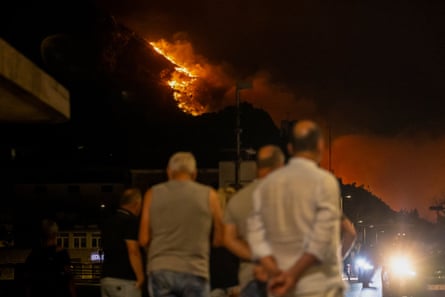
Crucially, the authors of the report, titled Limiting Overshoot, said the average global temperature could be returned to 1.5C this century only if heating stayed below about 1.8C. They warned nature’s capacity to store carbon was uncertain and would shrink the more the planet heats.
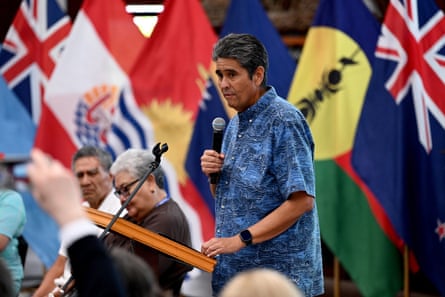
The president of Palau, Surangel Whipps Jr – this week hosting regional leaders including Australia’s Anthony Albanese for a Pacific Islands Forum meeting focused on security and climate – said the report was “a fork in the road moment for the planet”.
“It is hard to overstate the depth of emotion for those of us living on the frontline after having fought so hard to put the 1.5C limit at the heart of the Paris agreement,” Whipps said.
“We need to see an urgent and unprecedented increase in political will and investment in a climate safe future. Nobody can read this report and conclude otherwise.”
Vishal Prasad, from Pacific Island Students Fighting Climate Change, said the report was terrifying for young people from the Pacific.
“The International Court of Justice has made it clear – keeping to 1.5C is not a choice, it is a legal obligation,” he said. “We are not asking for your goodwill. We are not begging you. We are telling you what international law requires of you. End fossil fuel expansion. Your corporate profits cannot be allowed to extinguish our future.”
The UNEP executive director, Inger Andersen, said the future would “bring many unknowns”, but extreme heatwaves – such as those that smashed records and exacerbated wildfires and droughts this northern summer – were already proving climate impacts would “strike faster, hit harder and last longer”.
“We have to act with urgency and determination. Every fraction of a degree avoided, every year by which overshoot is shortened, and every adaptation action taken will save lives, will protect ecosystems, and reduce economic losses,” she told reporters.
Prof Debra Roberts, a report author and co-chair of the Intergovernmental Panel on Climate Change, said a key message was that “the rules of the game are now changing”.
“Existing approaches are no longer fit for purpose,” she said. “I think, for me, that’s the clarion call. We now have to reconfigure our climate governance around dealing with an overshoot pathway.”
She said that meant not just pollution cuts and carbon removal, but “bold adaptation” to protect infrastructure and livelihoods, help sustain political and social support for reducing emissions, and prevent resources being diverted to crisis response.
Climate Analytics, a science and policy institute, applauded the report for clearly describing the problem, but said it did a poor job of “showing us that there is a way out”.
Its chief executive, Bill Hare, said UNEP had barely mentioned the need to phase out fossil fuels or evidence showing “real zero” emissions was possible in many economic sectors by mid-century.
The report’s authors cited earlier work that found limiting heating to about 1.8C required global emissions to be halved by 2035. They said existing national policies were projected to lead to at least 2.3C heating, but it would still be possible to limit stay below 2C if countries delivered on net zero emissions commitments by mid-century.
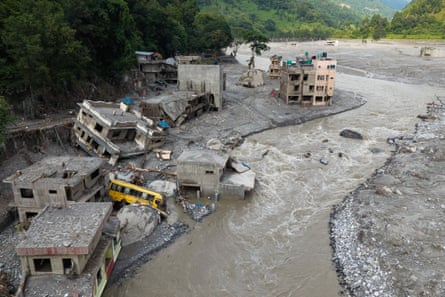
Prof Richard Betts, from the University of Exeter and UK Met Office and another report author, said the flooding catastrophe caused by the collapse of rock and glacial ice in Nepal and China was a demonstration of why the world needed to limit overshoot and come back to 1.5C.
“That specific event obviously is very complicated [but] we are committed to glacier loss,” he said. “We can stop them getting much worse by reducing emissions and limiting the amount of warming.”



















 English (US) ·
  French (CA) ·