

PROTECT YOUR DNA WITH QUANTUM TECHNOLOGY
Orgo-Life the new way to the future Advertising by AdpathwayThe nearly century-old fireboat David Campbell, which served Portland Fire & Rescue for almost 100 years, was lifted into place as the Columbia River Maritime Museum’s newest exhibit
By Jay Corella
The Daily Astorian
PORTLAND, Ore. — On Tuesday, hundreds watched as the Columbia River Maritime Museum added its newest outdoor exhibit: the fireboat David Campbell.
The hours-long lift of the 122-ton vessel, which began around noon on a clear sunny day, was supervised by dozens of construction workers, dozens of spectators — and even a passing U.S. Coast Guard helicopter. A sky-high 136-foot crane hoisted the boat from a barge, up and over the Barbey Maritime Center — and finally nested it into its exhibition space. It joins the pilot boat Peacock, just outside the Maritime Center, similarly juxtaposed along Marine Drive.
| NEW RESOURCE: Performance stations: Design for health, resilience and readiness
The boat was named in honor of Portland Fire Chief David Campbell who died in the line of duty in 1911. The vessel was originally launched in 1927 for Portland Fire and Rescue. In service of Portland Fire and Rescue, it was able to pump over 12,000 gallons of water per minute onto fires. One was a five-alarm fire at the Red Lion Hotel along the Columbia River in 2012, according to Portland television station, KGW.
The boat served the city of Portland for nearly 100 years until its 2021 retirement. The boat was placed in drydock in 2025 awaiting its move to the museum.
“I wish it was still in service because it’s such a phenomenal vessel but I’m really glad they were able to work something out with the museum to get it down here so the public can see it,” said Portland Fire and Rescue Deputy Chief Marty Gretch. Gretch served aboard the boat while it was in service with Portland Fire.
He said some of his favorite memories of the boat were taking it on the water during Fourth of July celebrations in Portland. Tuesday’s lift event was the first time Gretch had seen the boat since it was restored, he said.
Doug Taylor, who worked with Portland Fire and the restoration team, and who was also the boat’s project manager, said seeing it go to its exhibition space gave him conflicted feelings.
“I spent my career as a marine engineer and when you have to have the boat on land and you start drilling holes in it to provide electricity, it’s always weird because at that moment you know its career is over, even though I intellectually know it’s well over,” he said. “It’s always weird to see a boat you’ve worked on not go back in the water.” Taylor said he’s glad it’s found a home and that people will be able to see and appreciate it. “We take a lot of pride in what we’re doing. It’ll be around a long time.”
Bruce Jones, the museum’s executive director, said he was excited to add a new vessel to the museum’s collection. “We’ve been working on this project for several years and this is going to bring a whole new facet to the museum with the opportunity to go aboard a historic fireboat,” he said.
As an added attraction, once the exhibit is open, people will be able to climb aboard the fireboat.
The move was a surprise, sort of
Though the museum did not advertise the move — in case it had to be rescheduled — Jones embraced the audience that came out to watch the event unfold. “It’s always exciting to do something that the public enjoys and the public loves.”
The move did not come without its own challenges. The vessel, weighing more than 120 tons, is one of the heaviest the museum has in its collection. Figuring out the exact weight was a puzzle, Taylor said. “The biggest mystery for us — and for the crane company — was how much does the boat weigh?”
Taylor said his team used high-resolution laser scans to calculate the volume and the weight of the vessel to within 600 pounds. The team also used the scans to create the custom-made slings used to carry the boat.
Taylor said the move was rehearsed carefully to make sure the lifting team didn’t exceed the maximum weight for the crane — but they came close. At one point during the lift, Taylor said it was “within 90% of its max (weight) at that angle.”
Jones said another challenge facing the project was wind — if it had been blowing too hard, they would have had to reschedule the move. “The boat has quite a significant ‘sail area’ so the operators of the crane determined 17 knots is what they’re comfortable with.”
During the lead-up to the lift, Jones said winds peaked at 13 knots.
Once the fireboat David Campbell is on display, the exhibit will be free to visit; however, for a “nominal” fee, visitors will have the chance to climb aboard and see the interior of the historic vessel.
The area surrounding the Barbey Center which was closed off for the move is expected to re-open on July 24 after the exhibit is settled in and surrounding construction is complete.

Los Angeles County firefighters worked in some of Venezuela’s hardest-hit areas
July 17, 2026 06:22 PM
·

Emergency dispatchers are crucial for obtaining information needed to determine an emergency course of action
July 17, 2026 02:28 PM
·

Senator Bernie Moreno introduced legislation that would sanction Canadian officials, revoke visas and consider new tariffs over wildfire smoke
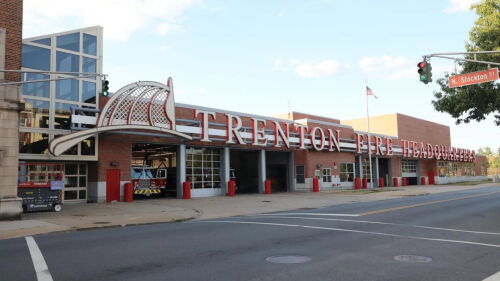
A proposed 48-unit development would provide attainable housing for Trenton firefighters, police officers, EMS personnel and other essential workers
© 2026 The Daily Astorian, Ore.
Visit www.dailyastorian.com.
Distributed by Tribune Content Agency, LLC.

Bidding closes July 1 at 2 p.m. for the NASCAR champion’s “Helmet of Heroes” from the 2026 DAYTONA 500





















 English (US) ·
  French (CA) ·