

 1 hour ago
2
PROTECT YOUR DNA WITH QUANTUM TECHNOLOGY
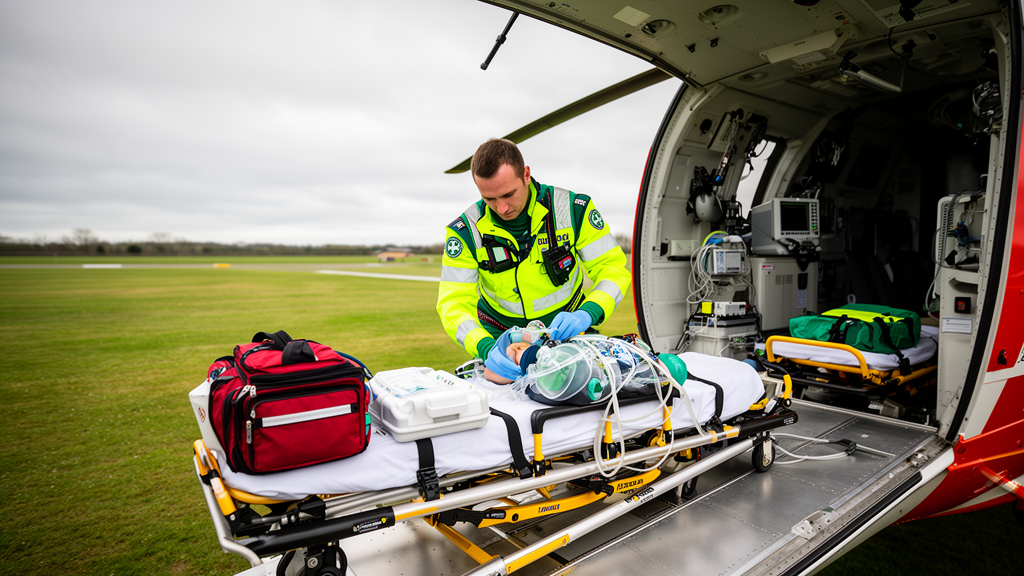
Orgo-Life the new way to the future Advertising by AdpathwayTransporting a critically ill individual from the intensive care unit to the operating room represents one of the most hazardous transitions in modern hospital care, routinely exposing physiologically unstable patients to dangerous secondary complications. Clinical data document that adverse events compromise approximately one out of every four patient transfers, frequently involving mechanical equipment malfunctions, the unplanned dislodgement of vital monitoring lines and endotracheal tubes, interrupted physiological tracking, and acute hemodynamic instability. Furthermore, measurable deteriorations in respiratory parameters have been confirmed twenty-four hours following a single transfer event, while patients deemed entirely too fragile for transit face bleak alternatives; bedside exploratory laparotomies performed in standard, unmodified intensive care rooms carry an 82.4 percent mortality rate and a median postoperative survival time of only 18.1 hours. Although hospitals historically countered these hazards with procedural checklists, dedicated transport teams, and stabilization protocols, these operational measures fail to eliminate the physical separation between specialized surgical suites and critical care environments. Addressing this challenge, an institutional perspective from the Chinese University of Hong Kong, Shenzhen Medical Center details an architectural and operational concept designed to bring emergency surgical interventions directly to the patient’s bedside.
The concept re-evaluates conventional hospital organization by questioning whether selected unstable individuals must undergo transit across sprawling facilities rather than receiving definitive procedural intervention in place. Rather than focusing exclusively on refining transport mechanics, the proposed care delivery model aligns with patient-centered critical care frameworks by seeking to dissolve physical infrastructure barriers between procedural surgery and continuous intensive monitoring. This institutional design is framed specifically as a hypothesis-generating structural concept rather than a validated clinical pathway, aiming to establish whether integrating operative equipment, strict environmental sterilization controls, and multidisciplinary critical care staffing inside an adaptable unit can feasibly mitigate the physiological risks inherent to physical transport for designated patient populations.
Developing an integrated procedural care model demands resolving historical differences between traditional operating rooms and conventional intensive care units across three fundamental pillars: personnel competencies, environmental engineering, and surgical instrumentation. Operating suites have historically been engineered to maintain rigorous aseptic fields, positive-pressure air circulation, and specialized surgical equipment supported by dedicated scrub and circulating personnel, whereas standard intensive care units prioritize extended continuous physiological monitoring, organ-support technology, and continuous bedside nursing care. To reconcile these disparate requirements within a cohesive space, architectural planners and clinical directors at the medical center organized their developmental blueprint around synchronized staffing structures, high-efficiency atmospheric airflow conversions, and portable operative hardware capable of transforming an intensive care room into an accredited procedural environment without displacing the patient.
The physical scale of the emerging medical center provided both the impetus and the design canvas for prototyping this unified care environment. However, because the facility represents a greenfield construction rather than an older hospital undergoing structural renovation, engineering teams possessed the unique opportunity to integrate necessary spatial dimensions, structural conduits, switchable ventilation ducts, and organizational frameworks into the architectural blueprints from the outset. Within this sprawling medical complex, the hybrid surgical intensive care model is specifically slated for initial deployment as a prototype within the trauma building, permitting controlled evaluation before broader institutional implementation is contemplated.
Addressing the human resource requirements of the proposed model capitalizes on the historical and clinical commonalities uniting anesthesiology and critical care medicine. Because modern anesthesiologists routinely manage advanced airways, complex hemodynamics, mechanical ventilation, and continuous pharmacological resuscitation, their professional competencies inherently bridge the divide between procedural surgical suites and critical care units. At the Shenzhen institution, the formal unification of these clinical disciplines under a combined Department of Anesthesiology, Critical Care, and Pain Medicine provides the organizational foundation necessary to foster cross-training, dissolve departmental silos, and support dual-competency care teams capable of delivering intraoperative anesthesia alongside intensive postoperative resuscitation.
Precedent from specialized pediatric units and recent emergency facility adaptations reinforces the practical feasibility of performing operative procedures outside conventional operating suites. Neonatal intensive care units have safely carried out open bedside procedures, including exploratory laparotomies, congenital diaphragmatic hernia repairs, and patent ductus arteriosus ligations, for decades, driven by a profound awareness of the life-threatening risks associated with transporting fragile neonates. Similarly, the widespread conversion of operating theatres and post-anesthesia care units into temporary critical care wards during the COVID-19 pandemic demonstrated the functional flexibility of hospital physical plants, with institutional reports showing intensive care capacity expansions of 52 percent within three days. Experience from these operational transitions underscored that clinical workforce competency, rather than fixed physical infrastructure alone, constitutes the primary operational variable governing patient safety during atypical facility utilization, reinforcing the importance of rigorous team preparation.
Environmental engineering represents the second critical domain in establishing a viable hybrid unit, as maintaining strict surgical asepsis is paramount for preventing surgical site infections. Conventional intensive care rooms typically operate with turbulent airflow at neutral or slight positive pressure, exchanging air between 6 and 15 times per hour, whereas standard operating rooms demand 20 to 25 air changes per hour under positive pressure with laminar flow filtered through high-efficiency particulate air systems. Prior empirical airflow simulations utilizing variable-air-volume installations demonstrated that specialized Venturi valve mechanisms could rapidly elevate intensive care room ventilation from 6 to 15 air changes per hour while establishing positive pressurization, achieving a 60.5 percent greater reduction in tracer gas infiltration compared to conventional control systems. The Shenzhen design plans an advanced switchable ventilation system capable of transitioning the procedural space to 20 to 25 air changes per hour with high-efficiency particulate air filtration, exceeding baseline dilution thresholds to maintain an aseptic envelope during invasive operations.
Spatial constraints are resolved through an architectural design that links two adjacent intensive care rooms via an openable acoustic partition wall, creating a modular suite of approximately 50 to 60 square meters. During standard hospital operations, the partition remains sealed, enabling both rooms to function independently as fully equipped, patient-centered intensive care suites optimized with circadian lighting, noise reduction features, and family accommodations to minimize delirium. When an emergency procedure is mandated, opening the partition creates sufficient clearance to position portable surgical platforms, surgical consoles, and assisting staff without impinging upon life-support systems, while anterooms equipped with differential pressure gradients and specialized filtration serve as clean vestibules to inhibit nosocomial pathogen transmission. Furthermore, the unit’s digital and electrical infrastructure is planned to accommodate high-draw surgical electronics and digital monitoring platforms, which have demonstrated the capacity to reduce intensive care length of stay by 34 hours, decreasing hospitalization from 232 to 198 hours in prior controlled assessments.
Technological convergence in surgical and anesthetic equipment has largely eliminated the historical reliance on fixed operating room utilities. General anesthesia historically necessitated bulky volatile anesthetic vaporizers, complex scavenging pipelines, and fixed nitrous oxide delivery lines built into operating room architecture; however, the emergence of total intravenous anesthesia utilizing target-controlled infusions of propofol and remifentanil has eliminated the need for gaseous anesthetic infrastructure. Randomized clinical trial data examining more than 3,000 surgical patients confirmed that total intravenous anesthesia yields major complication and thirty-day mortality rates equivalent to volatile anesthetics, allowing complete general anesthesia to be administered using mobile infusion pumps at the intensive care bedside. Concurrently, the miniaturization of surgical hardware, including portable laparoscopic imaging towers, high-intensity battery-powered LED headlights, handheld electrocautery devices, and point-of-care ultrasound, permits surgeons to complete minimally invasive operations without ceiling-mounted booms. Although commercially available convertible beds that simultaneously satisfy prolonged critical care comfort and multi-axis surgical positioning are currently lacking, short-distance patient transfers to an operative surface within the same room successfully eliminate transit through public hospital corridors.
Clinical utilization of the hybrid suite is proposed under strict multidisciplinary governance, incorporating rigorous eligibility criteria and explicit procedural boundaries to prevent inappropriate use. Candidate selection requires satisfying two baseline conditions: the estimated physiological hazard of moving the patient must exceed acceptable safety thresholds despite optimal critical care stabilization, and the planned procedure must be fully achievable by available bedside personnel with explicit escalation pathways. Physiological instability alone does not warrant bedside intervention, as severe instability can equally render surgical maneuvers hazardous. Conversely, the model explicitly excludes patients stable enough for standard transport, operations necessitating cardiopulmonary bypass or fixed fluoroscopic imaging systems, extensive open reconstructive operations, and interventions exceeding the room’s validated technical parameters.
To ensure systemic safety, the institutional model requires comprehensive pre-clinical testing, multidisciplinary oversight, and formal regulatory alignment before treating human patients. Institutional ethics committee authorization and a dedicated patient consent framework will explicitly notify patients or their designated surrogate decision-makers that procedural interventions are occurring in a hybrid critical care suite rather than a traditional surgical suite. Governance policies dictate that a multidisciplinary committee oversee clinical credentialing, audit procedural outcomes, and establish unambiguous parameters for converting to open surgery or transferring to conventional theatres. Prior to clinical activation, the installation must complete two distinct evaluative phases: first, rigorous engineering diagnostics to quantify air exchange rates, pressure gradients, electrical reliability, and airborne particulate burdens against national cleanroom and surgical department standards; second, extensive in situ multidisciplinary simulations designed to drill room conversion, crisis management, major hemorrhage protocols, airway emergencies, and rapid emergency transport pathways.
Ultimately, the hybrid surgical intensive care concept remains a hypothesis-generating proposal whose definitive clinical safety, therapeutic efficacy, and institutional cost-effectiveness require validation through structured prospective clinical trials. The narrative literature supporting the model draws from heterogeneous observational reports, environmental simulations, and targeted bedside procedure series rather than randomized outcome studies, meaning it cannot establish comparative infection rates or overall survival benefits. Furthermore, while newly constructed facilities like the Shenzhen center can incorporate specialized partitions, heavy electrical circuits, and switchable ventilation directly into architectural blueprints, established healthcare centers facing physical and budgetary constraints will likely need to pursue incremental adaptations, such as refining existing transport safeguards or standardizing bedside diagnostic resources, before attempting full structural modifications. By balancing operative requirements against the documented perils of patient transport, the institutional concept outlines a technical framework to evaluate whether bringing surgical interventions to the bedside can safeguard medicine’s most fragile patients.
Subject of Research: Design and rationale of a hybrid surgical intensive care unit model
Article Title: Designing a hybrid surgical ICU to avoid intrahospital transport in selected critically Ill patients: the CUHK-SZ institutional concept
Article References: Tsui, B. C.-H., Chan, H. H.-W., Peng, M., Qiu, M. J., Liu, W., Wang, X., & Tsui, J. J. (2026). Designing a hybrid surgical ICU to avoid intrahospital transport in selected critically Ill patients: the CUHK-SZ institutional concept. World Journal of Emergency Surgery, 21(1), Article 55. https://doi.org/10.1186/s13017-026-00739-2
Image Credits: AI Generated
DOI: 10.1186/s13017-026-00739-2
Keywords: hybrid surgical ICU, intrahospital transport, critically ill patients, patient transport safety, CUHK-SZ Medical Center, total intravenous anesthesia, switchable ventilation, HEPA filtration, air changes per hour, bedside surgery, damage control surgery, interdisciplinary critical care, in situ simulation, infection control, procedural suite design, surgical infrastructure, anesthesiology competencies, clinical risk balancing


















 English (US) ·
 French (CA) ·