

PROTECT YOUR DNA WITH QUANTUM TECHNOLOGY
Orgo-Life the new way to the future Advertising by Adpathway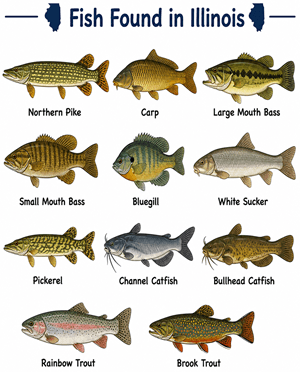
When students think about fishing, they often imagine catching the biggest bass or the most colorful trout. But for wildlife biologists, identifying a fish correctly is an important part of conservation. This Fish Identification activity gives students the opportunity to practice classification skills while exploring how scientists and conservation agencies protect native species. I focused on fish commonly found in Illinois, which is where my school is located.
In this activity, students examine illustrations of twelve common fish found in Illinois, including largemouth bass, bluegill, northern pike, and the protected lake sturgeon. Students learn to observe anatomical features such as body shape, mouth position, tail shape, and color patterns. Students then use a dichotomous key to identify each species, reinforcing one of biology’s most valuable scientific tools.
The activity begins with a realistic scenario. Students are part of a fishing trip where they must determine whether the fish they’ve caught can legally be kept. One fish could be the threatened lake sturgeon, and keeping it could result in a fine.
The resource includes colorful fish illustrations that resemble a field guide, making identification both engaging and accessible. Students work through a logical dichotomous key while learning vocabulary such as barbels, adipose fin, and forked tail.
One of the biggest takeaways from this lesson is that classification has real-world applications. Wildlife agencies rely on accurate species identification to monitor populations, enforce fishing regulations, and protect vulnerable species.
By placing students in the role of anglers and conservation scientists, this activity demonstrates that careful observation and scientific reasoning can help preserve biodiversity for future generations.

Skills Students Practice
Throughout the lesson, students will:
- Use a dichotomous key to identify organisms.
- Compare anatomical structures among closely related fish.
- Distinguish between similar species using observable traits.
- Apply evidence to support scientific conclusions.
- Connect biodiversity to wildlife conservation and environmental stewardship.
Related Resources
Dichotomous Keys with Smiley Faces – more practice with using a key to identify organisms
Taxonomy, Classification, and Dichotomous Keys– fictional organisms to identify
Lesson Plans on Evolution and Taxonomy
Notes and Slides on Taxonomy for Biology 1
Practice with Taxonomy – includes the five kingdoms and the Linnaeus system of classification





















 English (US) ·
  French (CA) ·