

 2 months ago
67
2 months ago
67
PROTECT YOUR DNA WITH QUANTUM TECHNOLOGY
Orgo-Life the new way to the future Advertising by Adpathway“It’s a constant battle,” says Tim Young. He and his family have been tracking the rainfall on their Norfolk farm since 1976, and the data shows the last six years have seen two-thirds the amount of rain compared with previous years. The lack of water has become the number one risk to Young’s business.
This summer has seen record-breaking climate induced heatwaves scorch much of Europe, which combined with droughts and “apocalyptic” wildfires has made farming virtually impossible. France has faced down fires that its president, Emmanuel Macron, called the worst since the second world war and on Wednesday half of England was declared officially in drought, with July expected to be the driest on record after winter floods, according to the Environment Agency. So how are farmers bearing up under the pressure?
“The vines are dying. The grass is yellow and now we can smell the smoke,” Uyen Do, an organic farmer in the Dordogne region of France says, almost in tears. “It’s already very difficult to survive economically and now with climate change it’s becoming a struggle that I’m not sure we’re capable of going through.”
Do took over the farm in 2018 and adopted organic farming practices in the hope to build resilience against the climate crisis. But with the climate changing much faster than most predicted, Do says her farm is just not able to adapt quickly enough. “It’s too fast. It’s too big,” she says.
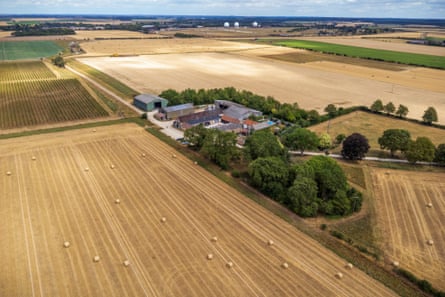
Young has struggled too, despite a much longer career in farming. Last year, the Environment Agency paused his licence to take water from the nearby river owing to low river flows, which he says had catastrophic impacts on his farm. He keeps anxiously checking his phone to see what the latest update will bring.
“In July, we had just 0.2mm of rain,” he says. “We’re so reliant upon that message.”
He would like to build a reservoir on his farm to store water in periods of intense rainfall and high river flows, but says cost and planning permission has always been a key barrier. He recently had to buy water from another farmer at an inflated price and so building a reservoir increasingly seems like an essential business decision.
“Building a reservoir would be good not just for the resilience of my business, but it could be a future income stream because I could sell that water,” he says.
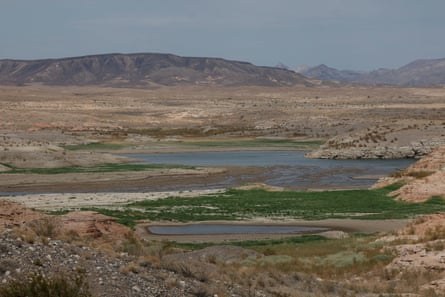
However, on-farm reservoirs aren’t necessarily the magic bullet solution. Paul Tompkins, the deputy president of the National Farmers’ Union, says some horticulture growers are concerned the water they saved in reservoirs over the winter could soon run out. As half of the UK was declared in drought, the regulator is warning that on-farm reservoirs will probably run out of supply in August in areas in drought status, which covers half of the country at present.
Luke King, the supply chain and technical director at the organic farming business Riverford, says without their on-site water storage “we just wouldn’t be able to farm”. All but one of their reservoirs are now empty, so using the stored water efficiently has been essential, he says.
“We put humidity sensors in our polytunnels and we’ve also got a soil moisture probe so we’re able to see exactly how dry the soil is so we can then water optimally, which is really good because it helps conserve water.”
For the food company Pip and Nut, water is also a key risk for their business.
Its founder, Pippa Murray, said in certain parts of California farmers have stopped growing almonds because it is no longer viable from a water perspective. These so-called “abandoned orchards” are expanding year-on-year, with the Almond Board of California stating the total almond acreage has fallen for the past five years.
after newsletter promotion
Pip and Nut has already increased its prices in the face of recent climate shocks and says they foresee more increases in the future. “The volatility is on an upward trend,” says Murray.
But King says drought is just one part of the problem. During the recent heatwaves, which saw several days where temperatures exceeded 30C, “the environment was so hostile that the plants are so stressed they want to die because they just can’t take it”.
On some farms, grass to feed animals has all but stopped growing, meaning farms are having to use animal-feed reserves that have been put aside for winter, which will have knock-on effects later in the year.
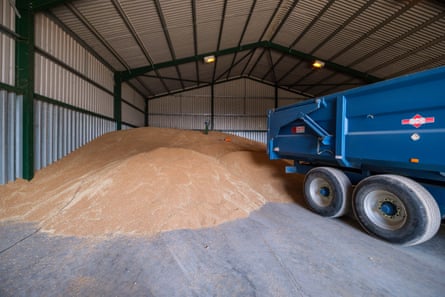
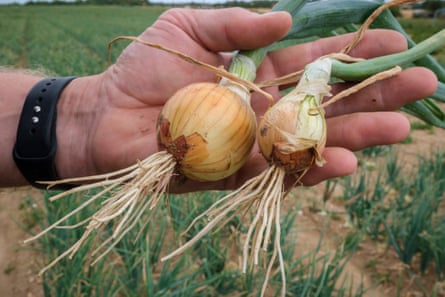
Last year’s extreme heat meant Young’s total onion crop was 500 tonnes smaller than expected because the hot temperatures and dry weather stopped them from growing to their optimal size.
“We have storage for 1,200 tonnes and last year we grew just over 700, so we were 35% down and that’s all my profit,” he says. Because supermarkets only want to buy onions that fall within a certain size range, a lot of Young’s onions ultimately went to waste. “We wouldn’t be able to cope with two years like that,” he says.
Prof Pete Falloon, the Met Office’s science lead on food security, who is advising the government on the resilience of our food systems, says a movement to more regenerative approaches, better flood management, water storage and using crop varieties that are more heat or drought tolerant is essential.
“We’re not necessarily talking about inventing something completely new. A lot of the practices are there already. It’s more a case of embracing them and farmers in the industry taking them out in the field, experimenting with them and learning from each other and learning what works well and what doesn’t in different parts of the country.”


















 English (US) ·
  French (CA) ·