

 2 months ago
87
2 months ago
87
PROTECT YOUR DNA WITH QUANTUM TECHNOLOGY
Orgo-Life the new way to the future Advertising by AdpathwayThere is a distinctive smell of cow manure in the air at the Duke of Westminster’s dairy farm near Chester. It is a world away from the collection of grand West End properties controlled by the duke that form the backbone of his near £10bn fortune, a decade on from becoming Britain’s youngest billionaire.
As part of his 349-year-old Grosvenor empire, Lea Manor Farm on the duke’s Eaton Estate in north-west England has fared better than most dairy farms in recent years.
But it has also been hit by declining milk prices and other challenges faced by British farmers. A series of heatwaves causing drought, with a fifth looming this week – combined with fertiliser shortages triggered by the Iran war, diseases and a scarcity of workers since Brexit – have made farming very difficult.
Milk prices are cyclical; higher farm-gate prices in the UK last year encouraged an expansion of production, and oversupply in the UK and overseas has led to price reductions of up to 50% this year, according to Mark Roach, the managing director of Grosvenor Farms. “I can’t imagine any other industries suffering a 50% reduction.”
Lea Manor has been an arable and livestock farm for centuries, with a focus on potatoes between 1984 and 2002, when it switched to cows after the realisation that growing potatoes on the heavy Cheshire clay was not sustainable.
The farm at Eaton Estate, which is part of Grosvenor’s sprawling portfolio of offices, shops, homes, woods and farmland, has 77 staff and 2,600 Holstein friesian cows; it produces more than 34m litres of milk a year – 13,200 litres a cow – and supplies Müller and Tesco. It is surrounded by fields where animal feed such as wheat, maize, barley and rye is grown, set in 4,685 hectares (11,577 acres) of land.
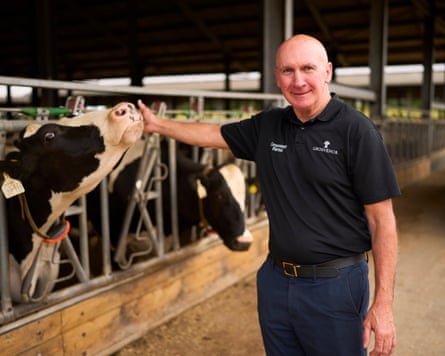
This year’s heatwaves – supercharged by the escalating climate crisis – have piled more pressure on farmers. When temperatures rise above 25C, cows become more lethargic, eat less and produce less milk. At 36C during the June heatwave, each Grosvenor cow produced up to six litres less milk a day, with the heat partly mitigated by a sprinkler system and the large airy barns.
At some other farms, the milk yield was down as much as 10 litres a day for each cow, Roach says. “It’s very, very challenging for farming.”
Mark Preston, an executive trustee of Grosvenor, says: “Extreme weather in many parts of the northern hemisphere is affecting crop yields and farm economics. Farmers are adapting where they can, but the full impact is likely to become clearer over the next growing season, reinforcing the importance of building greater resilience into the UK’s food production system.”
With almost three-quarters of England and all of Wales officially in drought, wheat half the normal height and the broccoli yield down 50%, the UK is forced to import more food from countries such as Spain to avoid shortages, while global prices are rising.
Rural estates are also grappling with labour shortages post-Brexit, which has meant the flow of new eastern European workers has all but dried up.
Many British farms are lossmaking, while Lea Manor – Grosvenor’s only dairy farm – is profitable, after a big revamp starting in 2012 to improve efficiency using technology. The farming division made a profit before tax of £2.6m in 2024, down from £3.6m the previous year, with turnover of £16.2m. By contrast, Grosvenor made an underlying profit of £88.7m from its UK properties last year, up 14% on 2024. The duke received dividends of £53.7m from the group in 2025.

Despite the differing scale, Roach says that the farm is “not a hobby of the duke, it’s a commercial business”. Hugh Grosvenor is one of the UK’s richest individuals, with an estimated fortune of £9.5bn, who upon the sudden death of his father in 2016 inherited the vast estate his family has owned for centuries.
The bequest was largely shielded from 40% inheritance tax because the estate is held in a series of trusts rather than by the duke personally. Grosvenor says that it pays inheritance tax through a recurring 6% payment on the value of its assets every 10 years, instead of a single payment of 40% upon death.
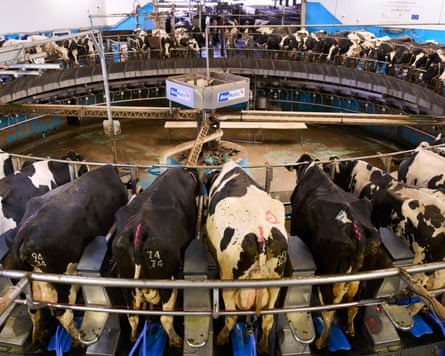
At Lea Manor, the cows are led three times a day from their open-sided barns to an indoor carousel where they are milked using automated machinery. The milking unit is attached by a farm worker but comes off automatically once the udder has been emptied to prevent overmilking, which can lead to mastitis; two robots clean the teats before milking and disinfect them before the animals step off the carousel. Standing in 60 berths, 360 cows can be milked in an hour.
Three tankers are filled every day, with 29,000 litres pouring into each tanker, plus another part-filled tanker, which then go to a Müller processing plant in Manchester, and the milk is for sale in a Tesco supermarket the following morning.
Sensors in the floor measure how the cows walk, so if they show signs of having a sore foot, they will get a foot bath to prevent rot. Sometimes the cows do not want to get off the carousel and have to be guided out of the door back to their barn.
Recurring bovine tuberculosis is another challenge for dairy farms, with testing often unreliable and no vaccine available. Meanwhile, sheep farmers struggle with bluetongue, an insect-borne virus, as changing weather patterns have led to warnings of new diseases.
The rise in factory-style dairy farming has raised concerns over farms using intensive systems to increase productivity from “battery cows”.
Grosvenor insists that overall its cows are healthy, pointing to its own statistics. “Unhealthy cows do not produce much milk,” Roach says. Though its milk is not classed as organic, the farm feeds cows grass and has no routine antibiotics use.
The group says the barns are larger than industry standards and open on the sides, allowing plenty of natural light and airflow. However, the cows are not put out to pasture and stand on concrete floors (with anti-slip grooves). Only 8% of dairy herds in the UK are housed all year round, according to the RSPCA, which says cows should be allowed to graze some of the time.
Grosvenor says: “The health of our herd, low incidence of disease and minimal antibiotic use gives us confidence that the system is working well. We have welcomed representatives from the RSPCA to the farm, who described it as one of the quietest and most content herds they had seen.”
Grosvenor is building a biomethane plant on the estate to produce energy from cow manure, in an effort to broaden its revenue streams. The 2.4-hectare (six-acre) facility is expected to generate 72 gigawatts of renewable gas a year from up to 170,000 tonnes of manure, enough to heat about 6,000 homes, starting in 2027.
It is not the only such rural family estate to have a reactor. Apsley Farms in Hampshire, which has been owned by the Du Val de Beaulieu family since 1936, operates the UK’s third largest biomethane plant and has been supplying renewable gas to the grid since 2014. It generates 104GWh of green gas a year along with renewable electricity for the local network, supplying 10,000 households.
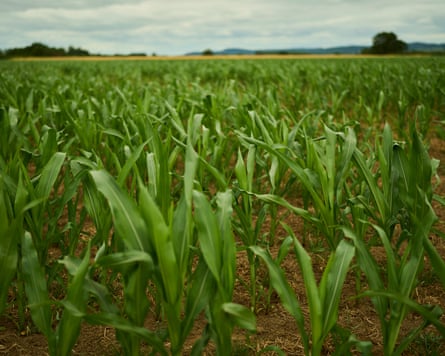
Manure is also used in Grosvenor’s fields, which means more than 80% of the forage fed to the dairy herd is grown without artificial fertilisers. Grosvenor prides itself on circular farming, a system designed to eliminate waste and reuse resources by turning crop waste into feed and animal waste into natural fertiliser, regenerating soil health. As a result, the group has not bought mined phosphate or potash fertilisers for about 15 years and only buys some nitrogen fertiliser.
The near-total blockade of the strait of Hormuz during the Iran war has led to global fertiliser shortages, a situation described as a “food security timebomb” by the head of the International Rescue Committee, David Miliband. Preston echoed those concerns, warning in May that the knock-on effects on food prices could arrive next year.
“The concerns we raised earlier this year remain very real,” Preston says. “Ongoing disruption to fertiliser supply chains continues to affect both availability and cost.”


















 English (US) ·
  French (CA) ·