

 9 hours ago
6
PROTECT YOUR DNA WITH QUANTUM TECHNOLOGY
Orgo-Life the new way to the future Advertising by AdpathwaySomewhere out on the Bering Sea, hundreds of miles off the coast of Alaska, a group of researchers onboard the trawler Alaska Knight haul up a heap of crabs from the seabed. As they sort and measure their haul, something seems wrong.
The catch, which usually features species such as the snow crab – a species of spider crab growing up to a metre wide with its legs outstretched – or its larger relative, the tanner crab, is instead dominated by an odd-looking hybrid of the two species.
These hybrids carry a strange mix of characteristics: a squashed M-shape in the mouth, a cross between the flat mouth of snow crabs and the distinctive M-shape of tanner crabs, and a mix of red and green eyes, one from each of its parents.
“I was struck by how hybridy they are,” says Erin Fedewa, a biologist at the National Oceanic and Atmospheric Administration’s (NOAA) Alaska Fisheries Science Center.
In the region where the ranges of snow crab overlap with tanner crabs, researchers would occasionally find hybrids, though they were a rarity. But in 2025, they recorded more than 13 times more hybrids than the historical average.
After the 2025 anomaly, the scientists waited with interest for this summer’s survey. “A lot of times it takes several years of our survey data to really understand what’s going on,” says Fedewa.
But she adds: “The very first station we sampled, I was seeing all of these large male hybrids. It was sort of like an affirmation for me.”
The 2026 survey showed that the hybrid increase is continuing, and commercially sized hybrid adult males now outnumber snow crabs.
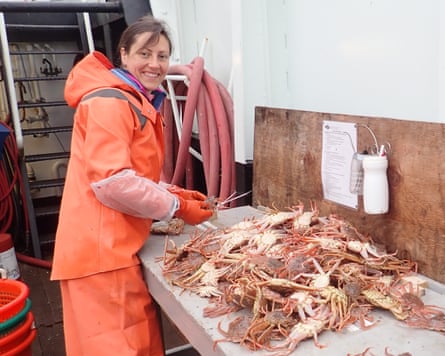
The phenomenon was triggered by an extreme heatwave in 2018 and 2019, when the Bering Sea became nearly ice-free by early spring. The heatwave led to mass starvation and a collapse in the snow crab population, causing the death of about 10 billion crabs.
Early signs of the devastation were apparent in 2019 and became shockingly obvious in 2021 (the 2020 data is missing due to the survey being cancelled during Covid): proof of one of the largest marine mass mortality events ever recorded.
In a study looking at the relationships between the abundance of different crab species and the heatwave, Fedewa and her colleagues found that the absence of snow crabs – which compete for the same resources and might also feed on younger crabs – allowed the hybrids to flourish.
Realising the magnitude of the hybrid surge, Fedewa’s first thought was: “This is going to be such a headache for fisheries management.”
The Alaska Fisheries Science Center has been conducting yearly surveys since the 1980s to assess the populations of commercially important species, such as walleye pollack, Pacific cod, snow and tanner crabs. The survey results are used to build population models that inform fishery managers in setting the quotas. After the snow crab collapse, the fishery was closed between 2022 and 2024, resulting in hundreds of millions of dollars in losses.
In the years after the collapse, snow crabs initially displayed signs of bouncing back. But the most recent survey showed progress had stalled and there was even a decrease in some size categories. Whether this has anything to do with the hybrid boom is not known.
Hybrids now make up more than half of the commercial-sized catch – but they are not officially considered a species and therefore have no set fishing quotas.
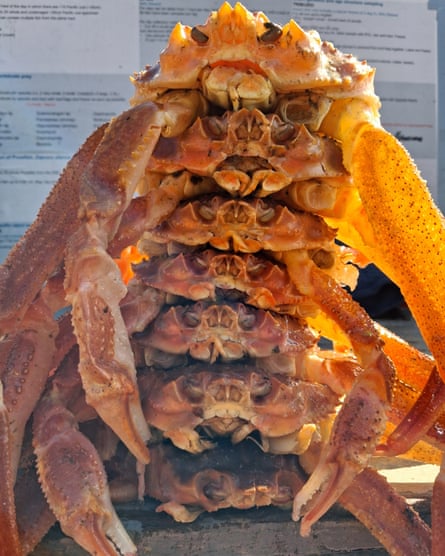
“Legally, hybrids do not exist,” says Ben Daly, regional supervisor at the Alaska Department of Fish and Game, who oversees the research and management of Bering Sea crabs, among others. “You’re either a snow crab or you’re a tanner crab. A tanner crab has two red eyes and an M-shaped mouth; everything else is a snow crab.”
So the hybrids can be legally sold as snow crabs, but they also use up the quota, which is still being kept to conservative levels after the collapse. Hoping to capitalise on the plentiful hybrids and make up for the losses of the past years, fisheries are pushing for separate quotas for the hybrids.
“That desire has validity to it,” says Daly. “The problem is twofold. Number one, we don’t know a whole lot about the ecology of hybrid crabs. Number two, snow crabs are still in a very depressed state. And so the risk is, if we set a limit based on snow and hybrids, but the fleet goes out and only targets snow crabs, all of a sudden we’re overharvesting snow crabs.”
The North Pacific Fishery Management Council, which is responsible for setting the quota, is keeping the question open for now, with a meeting in January that will bring together scientists, fishery managers and stakeholders to discuss what it might look like to be able to harvest hybrids.
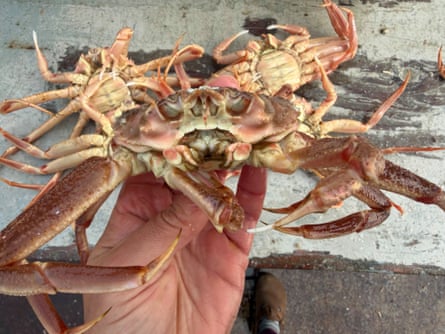
In the meantime, Fedewa and her colleagues have brought some hybrids back to their lab from their last expedition to try to find out more about their ecology. Nobody is even sure if the hybrids are able to reproduce with each other.
Linking a marine heatwave to such an extreme boom in hybrids appears to be unique in scientific literature, but perhaps that just reflects the difficulty of conducting these studies. Hybrids of closely related species might look very similar and therefore go unnoticed.
“I would be surprised if this isn’t actually a common phenomenon,” says Thomas Wernberg, a marine ecologist at the University of Western Australia and the Institute of Marine Research in Norway, who studies the effects of heatwaves on marine ecosystems.
“The impacts of marine heatwaves and extreme events are pervasive. There’s really no point of the biological hierarchy that is free from these impacts,” he adds.
Amid warnings that the world is on the brink of breaching the 1.5C (2.7F) warming limit, marine heatwaves are expected to become more of a norm than an anomaly, and the effects could be far-reaching, on species and human societies.
“I think this is a perfect example of how inflexible fisheries management is in the US,” says Fedewa. “As these events or these novel outcomes become more frequent in the future, our fishery management system needs to adapt to become more flexible.”


















 English (US) ·
 French (CA) ·