

 3 hours ago
1
3 hours ago
1
PROTECT YOUR DNA WITH QUANTUM TECHNOLOGY
Orgo-Life the new way to the future Advertising by AdpathwayA programmable quantum processor that computes with individual particles of light has operated in orbit, according to a team led by Philip Walther of the University of Vienna, which describes it as the first quantum processor to do so. Over eight months in orbit, the device generated, manipulated, and detected pairs of photons and showed the quantum interference that photonic quantum computing depends on, the Quantum Computing Report summarized.
The results appear in a preprint posted to arXiv by the Vienna-led research team and have not yet been peer reviewed. The researchers describe the work as a first step, not a finished space quantum computer.
The long-term goal connects to how we watch our planet. Many satellites collect far more raw data than they can send to the ground, because downlink bandwidth and contact time with receiving stations are limited. Processing some of that data on the spacecraft could help, and the Vienna team is testing whether quantum hardware can one day do that job.
Computing with Particles of Light
Many quantum computers use supercooled circuits or trapped atoms. This one uses photons. At its heart is a source that produces photons in pairs and sends them into a programmable network of optical pathways etched into a small glass chip, according to ScienceAlert.
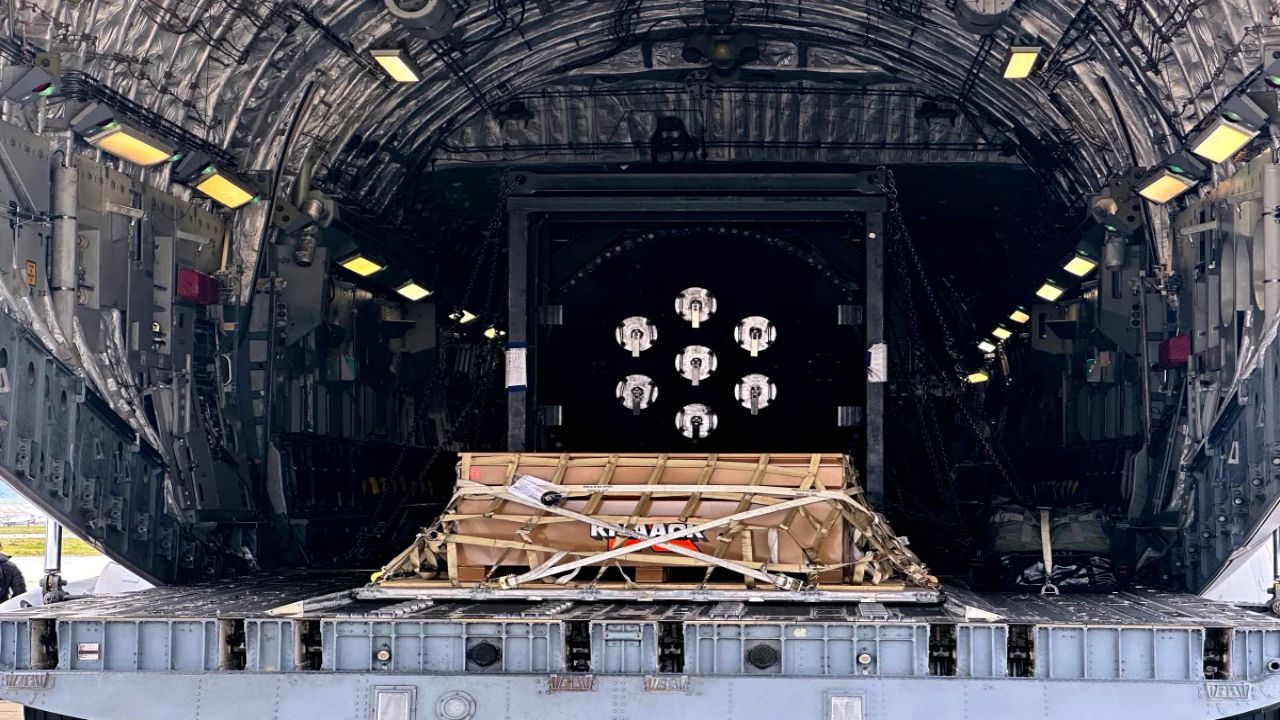
The payload includes the photon-pair source, a six-mode photonic circuit written into glass, single-photon detectors, and control electronics, and it weighs about 10 kilograms. For the device to work, paired photons must be indistinguishable in timing, wavelength, and polarization. When two identical photons enter opposite sides of the same optical junction at the same moment, they tend to leave together rather than separately, a quantum effect known as Hong-Ou-Mandel interference.
The team saw that effect in orbit. By gradually changing the temperature of the crystal that produces the photons, they tuned the particles until they matched. At about 32.5 degrees Celsius (90.5 degrees Fahrenheit), close to the point predicted by ground tests, the rate of photons emerging separately dropped sharply, producing the telltale dip. The team also reported running programmable operations on the chip.
A Rough Ride to Orbit
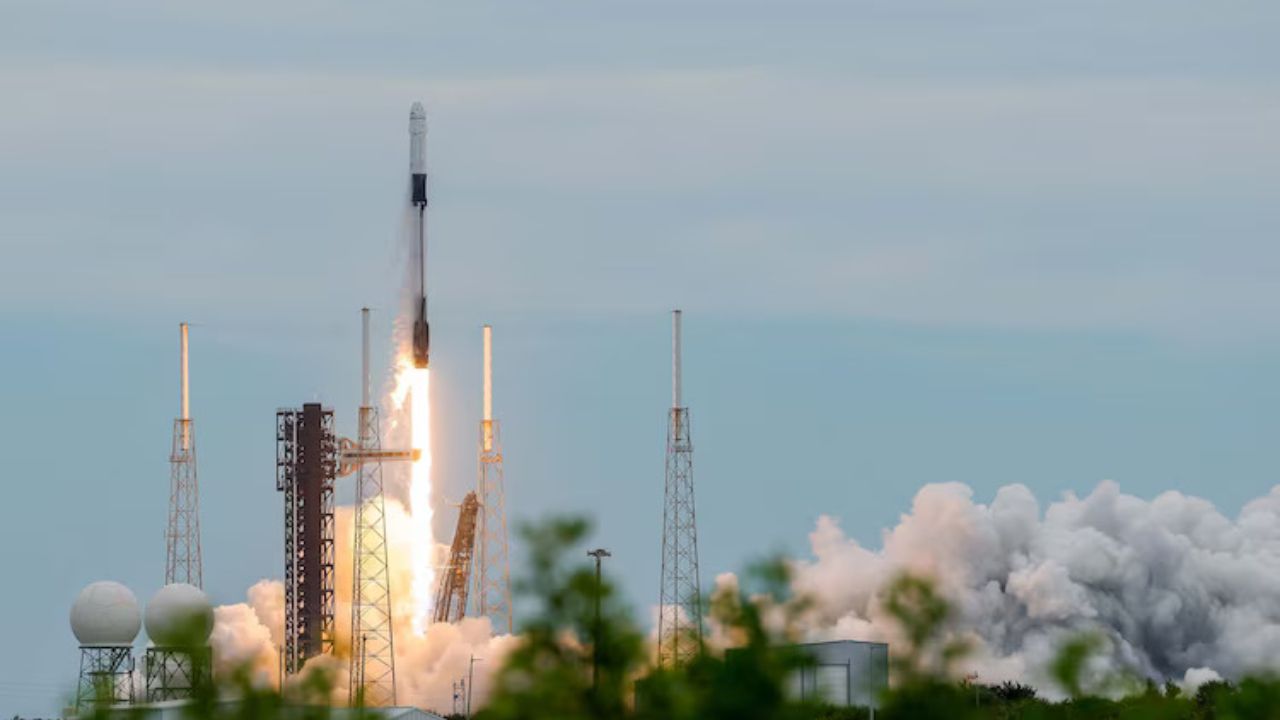
The device launched on June 23, 2025, aboard a SpaceX Falcon 9, according to a University of Vienna announcement, and operated about 510 kilometers (317 miles) above Earth on a D-Orbit ION platform. Before launch, the team reinforced delicate components and glued parts that could not be allowed to move. Prototypes were shaken in tests where the shock requirement reached around 1,500 times Earth's gravity at one resonant frequency.
Space brought its own problems. Only three of six photon detectors turned out to be usable. Sunlight created a noisy background, so the team took its most sensitive measurements during the roughly 30 minutes of each orbit spent in Earth's shadow. The payload sat behind a centimeter-thick aluminum shield, which blocked electrons well but not all protons, and after 52 days in orbit the detectors' false-count rate rose noticeably. The team adjusted detector voltage to recover some signal.
Then there was the laser. An adhesive inside it released vapor in the vacuum, coating nearby optics. In ground tests, that contamination cut the laser's output from about 20 milliwatts to 4 milliwatts within a week, and the output continued to decline in orbit.
Despite those setbacks, the measured interference visibility was 0.908, above the classical limit of 0.5. The uncertainty was large, however, so the result cleared that threshold by 2.14 standard deviations. The team reproduced the effect on two separate days, and it disappeared when they configured the processor so it should not appear.
Earth-Watching Satellites Are the Target
Satellites that track storms, wildfires, floods, ice, and land change generate enormous volumes of data. The researchers' stated aim is to classify and compress remote-sensing data on the photonic hardware itself and send only the results to the ground. "The results reported here are the first step along this path we are pursuing," the researchers wrote.
If that works at scale, it could shorten the delay between when a satellite sees something and when people on the ground receive useful results. That payoff is still hypothetical. The experiment did not process any satellite images, weather data, or disaster imagery. It demonstrated basic building blocks, not an application. Conventional onboard computers already compress and filter some satellite data, so any quantum approach will need to show a clear advantage over them.
Early Evidence, Not a Finished System
This is a single experiment described in a preprint, and outside experts have not yet formally reviewed it. The key quantum measurement carried considerable uncertainty, and hardware failures, from lost detectors to a fading laser, limited how much the team could measure.
Those limitations also have value. The researchers now know which parts failed in space and why, from an adhesive that outgassed to detectors degraded by radiation, lessons that can shape sturdier designs. The project was developed in about 18 months and funded by Austrian sources, including around 2 million euros from the Austrian Research Promotion Agency, Vienna news outlets reported.
The researchers frame orbiting processors as a natural partner to the quantum communication links already established between satellites and the ground. How long that will take, and whether such processors will outperform conventional onboard computers for real Earth-observation tasks, is not yet known.
What Readers Want to Know
What happened?
A University of Vienna-led team reports that a programmable quantum processor using photons operated in low Earth orbit for eight months, showing two-photon quantum interference in space.
Is this a full quantum computer?
No. It is a small photonic processor that demonstrated basic quantum operations. The team describes it as a first step, and it did not run practical applications.
Has the research been peer-reviewed?
Not yet. The results were posted as a preprint on arXiv and have not been formally reviewed by outside scientists.
What problems did the device face in space?
Only three of its six detectors were usable, sunlight added noise, radiation degraded the detectors, and an outgassing adhesive weakened the laser over time.
How could this help Earth observation?
The team's goal is to classify and compress remote-sensing data on the satellite and send only results to the ground, which could ease data bottlenecks for satellites that monitor weather, climate, and disasters.
When could it be used on real satellites?
No timeline has been given. More robust hardware and further tests will be needed before any practical use.
© 2026 NatureWorldNews.com All rights reserved. Do not reproduce without permission.
















 English (US) ·
  French (CA) ·