

PROTECT YOUR DNA WITH QUANTUM TECHNOLOGY
Orgo-Life the new way to the future Advertising by Adpathway
The first mission to land on a moon of Mars could launch as soon as next week, carrying with it a dustbuster-like instrument that The Planetary Society helped develop. If all goes well, this tool will help the Martian Moons eXploration (MMX) spacecraft bring back the first-ever samples from the Martian moon Phobos.
By returning samples from Phobos, the Japan Aerospace Exploration Agency’s MMX mission hopes to reveal what the moons of Mars are really like and how they formed — from another world smashing into Mars, as asteroids that got captured by Mars’ gravity, or in some other way entirely. What MMX finds would help reveal an early chapter of the Solar System’s history, one in which giant impacts and migrating asteroids likely transformed our planet.
Why is a Planetary Society-funded tool heading to Phobos?
Some of the greatest discoveries in the history of space exploration have come from picking up pieces of other worlds and bringing them back to Earth. But sampling is hard. As a form of redundancy, and to help test different technologies, JAXA is launching MMX with two ways to collect pieces of Phobos. One of these, called P-sampler, is based on a technology that The Planetary Society helped make happen.
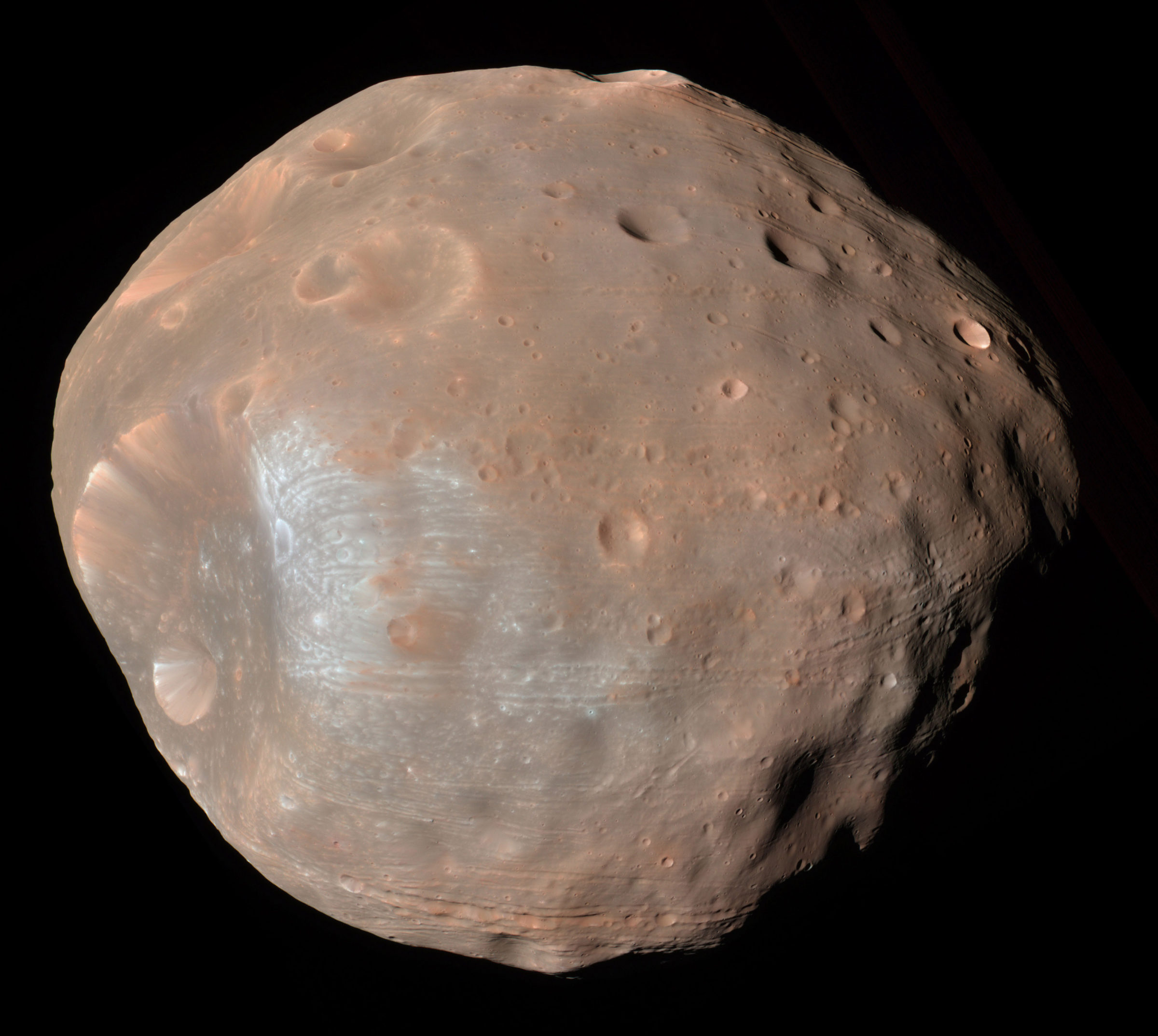 Color view of Phobos from Mars Reconnaissance Orbiter Mars Reconnaissance Orbiter approached to within 6,800 kilometers (4,200 miles) of Phobos to capture this enhanced-color view of the Martian moon on March 23, 2008.Image: NASA / JPL / U. Arizona
Picture a dustbuster attached to the landing leg of a spacecraft, and you won’t be far off. But instead of sucking material in, this technology — called PlanetVac — blasts out pure nitrogen gas. This stirs the dirt and rocks below into a tiny tornado, while another puff sweeps that material up into a collection chamber.
The result is a lightweight, low-cost, and efficient system that could potentially make it cheaper and easier to bring back samples from other worlds. If it weren’t for The Planetary Society’s help on two separate occasions, though, P-sampler might not have made it onto MMX.
This content is hosted by a third party (youtube.com), which uses marketing cookies. Please accept marketing cookies to watch this video.
PlanetVac Testing on Xodiac Rocket In 2018, Planetary Society members and supporters helped fund a test of the PlanetVac sample collection technology aboard a rocket called Xodiac. Xodiac, built by Masten Space Systems, takes off and lands vertically in California's Mojave Desert, allowing hardware developers to simulate the stresses of a rocket launch and landing. PlanetVac was attached to the rocket’s leg and successfully collected 332 grams of simulated Martian soil.
The first turning point came in 2013. At that time, space technology company Honeybee Robotics (bought by Blue Origin in 2022) had only tested parts of PlanetVac, and while NASA had partially funded the project, there weren’t enough resources to build a full prototype.
“That's when [The] Planetary Society came, and they said, ‘You know what? Ideas are fine, but let's try to demonstrate this,’" said Kris Zacny, vice president and director of exploration technology for Honeybee Robotics.
As part of its mission of advancing the scientific exploration of space, the Society finds and supports innovative science and technology projects. According to Bruce Betts, chief scientist at The Planetary Society, PlanetVac immediately stood out as a candidate. Our members pitched in to fund PlanetVac’s first complete prototype and a lab test in simulated Mars conditions. The result was a complete success.
From the Mojave to Phobos: PlanetVac rides with MMX
Japan’s MMX mission is about to launch for the moons of Mars, carrying a sampler with deep Planetary Society roots. Asa Stahl, public outreach astronomer at The Planetary Society, and Kris Zacny, vice president and senior research scientist at Honeybee Robotics, tell the story.
“It was a big deal,” said Zacny. “All of a sudden it turned something from a PowerPoint into a real, tangible thing.”
In 2018, the Society helped Honeybee take PlanetVac on a flight aboard a Xodiac rocket, one that would subject the instrument to the stress of a real launch and landing. That test proved that PlanetVac could work in the field, making it much more likely to be selected for a future mission. And in 2021, NASA selected a version of PlanetVac as one of the instruments to fly on Firefly Aerospace’s Blue Ghost Mission 1, which landed on the Moon in 2025. There, in an accomplishment that Zacny describes as “borderline magic,” PlanetVac successfully collected samples even though an uneven touchdown kept the instrument from resting flush with the Moon’s surface.
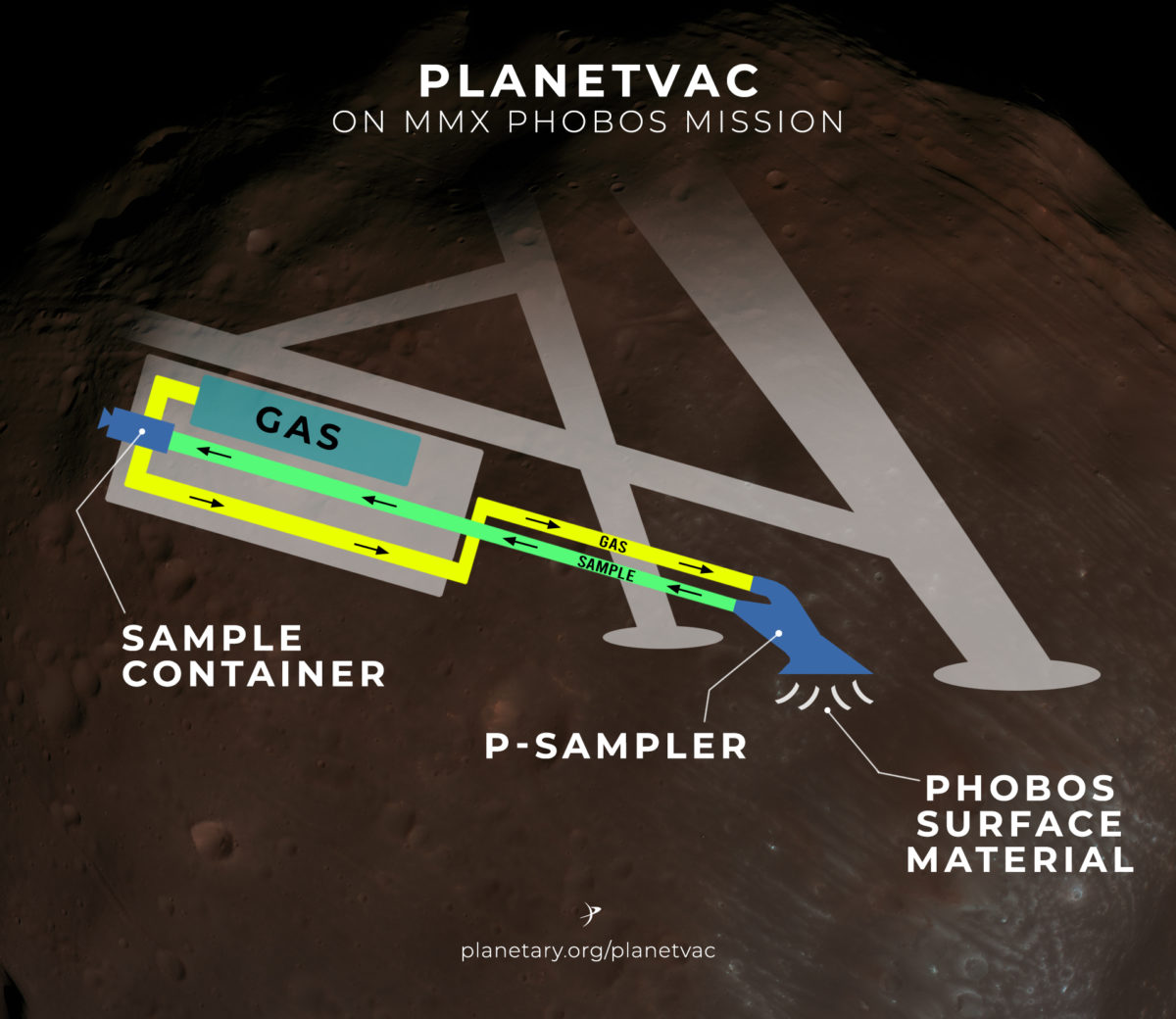 PlanetVac on MMX Phobos Mission A version of PlanetVac called P Sampler will fly to the Martian moon Phobos in 2026 aboard Japan's MMX mission, where it will collect a sample for return to Earth in 2031.Image: The Planetary Society
What else will MMX do on Phobos?
Once MMX arrives at Mars, its orbit around the red planet will allow it to circle Phobos at the same time. From that position, the spacecraft will study Phobos remotely for one year, using cameras and lidar to map the Martian moon, spectrometers to study the chemical makeup of Phobos’ surface, and a dust monitor to check for a faint ring around Mars. Another spectrometer will investigate the effects of space weathering on Phobos’ surface.
This reconnaissance will help the mission pick a spot where it will later descend to Phobos and drop off IDEFIX, a four-wheeled rover developed by the French and German national space agencies. IDEFIX will explore what the moon’s surface material is like in terms of texture and makeup, as well as take other measurements that will help provide a ground truth for the spacecraft’s remote sensing.
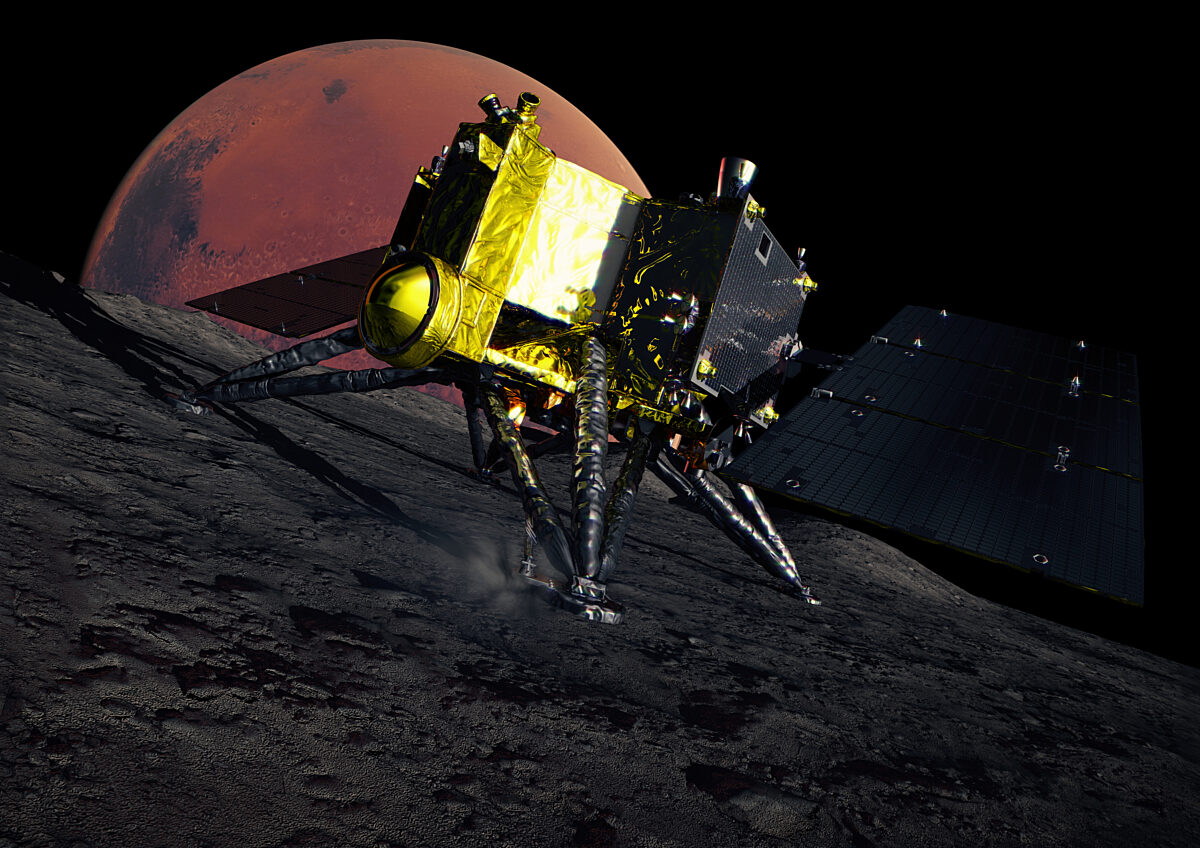 MMX sampling An artist's impression of JAXA's MMX spacecraft collecting material from the Martian moon Phobos using P-Sampler, a derivative of PlanetVac.Image: JAXA
Finally, MMX will land on Phobos and pick up samples with both P-sampler and its other collection device, a corer. If all goes well, the spacecraft may lift off and land on Phobos a second time, perhaps on the moon’s other side, and retrieve another sample core.
MMX will aim to leave Mars in 2030. As it makes its way out of the Mars system, the spacecraft will pass by the other Martian moon, Deimos, and explore it from afar. In 2031, MMX will return to Earth and drop off its samples, which will descend by parachute to a recovery site in Australia.
When will MMX launch?
MMX is scheduled to launch on Oct. 19, 2026 at 3:41 p.m. ET, which is 4:41 a.m. on Oct. 20 in Japan. If that launch is scrubbed, a broader launch window may remain feasible through Nov. 7. The mission will take off on an H3 rocket from the Yoshinobu Launch Complex at Tanegashima, Japan.
You Power the Next Great Discovery!
Fund future scientific research that advances space science and exploration with your gift today.

Empowering the world's citizens to advance space science and exploration.
Account Center • Contact Us • Privacy Policy


Give with confidence. The Planetary Society is a registered 501(c)(3) nonprofit organization.
© 2026 The Planetary Society. All rights reserved.
Cookie Declaration





















 English (US) ·
  French (CA) ·