

 7 months ago
192
7 months ago
192
PROTECT YOUR DNA WITH QUANTUM TECHNOLOGY
Orgo-Life the new way to the future Advertising by AdpathwayAn oddly low-density planet isn’t quite rocky or gaseous — instead, it might have a deep ocean of magma and a stinky, sulfurous atmosphere.
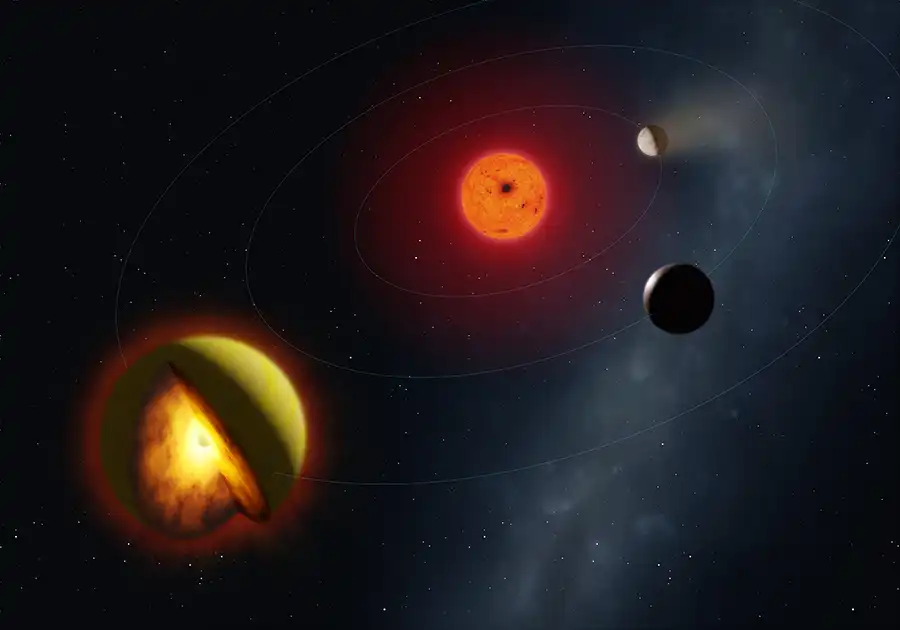 The sulfurous planet L98-59d and its companions orbit their host star in this artist's concept.
 Mark Garlick / markgarlick.com
Just 35 light-years away, in the southern constellation Volans, the Flying Fish, is a world unlike any other. The weird, low-density planet, known as L98-59 d, appears tohave a deep magma ocean and an equally thick, sulfur-rich hydrogen atmosphere, with the characteristic smell of rotten eggs. “It’s astonishing,” says Tim Lichtenberg (University of Groningen, The Netherlands).
Lichtenberg and his colleagues have developed detailed computer models to reconstruct the billions-of-years-long evolution of this fascinating planet, starting from observations obtained by multiple instruments, including the James Webb Space Telescope (JWST). Their conclusion, published March 16th in Nature Astronomy: L98-59 d, which now orbits at 0.05 astronomical unit (six times closer to its parent star than Mercury is to the Sun), must have originated much farther out. As a result, its molten interior holds vast amounts of sulfur compounds, according to the modeling.
“I think this is a very exciting paper, where the authors make a convincing case of explaining the evolution of this planet using the [available] observations,” says Yamila Miguel (Leiden Observatory, The Netherlands), who was not involved in the study. “The models are robust and the data comes from JWST, so I would say it’s a pretty nice result.”
L98-59 is a 12th-magnitude red dwarf orbited by at least five planets, the first three of which were found by NASA’s Transiting Exoplanet Survey Satellite (TESS) in 2019. Of these three, planet d stands out. The amount of starlight blocked by the planet during its periodic transits across the face of the red dwarf indicates that it is at least 50% larger than the Earth. However, it’s at most twice as massive, as evidenced by the amount of wobble it inflicts on its parent star. That means the planet’s density is somewhere between 3 and 3.4 grams per cubic centimeter — much lower than the density of similar-sized exoworlds. (Earth, for reference, is about 5.5 g/cm3.)
What’s more, recent JWST observations indicate the presence of relatively large amounts of sulfur (in the form of SO2 and H2S) in the planet’s atmosphere. Normally, a thick atmosphere wouldn’t survive long under the harsh radiation from its nearby star, says Lichtenberg. “Moreover, the sulfur content is much higher than in our solar system,” he says. “It’s all very surprising.”
Far-Out Formation of a Magma World
According to Harrison Nicholls (University of Oxford), team lead of the new study, there’s only one viable explanation: Lying on top of L98-59 d’s small iron core is a deep ocean of hot magma, containing large amounts of relatively heavy elements such as sulfur. On the seething surface, slow outgassing maintains a thick, hydrogen-dominated atmosphere. Meanwhile, the greenhouse effect of this massive gaseous envelope keeps the planet hot enough to remain almost completely molten for billions of years, explains Nicholls. Tidal heating, due to the gravity of other planets in the system, may also play a role.
The planet has cooled, though. The team’s intricate computer modeling (which takes into account geology, geochemistry, atmospheric physics, and the evolution of the parent star) shows that L98-59 d was probably even hotter (and larger, too) when it first formed some 5 billion years ago.
To explain the planet’s atmospheric composition, especially the abundance of sulfur, the planet must have formed in a volatile-rich environment — something only expected for the outer, cooler parts of the system, where heavier gases would have frozen and crystallized, and were thus more easily incorporated into a forming planet. Even then, the deduced mass fraction of sulfur (at least 1.8%) is remarkably high.
Furthermore, the models suggest there’s an active sulfur cycle going on. The observed sulfur compounds are created in chemical reactions driven by ultraviolet light from the star. Subsequently, those gases become trapped in the deep magma ocean below, which serves as a buffer for these volatiles before eventually releasing them again.
“We cannot yet quantify how rare this scenario is,” says Nicholls. “However, given the results of our modeling, and also on the basis of well-justified physical processes which happen during planet formation, we believe that these magma ocean planets may represent a substantial fraction of the exoplanets in our galaxy.”
Diversity of Worlds
The weird planet “reflects the wide diversity of the worlds which exist beyond the solar system,” according to the team in a press statement. “We may then ask: what other types of planets are waiting to be uncovered?”
“L98-59 d probably started out as a so-called ‘sub-Neptune,’ but may now be slowly evolving into something more like a super-Earth,” Lichtenberg says. “To me, it’s really a transition planet.”
“What’s astonishing is that exoplanets are still delivering huge surprises decades after the field began,” comments Sara Seager (MIT), who wasn’t involved in the new work. “We can look forward to more examples of this possible class of hydrogen-rich, sulfur-bearing atmosphere worlds.”


















 English (US) ·
  French (CA) ·