

 2 hours ago
8
2 hours ago
8
PROTECT YOUR DNA WITH QUANTUM TECHNOLOGY
Orgo-Life the new way to the future Advertising by AdpathwayEvery time a cell breaks down food, processes a drug, or responds to a chemical, it produces a cascade of small molecules known as metabolites. Reading that chemical chatter is the business of metabolomics, a field that promises new signs of disease, new ways to measure whether a treatment is working, and new insight into how diet and nutrition shape the body. Yet for all its promise, metabolomics has been haunted by an embarrassing problem: most of the molecules it detects cannot be identified. Researchers at the University of Central Florida have now built a tool designed to change that, and early results suggest the hidden fraction of the molecular universe may finally be within reach.
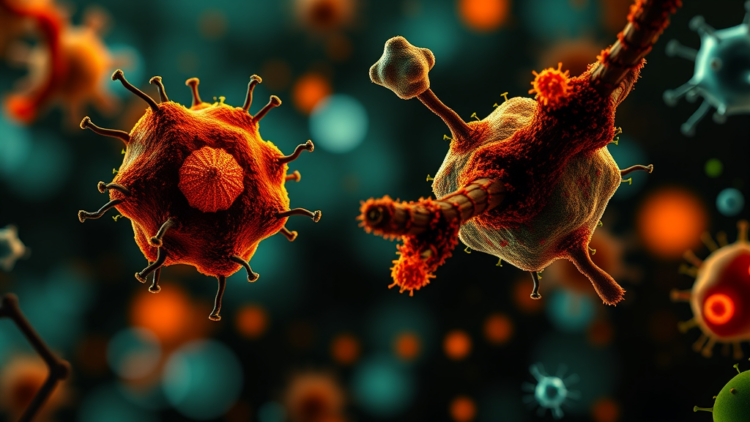
The vast majority of metabolites are detected with mass spectrometry, a laboratory technique that measures the mass and charge of tiny particles. When a sample is run through a mass spectrometer, each molecule produces a characteristic pattern called a mass spectrum, which in principle can be matched against libraries of known compounds. In practice, the matching works only for a minority of spectra. The rest belong to molecules that are clearly present and clearly measurable, but whose structures remain unknown. Researchers have come to call this inaccessible territory the dark matter of metabolomics, or the dark metabolome, a fitting name for a substance that can be detected but not identified.
The scale of the problem is enormous. According to Professor Vladimir Boginski of UCF, who led the new work, public repositories now hold roughly 8.4 million observed mass spectra of known and unknown molecules combined, and by current estimates the dark matter accounts for up to 90 percent of the entire observed molecular space. Every one of those unidentified spectra represents a potential biomarker, a molecular signature that could distinguish sick tissue from healthy, flag the early stages of disease, or reveal how a patient is responding to therapy. Instead, the data sit in databases, detectable but biologically silent, leaving a gap in what scientists can say about the genetic biome, cellular health, disease, and drug response.
Boginski and an interdisciplinary team of co-authors describe their solution in the most recent issue of Cell Reports Methods, in a paper titled Ordering molecular diversity in untargeted metabolomics via molecular community networking. Their tool, the Molecular Community Network, or MCN, takes a fundamentally different approach to organizing spectral data than the molecular networking methods that have dominated the field. Those traditional methods connect molecules only when their similarity scores, calculated from observed mass spectra, exceed a predetermined threshold. If two biologically related molecules fall just below the cutoff, the link between them is severed, and molecular families fragment into disconnected pieces.
That fragmentation is more than a cosmetic inconvenience. When a molecular family is broken apart, the known members lose touch with their unknown relatives, and the opportunity to infer the identity of the unknowns from their neighbors disappears. Boginski argues that this is precisely where biomarker discovery tends to stall. A molecule that reliably differentiates sick patients from healthy ones may show up clearly in a mass spectrum, yet if its structure cannot be assigned, the finding becomes a dead end. The spectrum is real, the signal is reproducible, but the molecule behind it remains a question mark, and a biomarker that cannot be identified cannot be developed into a clinical test.
The MCN replaces the rigid threshold with an algorithm drawn from the mathematics of community detection in large networks. Rather than asking whether each pair of molecules exceeds a fixed similarity score, the method divides the entire molecular network into its natural communities, groups of nodes that share a vast number of strong links internally while remaining only weakly connected to other groups. Once those communities are established, the strongest connections are retained to keep each community intact. The result is not a new structure imposed on the data, but a revelation of structure that was already present, hidden beneath the noise of near-threshold scores and fragmented families.
The practical consequence is striking. In the traditional approach, molecules that fall below the similarity cutoff can end up isolated, with no links at all. Under the MCN, almost every molecule in the network is linked to at least one neighbor, and those links typically connect molecules from similar molecular families. Boginski reports that nearly 95 percent of molecules are now connected and assigned to network communities, a dramatic expansion of the searchable molecular space. With nearly every unknown anchored inside a community alongside known compounds, the tool enables annotation propagation, the process of predicting the identity of an unknown molecule from the known identities of its neighbors.
Annotation propagation is where the dark matter begins to give up its secrets. If an unidentified spectrum sits inside a community dominated by, say, a particular family of lipids or bile acids, the algorithm can propose that the unknown belongs to that family, narrowing the search from millions of possibilities to a manageable set of candidates. Boginski notes that the team has shown this approach can indeed find previously unknown molecules based on their positions in the molecular community network, converting spectral orphans into annotated candidates that chemists can then pursue in the laboratory.
The method has already produced a discovery of its own. Using the MCN, Boginski and his co-authors identified a new class of bile acids, molecules produced by gut microbes that play important roles in digestion and metabolism. Among the newly recognized compounds is one that appears only in early infants, a finding that carries obvious implications for understanding the developing infant microbiome and the chemical dialogue between microbes and their youngest hosts. Crucially, the discovery followed the tool’s characteristic workflow: the new bile acids were first predicted computationally by their positions in the molecular community network, and then confirmed experimentally by the researchers in the lab, a sequence that demonstrates the pipeline from prediction to validation.
Boginski describes that first discovery as just the tip of the iceberg, and the reasoning behind his confidence is straightforward. Because the MCN runs on mass spectrometry data that has already been collected, the roughly 8.4 million spectra sitting in public repositories are now mapped and open to reanalysis. No new experiments are required to begin mining the dark metabolome; the raw material has existed for years, waiting for a method capable of organizing it. Each reanalysis pass has the potential to convert dead-end spectra into identifiable molecules, and each identified molecule becomes a candidate biomarker for disease, a measure of treatment efficiency, or a window into how diet and nutrition act on the body. For a field in which up to 90 percent of what can be measured has remained uninterpretable, the arrival of a tool that connects nearly every molecule to a molecular family may mark the moment the dark matter starts to give way.
Subject of Research: Computational molecular networking for identifying unknown metabolites in untargeted metabolomics
Article Title: UCF researcher develops new resource to identify unknown molecules for biomarker discovery
Article References: UCF researcher develops new resource to identify unknown molecules for biomarker discovery. (n.d.). Original publication
Image Credits: AI Generated
DOI: Not provided
Keywords: metabolomics, dark metabolome, mass spectrometry, molecular community network, biomarker discovery, bile acids, gut microbiome, annotation propagation, network analysis, University of Central Florida, Cell Reports Methods, Vladimir Boginski
Cite Scienmag News
APA MLA Chicago
Copy citation Download RIS
Tags: advances in metabolomics detection methodsannotation propagationbile acidsbiomarker discoverybiomarker discovery in metabolomicsCell Reports Methodscellular metabolite analysischemical chatter of metabolitesdark metabolomeGut microbiomemass spectrometrymass spectrometry in metabolite identificationmetabolite identification challengesmetabolite structure elucidationMetabolomicsmetabolomics and disease biomarkersmetabolomics dark mattermetabolomics research techniquesmolecular community networknetwork analysisnew network tools for metabolomicsunidentified metabolites in metabolomicsUniversity of Central FloridaVladimir Boginski
















 English (US) ·
  French (CA) ·