

 2 weeks ago
37
2 weeks ago
37
PROTECT YOUR DNA WITH QUANTUM TECHNOLOGY
Orgo-Life the new way to the future Advertising by Adpathway
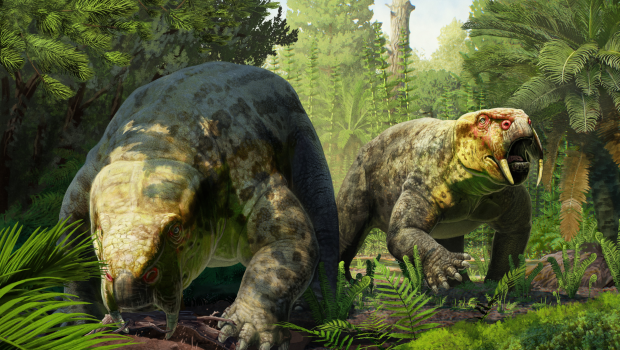
Published on September 18th, 2026 | by Hady George
I can’t imagine how ecstatic 9-year-old me would have felt if I told him he would get to unveil to the world a new fossil species, let alone one that informs on the oldest dinosaurs. 25-year-old me is pretty happy with the work too, but to be honest, it is not thrill or joy that overwhelm me. Instead, my awareness of the limitations of the research and the new questions it begs a fossil nerd to ask leave me with a deepened sense of humility and curiosity. A list of follow-up research projects in my phone’s notes app has been gradually lengthening the more I think about the new knowledge my collaborators and I have uncovered. Now that our knowledge can finally be shared with the wider scientific community in the form of an open-access research paper and publicly accessible data, I hope more eager scientists find the interest to pursue this avenue of research. I also find myself reflecting on the path it took to get here from when I was first invited onto this project, and I think that too may be worth sharing. Here, I hope to walk you through the “behind-the-scenes” of this research in case you may be interested in knowing what can go into identifying a new fossil species or palaeontological research more generically. If you’re an experienced, wise scientist you might find it amusing to read about the silly mistakes the new generation makes while attempting to navigate academia. And if you’re not a scientist at all, please be reassured I’ve left out a lot of the boring technical terms.
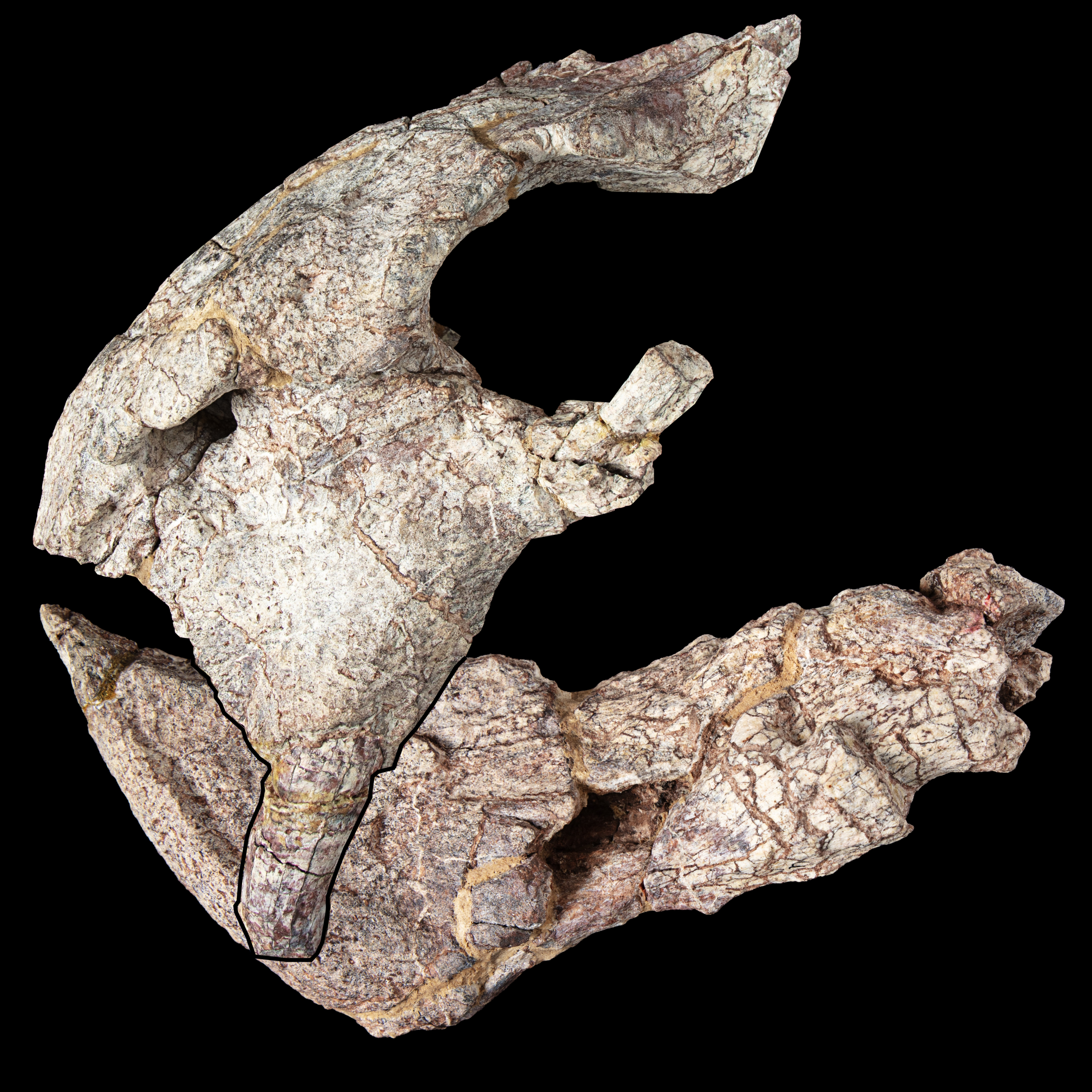 The main portion of the skull and the lower jaw of the holotype of Dinodontosaurus isiyavamanda. Photos originally taken by Jonathan Jackson before layered on top of one another by Hady George.
My involvement in the research project started not long after Tetzoocon 2022, which I attended a few months after completing my master’s in palaeontology at the University of Edinburgh. My friend Cassius Morisson, who was a speaker at the convention introduced me to Dean Lomax who was also a speaker. Dean and I had a quick chat over coffee where I mentioned to him my interest in researching dicynodonts, a peculiar group of ancient relatives of mammals that sort of look like pigs but with a beak and tusks. Dean then mentioned he had a friend who had been trying to publish some work he did as a master’s student on a dicynodont, and that he would put me in touch with him. I cannot stress enough how important it is too put yourself out there in your academic circles, no matter how much imposter syndrome may be pulling you down. I still find it surreal I get to meet and chat with friendly and brilliant scientists from all over the world who are regularly reshaping our perspectives on the deep past. Sometimes, you find people who introduce you to your future coauthors. In this instance, Dean introduced me to Nigel Larkin, a world-leading conservator of natural history specimens and preparator of fossils.
One of Nigel’s first ventures into the world of fossils was through his master’s, and like mine, it was on dicynodont fossils. In 1994, Nigel completed his master’s research project (degree awarded by the University of London) on fossils collected from the Triassic of Tanzania in a 1963 expedition. A huge swathe of bones was collected, altogether they represent a 240ish million-year-old graveyard of dicynodonts. The leaders of the expedition, Barry Cox and John Attridge (both have sadly passed away since) brought the collection to the Natural History Museum in London (NHM). Nigel must have spent long hours figuring out exactly what sort of dicynodonts were discovered. Eventually, he came to the conclusion that the best-preserved material represented a new genus and species: Ruhuhuungualasaurus croucheri. The first part of the binomial translates to ‘clawed reptile of Ruhuhu’, the Ruhuhu Basin being the geological unit in Tanzania where the fossils originally came from. The second part honours Ronald Croucher who was once the head of the Palaeontology Laboratory at the NHM. In his thesis, somewhat presciently, Nigel argues Ruhuhuungualasaurus may be related to the South American Dinodontosaurus.
Nigel was delighted to learn I had done my master’s thesis on a dicynodont, albeit one from older, Permian rocks. I had studied the natural mould of a skull of a 252ish million-year-old critter from the North of Scotland belonging to the species Gordonia traquairi. Generously, Nigel offered me the opportunity to take the next step in my research by helping transform his 1994 thesis into a peer-reviewed paper of the 2020s. As soon as I could turn my attention to this project, I was faced with what might forever be one of the most intimidating obstacles of my career: Dinodontosaurus. At first, when I compared the Tanzanian material to that of the South American dicynodont, I could see some clear differences in the anatomy. I came to the decision that the Tanzanian fossils did not belong to Dinodontosaurus, but rather a new genus. Unfortunately, due to the official rules surrounding the naming of species, we could not go with Ruhuhuungualasaurus. Maybe this is for the best though, as seven Us is so excessive that this name has been misspelt every time it’s appeared in the scientific literature. I won’t say what was the name we were going for at the time as a replacement, I’m planning on keeping it available for a future species. I was confident enough with my assessment I decided to present my work at a scientific conference. Our conclusion was presented in a poster I put together for the Symposium of Vertebrate Palaeontology and Comparative Anatomy (SVPCA) in 2023, and this is when Dinodontosaurus first crept up on me.
After my master’s supervisor Christian Kammerer caught a glimpse of the poster, he emailed me about errors I made in interpretation of the anatomy of the skull I was focusing on. Christian is as knowledgeable about the anatomy of dicynodonts and other protomammals as one possibly can be. Beyond simply pointing out some basic errors (e.g. I thought the crack at the tip of the jaw was a real biological feature, and not just the fossil being broken; very silly I know), he also mentioned that a lot of what I thought were unique anatomical traits were actually present in Dinodontosaurus. He sent me almost 800 high-quality photos of Dinodontosaurus fossils found across Argentina and Brazil, and I could see what he meant. My taxonomic assessment, that the Tanzanian material was a new genus, was completely wrong. This whole time I had been looking at Dinodontosaurus, and I hadn’t even realised it. Some of the worst imposter syndrome I’ve ever felt was at this moment. If I can’t even get this assessment right, what hope did I have at getting the tricker details right? Surely, I wasn’t capable of writing an academic paper on these fossils. Keep in mind that as much help as Nigel and my other coauthors were throughout this project, none of us were senior professors with a longstanding expertise in the ancient relatives of mammals (Mike Day wasn’t a coauthor at this point). After spending a day or two collecting myself, I returned with renewed enthusiasm. I refused to give up, and I’m glad I made this choice. We are discovering the secrets of past alien-like animals after all.
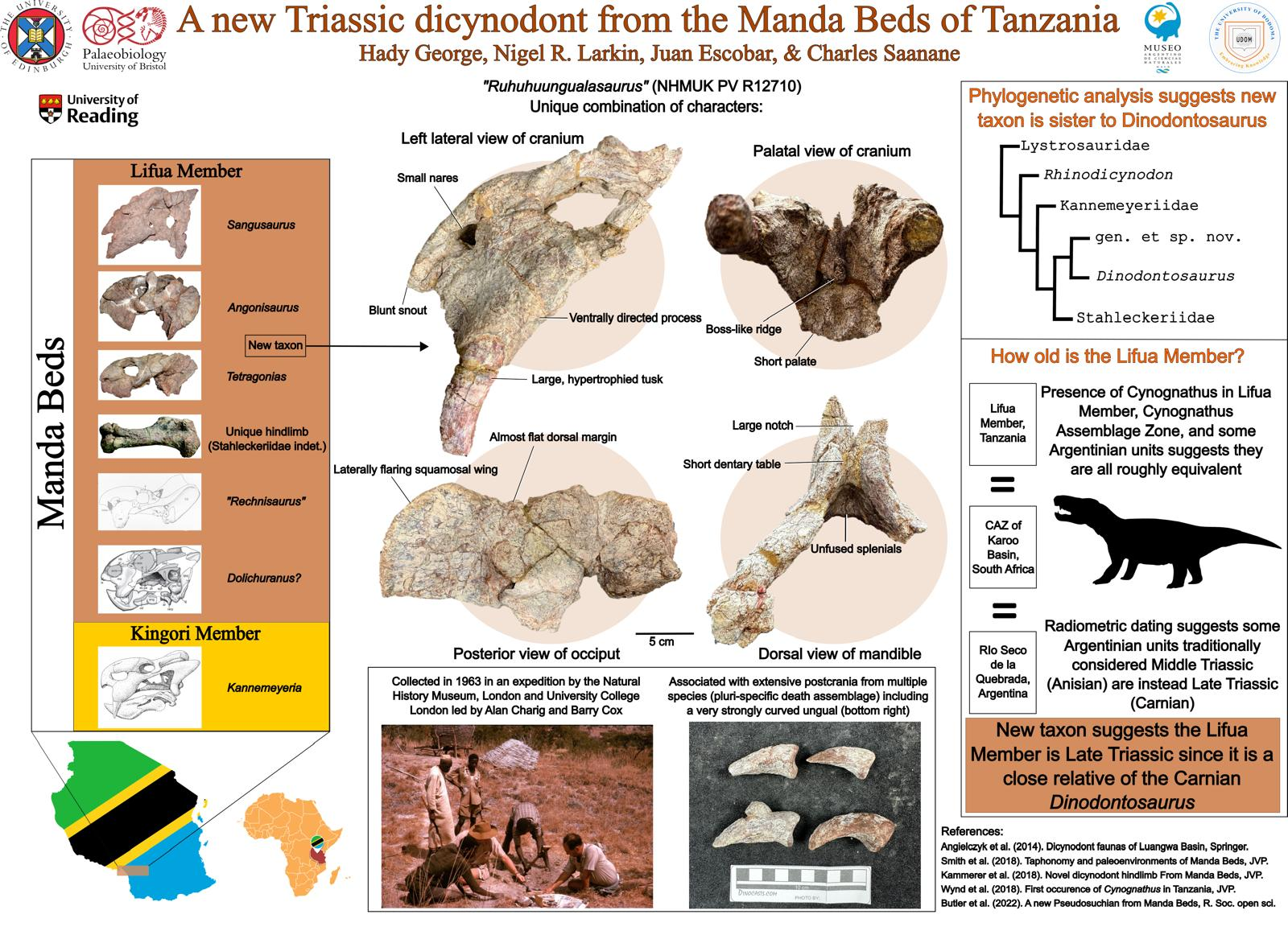 The poster where I got the taxonomy all wrong. This was presented at SVPCA 2023 and should NOT be used as a reference.
I again went through all the anatomical intricacies that I could find in the skull I was studying. I took more care with making comparisons to other species and carefully consulted the hundreds of images Christian had sent me. This was during the first year of my PhD at the University of Bristol (as of writing this, I am in my final year). In the Life Sciences Building, first year students are typically kept in a shared basement office. I spent long hours in there ruminating over how sloped some parts of some skulls seemed to be and other tedious bits of anatomy. It certainly was not fun and came at the cost of missing out on social events and exercise, but I did manage to come to new conclusions. The Tanzanian material seemed to be Dinodontosaurus. It had all the basic features of the genus including tusks, a swollen boss above the beak, and the back of the head was not notably exaggerated in any way. In many ways, Dinodontosaurus is generic (pun not intended). Its gross skull anatomy is like the default version of Triassic dicynodont skulls. This is where Dinodontosaurus gave me yet another headache. ‘Being basic’ is not a substantiative argument that survives peer-review. This is not to say Dinodontosaurus doesn’t have unique, derived anatomical features. It absolutely does, but they are characteristics of the sutures (rigid joints between skull bones) that I cannot identify in the Tanzanian skull because the surface quality of the fossil has been damaged by erosion. You can see why this was so troublesome.
The roof of the mouth (technically called the palate) of the Tanzanian skull I was studying had a clearly unique feature. What is normally a super thin cutting ridge was instead a bulbous structure. This was originally the main feature I had based my previous assessment on. I could not identify anything like this in the South American Dinodontosaurus material, but one or two Brazilian specimens Christian sent me photos of seemed to have something like it. I came to the conclusion that we must instead identify the Tanzanian fossil as Dinodontosaurus cf. tener. For the uninitiated (lucky you), this basically means: ‘it looks like Dinodontosaurus tener (the main Brazilian species), but it might not be Dinodontosaurus tener, and I don’t really have a clue. It’s an honest, but somewhat disappointing conclusion to come to. Here, I am beyond glad my coauthor Juan Escobar came to save us.
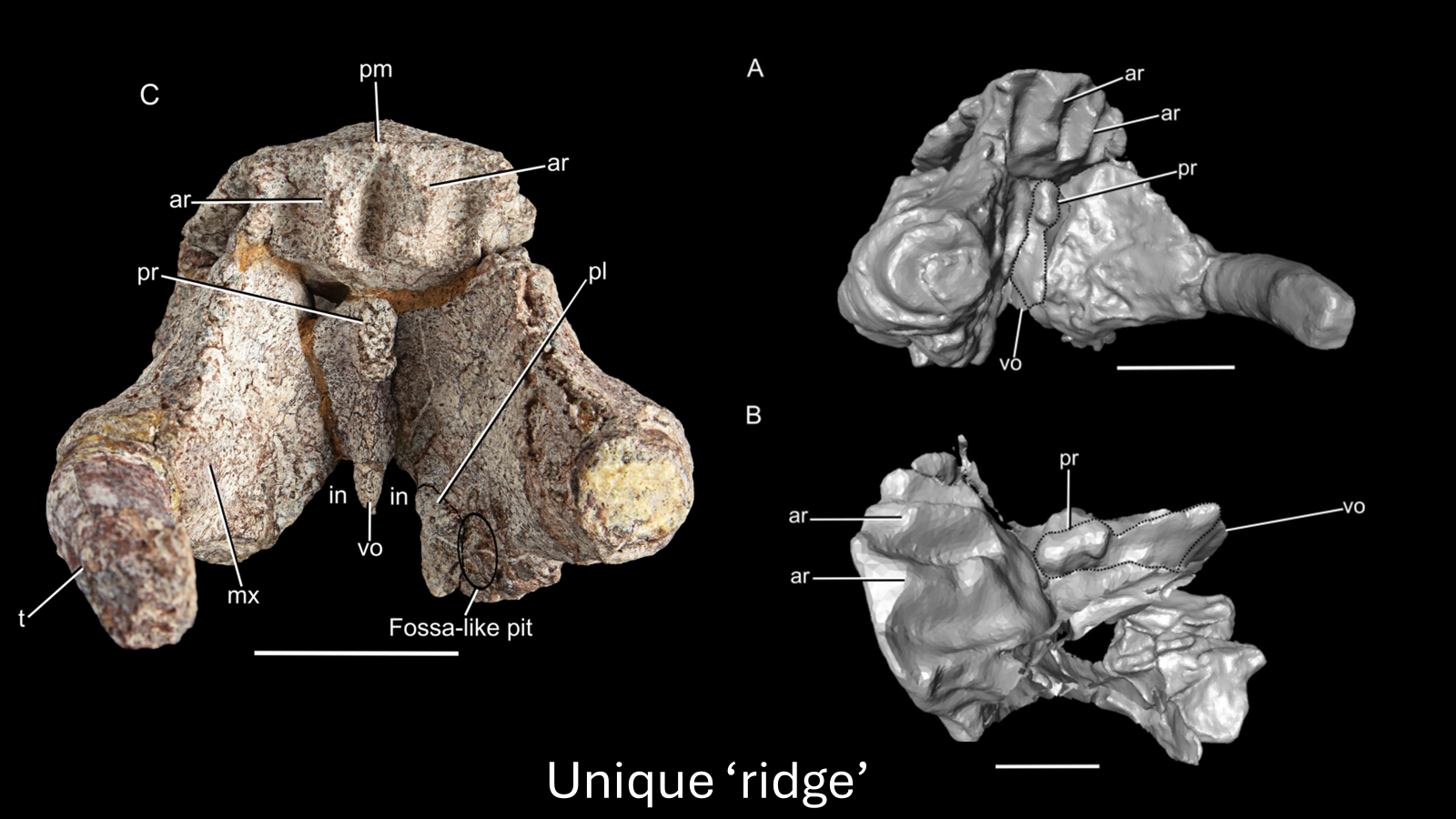 The unique palate anatomy of Dinodontosaurus isiyavamanda. Note how the ‘pr’ (posterior ridge) is bulbous rather than ridge like. Photo on left taken by Jonathan Jackson.
Juan has recently completed his PhD on the Argentinian representative of Dinodontosaurus (D. brevirostris), and few can rival his knowledge of the accursed beast. Juan suggested we shouldn’t be drawing comparisons to every single Dinodontosaurus specimen I had seen in Christian’s photos. Many were unpublished and had yet to be formally assigned to a specific species. Juan gave me a list of which ones to exclude from our comparisons, and I adjusted the taxonomic assessment accordingly. None of the official specimens of Dinodontosaurus tener had the unique palate of the Tanzanian skull. We also now know that Dinodontosaurus brevirostris isn’t a perfect match for it thanks to Juan’s 2023 paper on its lower jaw anatomy. Those are the only two established species of Dinodontosaurus and both are from South America. The former is from Brazil, and the latter is mainly from Argentina but is now also known from Brazil. This means our Tanzanian skull was not only the first record of Dinodontosaurus outside of South America, but also a new species. We can look back on this and see this as Juan correcting my mistake of drawing comparisons to unpublished specimens, but there are so many Dinodontosaurus specimens it is difficult to keep track of them. Palaeontologists are used to having one or two specimens to compare to for each species, or at least one good reference specimen (e.g. holotype, paratype, lectotype), but the convoluted history of study of Dinodontosaurus has left us with a bit of a mess. I’m not the first and won’t be the last to get headaches from this animal 240ish million years after its extinction.
That was the hardest part done, and now that we had Dinodontosaurus in Tanzania, it got me thinking about how old the rocks it’s from must be. The fossils we studied are from the same geological unit that yields the silesaur Asilisaurus and potentially also Nyasasaurus. Both of these reptiles have been argued to be the oldest dinosaurs as the unit has historically thought to be Anisian in age (the middle of the Middle Triassic). But the South American Dinodontosaurus fossils are not that old, and we know that from radiometrically dated rocks in Argentina and Brazil. The age of the Tanzanian unit was based on outdated links to units in South Africa. After compiling a very long list of fossil species in all these mentioned countries, it was evident that the Tanzanian unit can’t be that old. If we’re deciding its age based on which other unit it has the most in common with, since we can’t radiometrically date the rocks because we don’t have the right minerals, then the Tanzanian unit should be considered the same age as the South American rocks. Although on different continents (which were connected back in the Triassic) the faunas are incredibly similar. Previous researchers had suggested this based solely on the cynodonts (another group of protomammals) and in discussion of other units like that in Zambia (and also very recently based on poposauroid material, but I totally missed this paper when it was published; very silly I know), but now with Dinodontosaurus in play, the evidence is overwhelmingly in our favour. The Tanzanian unit, and its alleged oldest dinosaurs, are probable no older than end Ladinian – Carnian or late Middle Triassic to beginning Late Triassic in simpler terms. We don’t know exactly how many years we’ve shortened its age, but it’s something like 6-8, maybe 10 million years younger now.
Coming to that realisation, and convincing coauthors and later reviewers of it, has been extremely satisfying. ‘Recalibrating the origin of dinosaurs’ if you want to put it so dramatically, never got any real pushback. After I presented this at the Society of Vertebrate Palaeontology meeting of 2023, I asked curator of mammals at the Field Museum and stem-mammal expert Kenneth Angielczyk what he thought of the whole thing. His response was simply: “it’s convincing”. Ken is one of the greats we proverbially stand on the shoulders of, so that immediately became a career highlight. I may have screwed up the taxonomy repeatedly, embarrassing myself time after time, but this “bigger picture” conclusion I got right from the beginning. When I need to, I look back at this to remind myself my failures don’t define me, my successes do too, and so do the journeys I took to arrive at both.
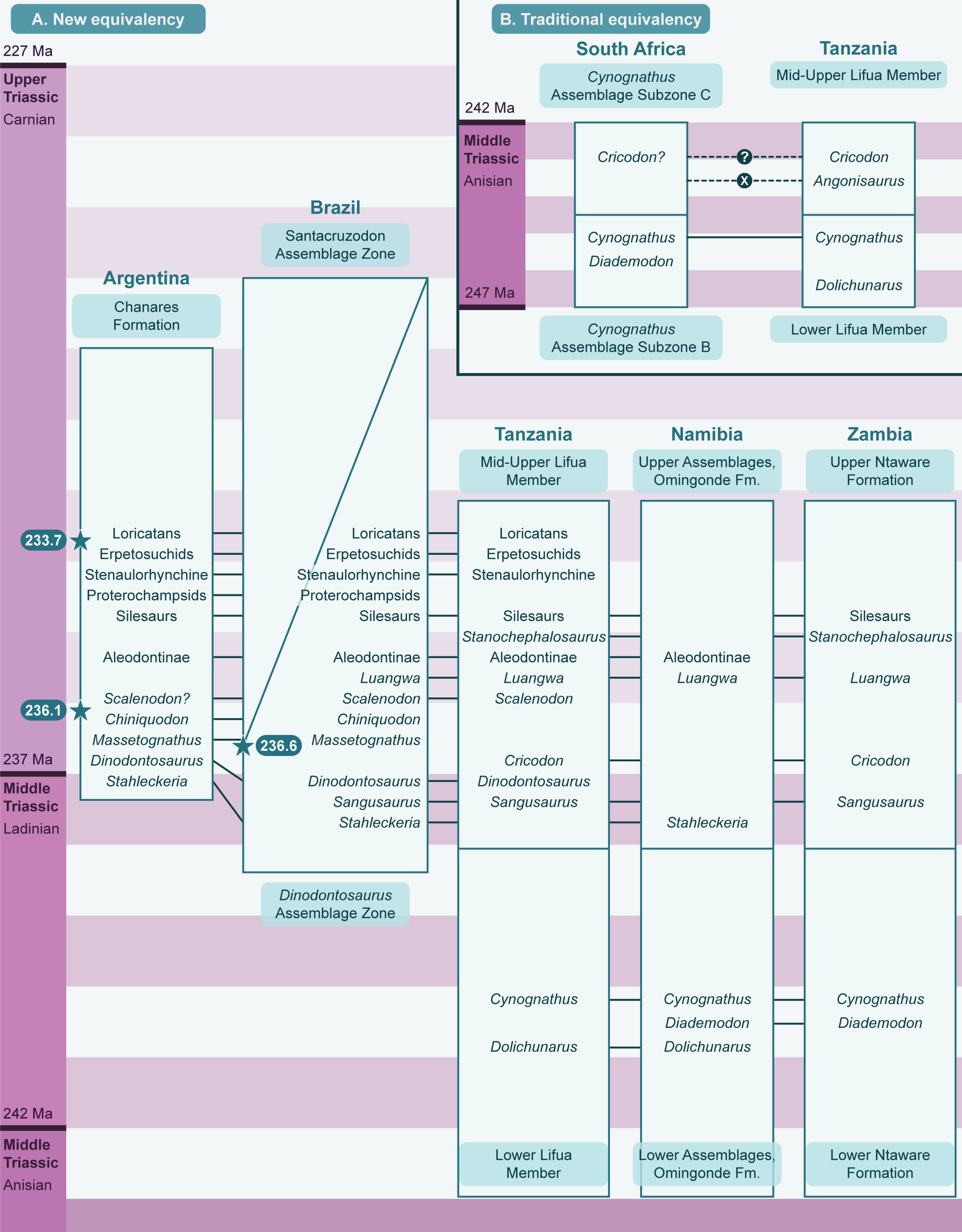 The new and traditional equivalences between Gondwanan geological units in Argentina, Brazil, Tanzania, Namibia, and Zambia. It is clear Dinodontosaurus is only one of many connections, but it is arguably one of the most important ones considering its abundance in South America. Schematic made by Science Graphic Design.
In December of 2024, a few weeks before going on Winter vacation, I submitted the work we’d done as a manuscript to Journal of Vertebrate Palaeontology. At this stage we also bolstered our taxonomic assessment with the findings me, Juan, and my friend Edmund Moody gathered from phylogenetic analyses. Juan and I handled one mathematical approach to recovering evolutionary relationships and Ed handled another two. Ed is renowned for his work on producing genealogies from genetic data, and is well known for his recent work on the reconstruction of the genome of the ancestor of all life on Earth. Dicynodont evolution is small fry to him. Together with Nigel, Mike Day who is a curator at the NHM and has played a huge role in kickstarting my career by hosting me time and again to study fossils, and Charles Saanane who is our colleague in Tanzania that helped with deriving the name of the new species, we wrote the paper.
The review process was brutal and super lengthy (submitted Dec 2024, published Sept 2026). I won’t get into all the details, but I will say it would have been much easier if we had a professor or some sort of senior academic to supervise. My coauthors were incredibly helpful, especially Mike as he’s an experienced describer of therapsids, but writing scientific papers well is an extremely difficult task to master. The reviewers and editors had a lot to say, much more about the writing than the science. There were still important comments on the science though. Christian and Ken reviewed the paper after all, and they can be incisive. I mean this in the best way. The paper was greatly improved thanks to their constructive criticism. At first Ken gave major revisions (he said ‘moderate’, but they felt ‘major’), and in the second round of review Christian gave major revisions. It was not easy, but I am grateful. I’m especially thankful for Ken pointing out that the referred specimen he collected does indeed have one of the diagnostic sutures of Dinodontosaurus, alleviating me of some of the mental pain I was suffering from. I could now say more than just a lot of technical anatomical words that basically meant ‘it looks basic’. Also, I did all this while juggling my PhD on jaw mechanics in fish and amphibians. Time management was everything, and I have sacrificed loads of my free time to get here. It was definitely worth it, but I can’t see myself undertaking such a side-project again (not to anyone’s surprise, writing a 100-page manuscript is not as fun as going out with your friends).
Once all the science was done, we had to decide on a name for this new Dinodontosaurus species. Originally, I floated the idea of naming it after Christian, but he wasn’t the biggest fan of the idea when I mentioned it to him. I totally sympathise; it is Dinodontosaurus at the end of the day. Afterwards, we thought naming it after Barry Cox would be nice. He did co-lead the expedition that found the fossil, and he had studied the Brazilian Dinodontosaurus fossils long ago. It felt appropriate to honour him for his contributions to ‘dicynodontology’ as I hoped to put it. However, at the Society of Vertebrate Palaeontology conference in 2025, Emma Dunne gave a presentation on naming fossil species in the languages of the native peoples of regions fossils are from, and we chatted about this afterward. I thought it would make more sense to instead commemorate the locals who helped with the collection of the Tanzanian skull in the 60s. Their names were never recorded so we cannot honour them individually, but we can honour them as a people. ‘Isi ya vamanda’ are the Manda words for ‘country of the Wamanda’, who are the local people of Southwest Tanzania where the fossils are from. To wrap up, that’s how we arrived at the new name. Actually registering an official name for a species of animal is super easy. It was by far the easiest part in this whole four-year ordeal. You just fill in some boxes in a website. This side-quest has both raised and humbled me, and I stand before you as someone who is half-expecting a future scientist to refute my findings and synonymise/invalidate the novel species once new data is collected, as is often the case in science, especially when this science concerns dicynodonts. Whether this happens next year or next century is a mystery, so for now, please welcome Dinodontosaurus isiyavamanda.

Hady George is a palaeontology PhD student at the University of Bristol researching jaw function across the fish-tetrapod transition among other things like dicynodonts, and seemingly always has a pop science book somewhere.
Cover art by Gabriel Ugueto
Full scientific paper here: https://tandfonline.com/doi/full/10.1080/02724634.2026.2692542
Tags: Dinosaurs, synapsid, Therapsids
















 English (US) ·
  French (CA) ·