

 1 month ago
81
1 month ago
81
Planning a trip is exciting, but creating a travel itinerary can sometimes feel like a project in itself. There are flights to compare, hotels to book, attractions to research, restaurants to consider, transportation to figure out, and a seemingly endless list of things you might want to see and do.
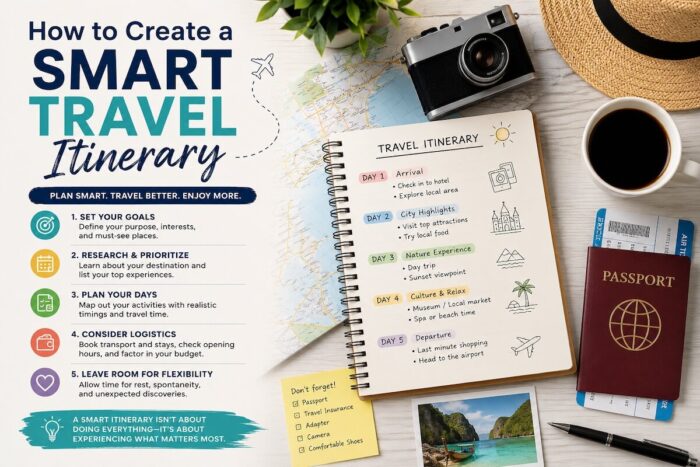
How to Create a Smart Travel Itinerary
As a travel writer and someone who regularly plans trips, I have learned that a good itinerary is not about squeezing as many attractions as possible into a single day. It is about creating a realistic plan that helps you experience a destination comfortably while still leaving room for the unexpected.
I have had trips where everything went according to plan, and I have also had days when a delayed flight, heavy rain, traffic, or a restaurant that suddenly closed completely changed my schedule. Those experiences taught me an important lesson: the best itinerary is one that gives you direction without making you feel trapped by your own schedule.
Whether you are planning your first international vacation, a weekend getaway, a family holiday, or a multi-city adventure, here is how to create a travel itinerary that is organized, realistic, and enjoyable.
1. Start by Defining What You Want From the Trip
Before researching attractions, ask yourself a simple question: What kind of trip do I want to have?
This is more important than it sounds.
Two people can visit the same destination for five days and come home with completely different experiences. One traveler may want to visit every museum and historic attraction, while another may be more interested in restaurants, shopping, nightlife, and cafés.
Perhaps you are traveling specifically for food. Maybe you want a relaxing beach vacation. You could be interested in photography, architecture, hiking, theme parks, luxury hotels, local culture, or simply experiencing everyday life in another city.
Write down your priorities before you start building the itinerary.
I usually divide them into three categories:
Must-do: Experiences I would regret missing.
Would like to do: Things I would enjoy if I had enough time.
Optional: Interesting activities that can easily be removed if the schedule becomes too busy.
This simple system prevents your itinerary from becoming a giant checklist.
For example, if you are visiting Tokyo for the first time, visiting Shibuya, Asakusa, and a few major attractions might be your priorities. But if you have already visited Tokyo several times, you might prefer spending a day exploring neighborhoods, visiting specialty cafés, shopping for local products, or taking a day trip outside the city.
Your itinerary should reflect your travel style, not somebody else’s.
2. Determine How Many Days You Actually Have
The number of days on your plane ticket is not necessarily the number of days you have available for sightseeing.
This is one of the first things I consider when planning a trip.
Suppose you fly from Manila to Seoul and arrive at 7 p.m. By the time you clear immigration, collect your luggage, travel to your hotel, check in, and have dinner, most of the evening may already be gone.
Similarly, if your return flight leaves at 9 a.m., your final day is essentially a travel day.
I therefore divide trips into:
- Full sightseeing days
- Arrival days
- Departure days
- Travel days between destinations
This gives you a much more realistic picture of how much time you have.
For a multi-city itinerary, pay particular attention to travel days. Moving from Paris to Amsterdam may take several hours of travel time, but the real time commitment includes packing, checking out, getting to the station, waiting for your train, traveling, getting to the next hotel, and checking in.
That can easily consume half a day.
3. Research Before You Start Scheduling
Once you know how much time you have, start researching the destination.
This is the fun part because you can begin discovering what makes the place interesting.
Look for:
- Major attractions
- Historic landmarks
- Museums and galleries
- Local markets
- Shopping districts
- Parks and gardens
- Beaches
- Food destinations
- Recommended restaurants
- Neighborhoods worth exploring
- Day trips
- Seasonal activities
- Festivals and events
- Local transportation
- Popular tourist experiences
At this stage, don’t worry about putting everything into a schedule.
Create a master list instead.
I often save places on a map as I research. After collecting enough destinations, I look at the map and start noticing natural clusters. That is when itinerary planning becomes much easier.
You may discover, for example, that five places you wanted to visit are all within walking distance of each other. Suddenly, what looked like five separate activities becomes one very efficient day.
4. Group Attractions by Location
If there is one itinerary-planning trick I recommend above everything else, it is this:
Group places that are close together.
Do not plan your day based solely on which attraction you want to visit first.
Think geographically.
Imagine you are visiting a large city, and your list includes a museum, a historic palace, a market, a shopping street, a restaurant, and an observation deck.
Instead of assigning them randomly to different days, consider their locations.
If the museum and palace are in the same district, visit them together. If the market and shopping street are nearby, combine them. If the observation deck is close to your evening restaurant, schedule those activities together.
This saves transportation time and, just as importantly, energy.
It also makes your trip feel more natural. Instead of constantly jumping from one part of the city to another, you can spend several hours exploring one neighborhood properly.
5. Think About Your Route
After grouping attractions geographically, create a logical route.
A typical sightseeing day might look like:
Hotel -> breakfast -> major attraction -> nearby attraction -> lunch -> neighborhood exploration -> coffee break -> sunset activity -> dinner -> hotel
You do not have to follow this structure exactly, but it gives your day a natural rhythm.
I also like starting the morning with one major attraction. This is often when I have the most energy, and popular attractions can be less crowded earlier in the day.
The afternoon can then be used for something less demanding, such as shopping, exploring a neighborhood, visiting a café, or taking photographs.
Evenings are ideal for dinner, nightlife, scenic viewpoints, or simply walking around the destination.
6. Don’t Try to See Everything
This is probably the hardest lesson for enthusiastic travelers.
When you are visiting somewhere for the first time, everything looks interesting. You see beautiful photographs online and immediately want to add another attraction to your itinerary.
Before long, you have created a schedule that runs from 7 a.m. to midnight.
It looks impressive.
It is also exhausting.
I would rather visit six places properly than rush through 15 attractions just to say I was there.
Give yourself enough time to actually experience a place.
A museum might take two hours. A historic neighborhood might deserve half a day. A famous market might be worth exploring slowly rather than treating it as a 30-minute stop.
Remember that travel is not a competition.
7. Allow Extra Time for Transportation
One of the biggest differences between an amateur itinerary and an experienced traveler’s itinerary is how transportation time is handled.
A navigation app might tell you that a destination is 25 minutes away. That does not necessarily mean the journey will take 25 minutes.
You may need to:
- Walk to the station
- Find the correct platform
- Wait for a train
- Change lines
- Walk from the station
- Find the entrance
- Navigate crowds
- Stop for photographs
- Deal with traffic
I usually add a buffer to important journeys.
This is particularly important when you have a timed reservation. If your museum entry is at 2 p.m., don’t plan to arrive at 1:55 p.m. Give yourself enough time to deal with unexpected delays.
The same principle applies to airport transfers.
 Simple Travel Itinerary Guide
8. Plan Your Accommodation Around Your Itinerary
Where you stay can have a surprisingly big impact on how much time you spend traveling.
A cheaper hotel located far from the attractions may not actually save you money if you spend hours commuting every day.
When choosing accommodation, look at:
- Location
- Access to public transportation
- Distance from major attractions
- Airport accessibility
- Restaurants and convenience stores nearby
- Neighborhood atmosphere
- Check-in and check-out times
For city trips, I often prefer staying somewhere central or near a major transportation hub.
For resort vacations, the opposite may be true. If the goal is relaxation, staying inside the resort and minimizing transportation may be exactly what you want.
Your hotel should support your itinerary rather than work against it.
9. Don’t Schedule Every Meal
I love discovering restaurants when I travel, so food is always an important part of my itinerary. But I don’t believe every meal needs to be planned weeks in advance.
Choose a few restaurants or food experiences that are genuinely important to you.
For example:
Must-try: A famous local restaurant that requires reservations.
Recommended: A neighborhood restaurant near your afternoon activities.
Flexible: Street food, cafés, markets, or casual restaurants you can decide on during the day.
This gives you a balance between planning and spontaneity.
Sometimes you discover a restaurant while walking around that looks much more interesting than the one you had originally planned. Leave yourself enough flexibility to change your mind.
10. Make Reservations When They Matter
While you shouldn’t reserve everything, certain experiences should be booked in advance.
These can include:
- Popular restaurants
- Theme parks
- Special exhibitions
- Guided tours
- Popular attractions
- Observation decks
- Scenic trains
- Limited-entry experiences
- Special events
Put these reservations into your itinerary first.
Everything else can be built around them.
For example, if you have a restaurant reservation at 7 p.m., you can spend the afternoon exploring attractions nearby instead of scheduling something on the opposite side of the city.
11. Check Opening Hours and Closed Days
Never assume an attraction is open simply because it appears on a travel website.
Check its official operating hours whenever possible.
Museums may close on Mondays. Markets may operate only on certain days. Restaurants can have irregular schedules. Attractions may also close temporarily for maintenance.
Seasonal changes are another consideration.
Some destinations have shorter operating hours in winter, while others may have extended hours in summer or during peak tourist periods.
Before finalizing your itinerary, verify the places that matter most.
A five-minute check can prevent a wasted afternoon.
12. Plan Around Your Energy Level
This is something many travel itineraries completely ignore.
You may technically have enough hours to visit six attractions, but do you realistically have the energy to do it?
Walking 15 to 20 kilometers every day sounds manageable when you are sitting at home planning your trip. It feels very different when you have already spent six hours sightseeing.
Try alternating busy periods with lighter ones.
For example:
Day 1: Arrival + light sightseeing
Day 2: Major sightseeing day
Day 3: Day trip
Day 4: Relaxed neighborhood exploration
Day 5: Shopping + flexible activities
This is especially useful on longer trips.
A slower day can actually make the rest of your vacation more enjoyable.
13. Build in Free Time
Some of the best travel experiences are the ones that were never planned.
Maybe you find a beautiful café while walking through an unfamiliar neighborhood. Perhaps you discover a local market or stumble upon an interesting bookstore. You may simply want to sit somewhere and watch the city go by.
These moments are difficult to schedule—and that is exactly why you should leave room for them.
I recommend keeping at least a few hours of free time during longer trips.
Think of free time as part of your itinerary rather than a gap in it.
14. Consider the Weather
Weather can completely change a travel plan.
If you are visiting during the rainy season, don’t build an entire day around outdoor activities.
Instead, create alternatives.
For example:
Plan A: Walking tour + outdoor attraction + scenic viewpoint
Plan B: Museum + café + shopping + indoor attraction
This approach is particularly useful for destinations where weather can change quickly.
Check the forecast before leaving your hotel each morning, and make small adjustments as needed.
A good itinerary should be flexible enough to respond to the weather.
15. Create a Backup Plan
Weather isn’t the only thing that can disrupt your schedule.
Flights get delayed. Trains are canceled. Attractions reach capacity. Restaurants close unexpectedly. You may simply wake up and realize you are too tired to follow your original plan.
Don’t panic.
Have a few backup activities in each destination.
For example, if your outdoor activity is canceled, you might visit a museum, a shopping center, a food market, or a café instead.
You don’t need a second itinerary that is as detailed as your main one. Just keep a list of alternatives nearby.
16. Include a Travel Budget
An itinerary is also an excellent place to keep track of your expected expenses.
Estimate costs for:
- Flights
- Hotels
- Airport transfers
- Local transportation
- Attractions
- Food
- Tours
- Travel insurance
- Internet or eSIM
- Shopping
- Miscellaneous expenses
For Filipino travelers, I find it useful to keep the destination’s local currency alongside an approximate PHP conversion.
For example:
Train: JPY 500 / approximately PHP equivalent
Lunch: JPY 1,500 / approximately PHP equivalent
You don’t need to calculate every expense perfectly. The goal is simply to know whether your daily spending is within your budget.
17. Add Important Booking Details
Your itinerary should function as a travel reference document, not just a sightseeing schedule.
Include:
- Flight numbers
- Departure and arrival times
- Hotel names
- Hotel addresses
- Reservation numbers
- Train bookings
- Tour details
- Attraction tickets
- Restaurant reservations
- Airport transfer information
For international travel, also keep digital copies of your passport, travel insurance, and other important documents in a secure location.
Having everything together can be extremely helpful when you are tired, rushing through an airport, or trying to find a reservation confirmation on your phone.
18. Don’t Forget Travel Days Between Cities
Multi-city trips require additional planning.
Suppose you are visiting three cities over 10 days. It may be tempting to think:
City A — 3 days
City B — 3 days
City C — 4 days
But those numbers don’t account for transportation.
A better approach is to identify your actual usable sightseeing hours.
If you leave City A at 9 a.m. and arrive in City B at 2 p.m., you probably won’t have a full sightseeing day in City B.
Consider the entire door-to-door journey.
This is why I often recommend staying longer in fewer destinations rather than constantly changing hotels.
19. Keep Arrival and Departure Days Simple
Arrival day is rarely as productive as it looks on paper.
After a long flight, you may be tired, hungry, jet-lagged, and dealing with luggage.
Instead of scheduling a major attraction immediately after checking into your hotel, consider exploring the surrounding neighborhood.
Have dinner nearby. Take a short walk. Buy essentials. Get some rest.
Departure day should be even simpler.
Don’t plan an important sightseeing experience several hours away from the airport just because your flight isn’t until late afternoon.
Give yourself a comfortable buffer.
Missing a final attraction is much better than missing your flight.
20. Make the Itinerary Easy to Read
A travel itinerary does not need to be complicated.
In fact, the simpler it is, the more useful it becomes.
I prefer organizing each day into:
Morning
Main activity or attraction
Lunch
Restaurant or neighborhood
Afternoon
Second major activity
Evening
Dinner, shopping, nightlife, or free time
You can add transportation details underneath each section.
This format works particularly well on a phone because you can quickly see what you are supposed to be doing without scrolling through a huge paragraph.
21. Use a Color-Coded or Priority System
If you are creating a detailed itinerary, consider assigning priorities.
For example:
A — Must do
B — Should do
C — Optional
If your schedule gets disrupted, remove the C activities first.
You can also separate activities into categories such as:
- Sightseeing
- Food
- Shopping
- Transportation
- Reservations
- Free time
This is especially useful for longer trips.
22. Leave Room for Spontaneity
This may sound contradictory after all this talk about planning, but it is one of the most important points.
You don’t travel simply to complete an itinerary. You travel to experience a place.
If a neighborhood is more interesting than expected, stay longer.
If you find an amazing restaurant, enjoy the meal instead of rushing to the next attraction.
If you are exhausted, go back to the hotel.
If you suddenly hear about an interesting local event, change your plans.
A good itinerary should serve you—not the other way around.
A Sample Travel Itinerary
Here is an example of how I would structure a five-day city trip.
Day 1 — Arrival and Easy Exploration
Morning: Flight and arrival
Afternoon: Airport transfer, hotel check-in, and rest
Late afternoon: Explore the neighborhood around the hotel
Evening: Dinner at a nearby restaurant
The first day is intentionally light. After a long journey, there is little value in rushing immediately to the major attractions.
Day 2 — Major Sightseeing
Morning: Visit the city’s most important landmark
Late morning: Explore nearby historic attractions
Lunch: Local restaurant in the area
Afternoon: Museum or cultural attraction
Late afternoon: Coffee break
Evening: Shopping or scenic viewpoint
Dinner: Restaurant reservation
This is your main sightseeing day, so you can be more ambitious with your schedule.
Day 3 — Neighborhood Exploration
Morning: Local market and breakfast
Late morning: Walking tour
Lunch: Local specialty
Afternoon: Shopping and cafés
Evening: Free time
This type of day lets you experience the destination at a slower pace.
Day 4 — Day Trip
Morning: Early departure
Late morning: Explore day-trip destination
Lunch: Local restaurant
Afternoon: Continue sightseeing
Evening: Return to the city
Keep the evening flexible because you may be tired after a full day outside the city.
Day 5 — Shopping and Departure
Morning: Breakfast and check-out
Late morning: Shopping or final sightseeing near the hotel
Lunch: Final meal
Afternoon: Airport transfer
Evening: Flight home
This schedule allows for delays and avoids putting unnecessary pressure on your final day.
Common Travel Itinerary Mistakes to Avoid
Even experienced travelers can fall into the same planning traps.
Trying to See Everything
You don’t need to visit every attraction. Choose the experiences that matter most to you.
Ignoring Distance
Always check the actual distance between destinations rather than assuming places are close because they are in the same city.
Scheduling Too Many Activities
If every hour is accounted for, you have no room for delays, meals, photographs, or unexpected discoveries.
Forgetting Rest
Travel is physically demanding. Schedule downtime.
Booking Too Many Fixed Activities
Having multiple reservations every day can make your vacation feel like a business conference.
Ignoring Opening Hours
Always verify operating schedules before adding attractions to your itinerary.
Forgetting Travel Time
Transportation should always be included in your planning.
Changing Hotels Too Often
Constantly packing and unpacking can consume more time than you realize.
Not Having a Backup Plan
Always have an alternative when an important outdoor or weather-dependent activity is involved.
Making the Itinerary Too Rigid
A schedule should guide you, not dictate every minute of your vacation.
My Approach to Creating a Travel Itinerary
After planning countless trips, my approach has become relatively simple.
First, I make a list of everything I want to see, eat, photograph, and experience.
Then I put all those places on a map.
Next, I group them geographically.
After that, I identify the activities that require reservations and build the rest of the itinerary around those fixed commitments.
I then add transportation time, meals, rest periods, and free time.
Finally, I look at the itinerary and ask one question:
Does this actually sound like a fun vacation?
If the answer is no, I remove something.
That final step is important. An itinerary can be efficient and still be exhausting. The purpose of planning is to make travel easier—not to create another source of stress.
Final Thoughts
Creating a travel itinerary is part research, part organization, and part common sense. You need enough planning to make the trip run smoothly, but enough flexibility to allow the destination to surprise you.
Start by identifying your priorities. Decide how much time you really have. Group attractions by location, consider transportation, make reservations for the experiences that matter most, and leave room for meals, rest, weather changes, and unexpected discoveries.
Most importantly, don’t confuse a busy itinerary with a good itinerary.
A successful trip isn’t measured by how many attractions you checked off your list. It is measured by how much you enjoyed the experience.
Plan the important details, give yourself breathing room, and don’t be afraid to change your plans once you arrive. Some of the most memorable travel experiences happen between the lines of the itinerary.
Follow and subscribe to OutofTownBlog.com on Facebook, Twitter, Instagram, Pinterest, and YouTube for more Travel-related updates.
Read:


















 English (US) ·
  French (CA) ·