

PROTECT YOUR DNA WITH QUANTUM TECHNOLOGY
Orgo-Life the new way to the future Advertising by AdpathwayHighlights
- Phobos and Deimos are the two small, rocky moons that orbit Mars.
- Mars and Earth are the only rocky planets in the Solar System with moons.
- PlanetVac, a sample collection tool crowdfunded by The Planetary Society, will help bring back pieces of Phobos as part of Japan’s Martian Moons eXploration (MMX) mission.
Small, irregular, fleeting
Mars is the Roman god of war, corresponding to the Greek god Ares. In myths, this god had two sons: Phobos, the personification of fear and panic, and Deimos, who embodied terror and dread. In 1877, when the two moons were discovered, they were given those fearsome names.
Closest to the red planet is Phobos, a rocky moon that is too small to have been shaped into a sphere by its own gravity. This gives it an irregular, lumpy shape, with dimensions of roughly 27 by 22 by 18 kilometers (17 by 14 by 11 miles) — about the size of a major city on Earth.
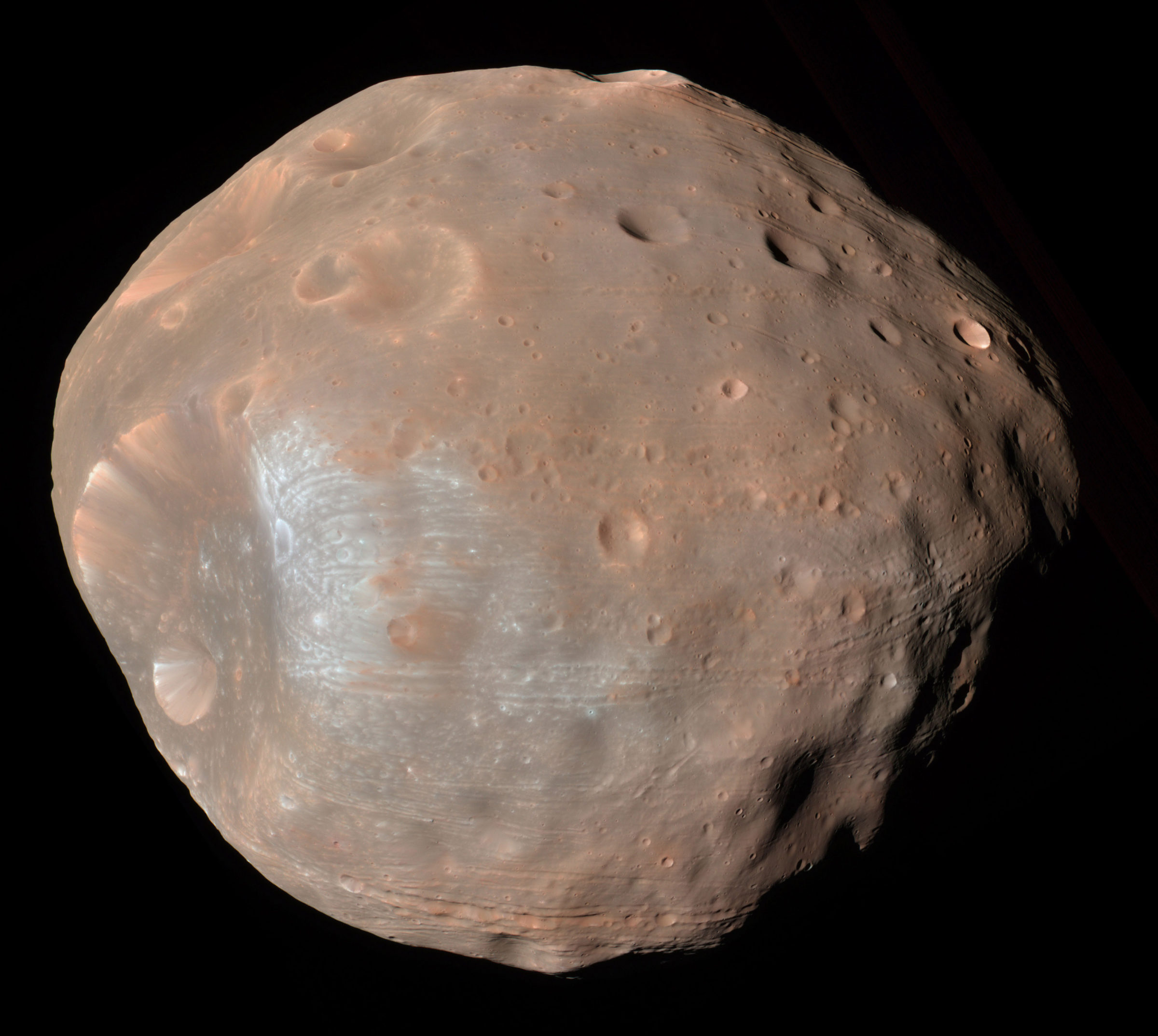 Color view of Phobos from Mars Reconnaissance Orbiter NASA's Mars Reconnaissance Orbiter approached to within 6,800 kilometers (4,200 miles) of Phobos to capture this enhanced-color view of the Martian moon on March 23, 2008.Image: NASA / JPL / U. Arizona
Phobos orbits at an average distance of 5,989 km (3,721 miles) above the Martian surface. This is the closest orbit of any moon in the Solar System. Phobos is also getting closer all the time, being gradually pulled in by Mars’ gravity. It only gets 2 centimeters (about 0.8 inches) closer per year, but that adds up: in roughly 30 to 50 million years, Phobos is expected to get close enough for Mars’ gravity to rip it apart, causing debris from the moon to land on Mars and possibly form a ring around the planet.
Deimos is about half the size of Phobos, measuring about 15 by 12 by 11 kilometers (9 by 7 by 6.8 miles). It orbits Mars at an average distance of 23,460 kilometers (14,580 miles). Unlike Phobos, which is getting closer to Mars, Deimos’ orbit is slowly getting larger. It is expected to eventually break free from Mars’ gravitational pull and become categorized as an asteroid orbiting the Sun.
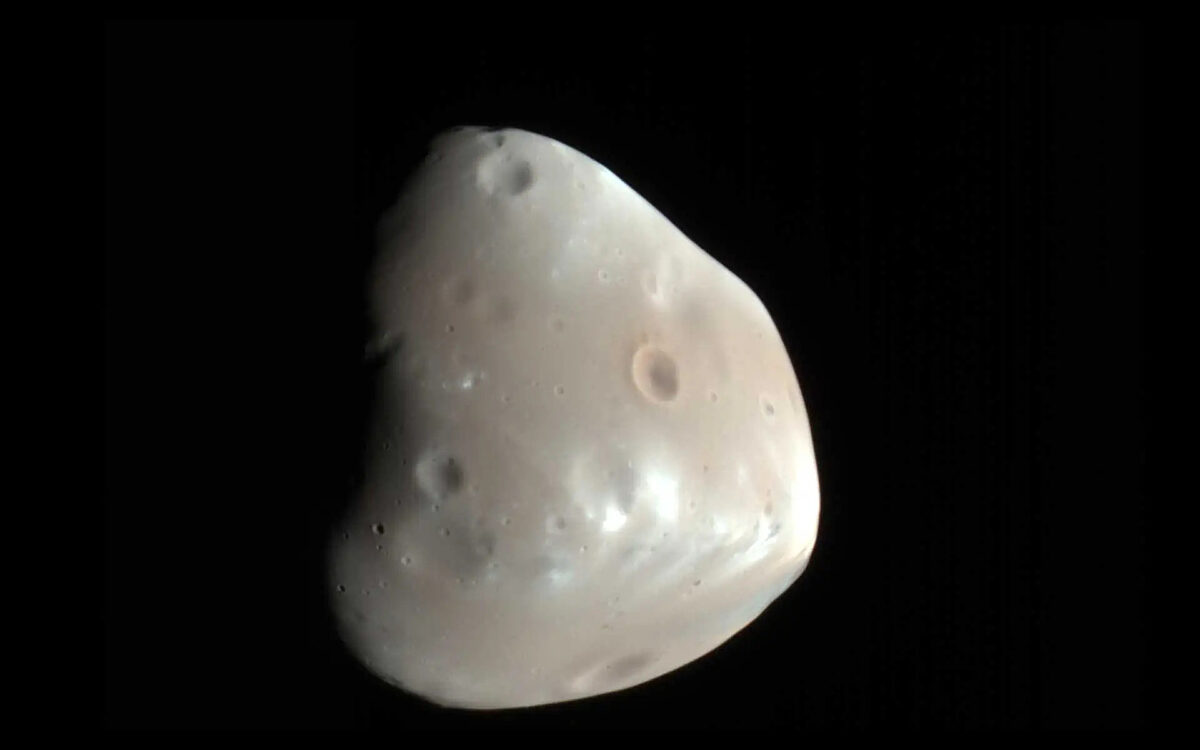 Deimos from MRO This enhanced-color image of Deimos, the smaller of the two moons of Mars, was taken on Feb. 21, 2009. The image was taken by HiRISE (High Resolution Imaging Science Experiment) on NASA's Mars Reconnaissance Orbiter.Image: NASA/JPL-Caltech/University of Arizona
Why explore Phobos and Deimos?
The Martian moons may seem small and unremarkable compared to larger, more dynamic worlds. But they hold mysteries that could shed light on the history of the entire inner Solar System, including how Earth may have gotten its water.
Mars is the planet that humans have sent the most spacecraft to study. Many of these missions also observed Phobos and Deimos, including NASA's Mariner 9, Viking, and Mars Reconnaissance Orbiter missions, ESA's Mars Express, India's Mars Orbiter Mission, and others. Despite all this study, the origins of these moons remain unknown.
The main hypotheses are that Phobos and Deimos were asteroids from the outer Solar System that were captured by Mars’ gravity, that they both formed from the disruption of a single parent body, or that they accreted from debris left over from the formation of Mars. There is evidence that could support each hypothesis, and both all implications for how the inner Solar System formed.
This mystery is one of the motivations behind the Martian Moons eXploration (MMX) mission, which aims to launch as soon as November 2026.
Led by the Japan Aerospace Exploration Agency (JAXA) with contributions from NASA, the European Space Agency, and the French and German space agencies, MMX will travel to Phobos to observe its topography, internal structure, composition, and gravity. Most remarkably, it will collect samples of rock and sand and return them to Earth for further study. To perform the first-ever sample collection from a Martian moon, MMX will employ two sample collection devices, including PlanetVac, a technology that Planetary Society supporters helped enable by funding tests in 2013 and 2018.
MMX is expected to return samples from Phobos to Earth in 2031. Analysis in full-scale laboratories could shed light on the origins of the samples. If Phobos is a captured asteroid, there should be substantial water and organic materials like we find on similar small worlds. If the Martian moon accreted from material leftover from the planet’s formation, the heat and energy created during that process should have removed most traces of water.
MMX will also be a technology demonstration mission — perhaps contributing to future missions to bring samples home from the red planet itself.
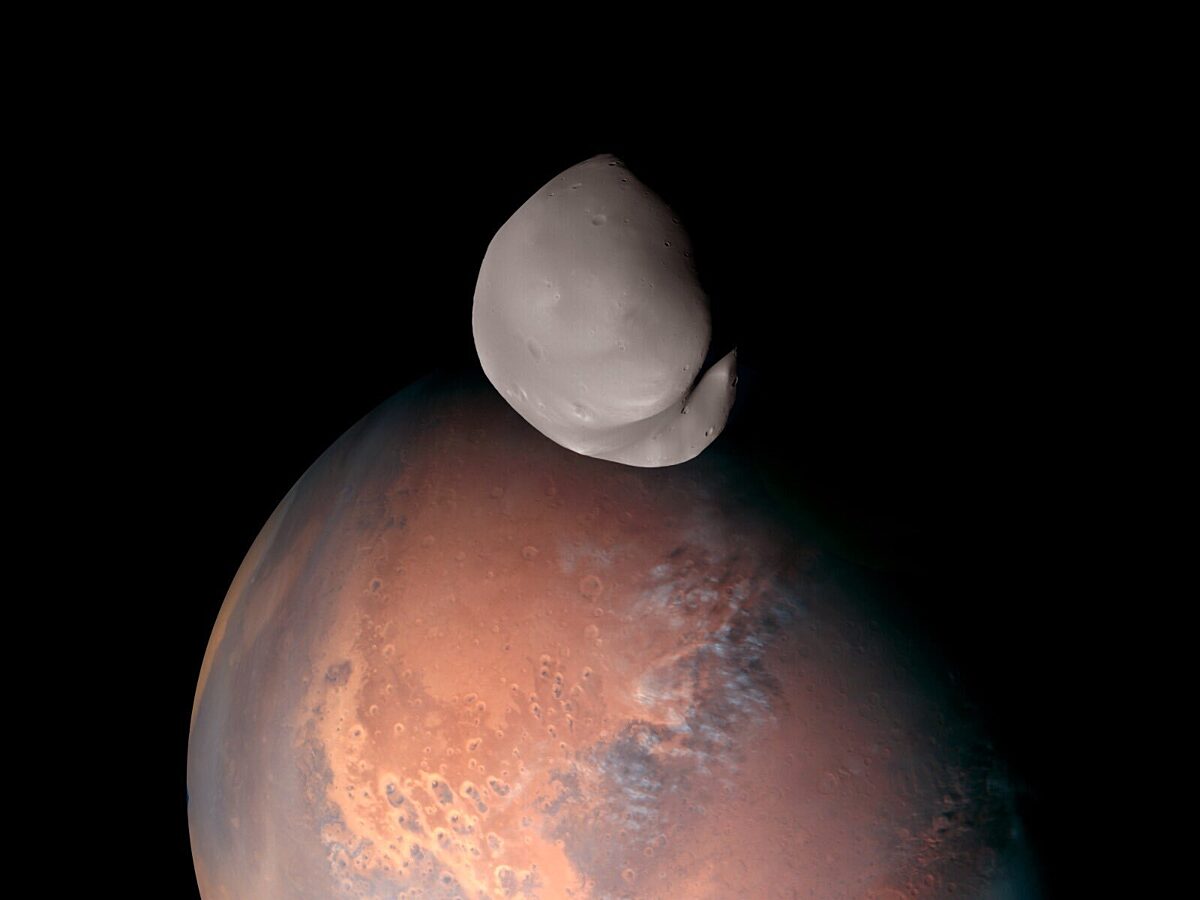 Deimos over Mars The United Arab Emirates Space Agency's Hope Mars Mission captured this view of Deimos over Mars during a flyby on March 10, 2023.Image: Emirates Mars Mission

Account Center • Contact Us • Privacy Policy


Give with confidence. The Planetary Society is a registered 501(c)(3) nonprofit organization.
© 2026 The Planetary Society. All rights reserved.
Cookie Declaration



















 English (US) ·
  French (CA) ·