

PROTECT YOUR DNA WITH QUANTUM TECHNOLOGY
Orgo-Life the new way to the future Advertising by AdpathwaySpace Snapshot

These images of the Cat’s Head Nebula, a region of gas and dust within the larger Carina Nebula, roughly 7,500 light-years away, show the different perspectives of the James Webb Space Telescope and the Hubble Space Telescope. The left image was taken by HST at visible wavelengths, while the middle and right images were taken by JWST at near- and mid-infrared wavelengths, respectively. Want to see more beautiful sights like this? Vote on this year’s best space exploration image in our Best of 2026 awards! Image credit: NASA & ESA.
Fact Worth Sharing

The Carina Nebula hosts a star, Eta Carinae, that briefly became the second brightest star in the sky in 1843. An eruption was involved, but it was not a supernova, and astronomers have yet to reach a consensus on exactly what caused the increase in brightness.
Mission Briefings


The U.S. election flipped control of Congress from Republicans to Democrats. Jack Kiraly, chief of advocacy at The Planetary Society, led a webinar discussion on Nov. 4 to unpack how the midterm election results might affect U.S. space policy, including who’ll be on the committees that oversee and fund NASA. Image credit: Andy Withers.

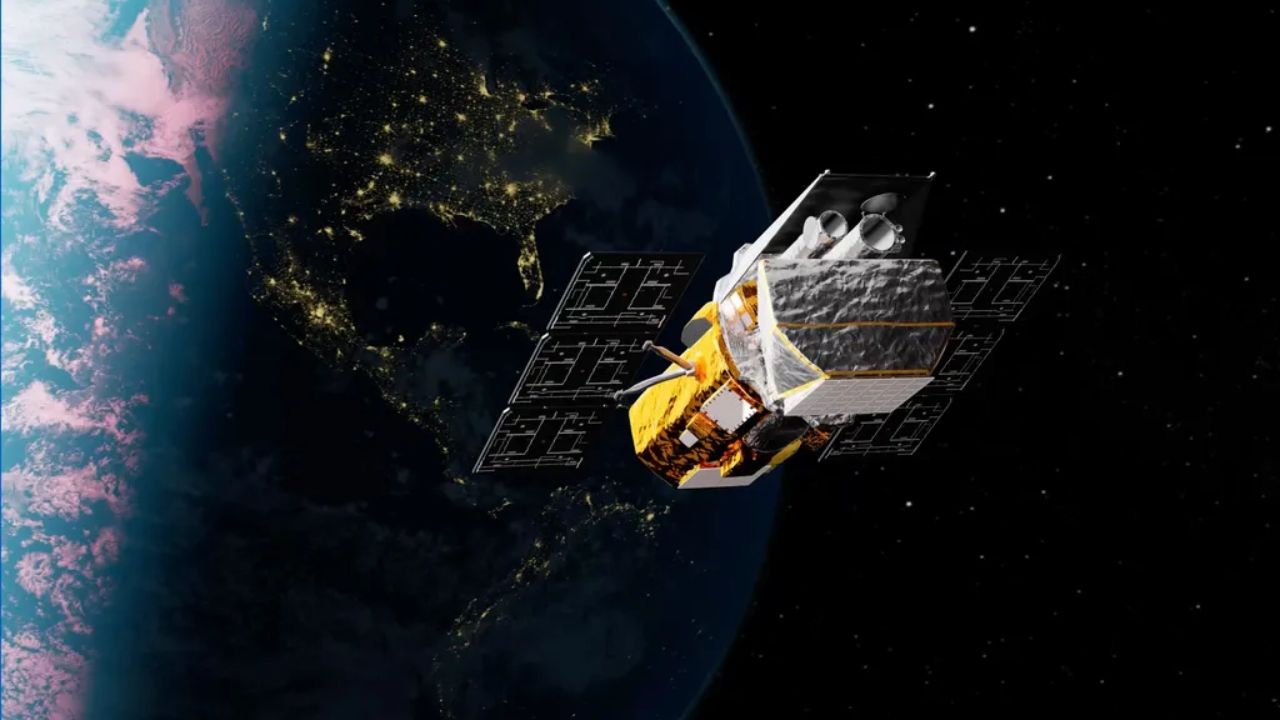
NASA’s Neil Gehrels Swift Observatory re-entered Earth’s atmosphere. On Wednesday, Nov. 4, after over 20 years of science operations, atmospheric drag finally brought the space telescope down, burning up as it entered the atmosphere. Earlier this year, a mission to reboost the gamma-ray burst observatory to a safer orbit was unsuccessful.

China announced how it plans to land taikonauts on the Moon. Last weekend, the chief designer of the Chinese lunar exploration program outlined a strategy in which a lunar lander and crew spacecraft will launch separately and dock in lunar orbit, after which two taikonauts will take the lander down to the Moon and back.
From The Planetary Society


102 years ago, Edwin Hubble discovered that galaxies exist beyond the Milky Way. On this week’s Planetary Radio, learn about the significance of this discovery and the push for the designation of Oct. 5 as National Beyond the Milky Way Day. Pictured: Edwin Hubble’s original glass photographic plate of the Andromeda Nebula, imaged with the 100-inch Hooker Telescope at Mt. Wilson Observatory. Image credit: Sarah Al-Ahmed / The Planetary Society. Plate courtesy of Carnegie Science.
The Planetary Society is hiring a Community Organizer. As part of our Space Policy and Advocacy team, this new role will help build a powerful network of advocates to scale up the Society's grassroots movement for the scientific exploration of space. Applicants must be authorized to work in the United States.
Two of our leaders have won a major award. At its conference last week, the American Astronomical Society's Division for Planetary Sciences presented Casey Dreier, our chief of space policy, and Jack Kiraly, our chief of advocacy, with the 2026 Harold Masursky Award for exceptional service to planetary science and space exploration. In their acceptance speech, Kiraly announced the date of our next Day of Action in Washington, D.C.: Jan. 31 to Feb. 1.
Celebrate Voyager 1’s one light-day milestone with us! This month, NASA’s Voyager 1 will become the first human-made object to travel one light-day from Earth. Join us on Nov. 18 at 8:00 p.m. ET for a special livestream in our online member community and on YouTube. Voyager Project Manager Suzanne Dodd, Mission Manager Kareem Badaruddin, and Project Scientist Linda Spilker of NASA’s Jet Propulsion Laboratory will share stories from their decades on the mission. Renowned space artist Don Davis will also join us to reveal a new work commemorating this tremendous achievement. Stay tuned for more details.
What's Up

This week, look for yellowish Saturn well-placed in the evening sky. Later in the night and toward the pre-dawn, find bright Jupiter and reddish Mars very near one another to the east. Venus also appears low in the east shortly before sunrise. Find out what else to look for in November’s night skies.
Wow of the Week

Send your name to Titan! When NASA’s Dragonfly mission launches in 2028 to Titan, a moon of Saturn, it will carry a chip carrying the names of everyone who signs up through this online form. Hundreds of thousands of people have already put their names down. Image credit: NASA/The Planetary Society.
Send us your artwork!
We love to feature space artwork in the Downlink. If you create any kind of space-related art, we invite you to send it to us by replying to any Downlink email or writing to [email protected]. Please let us know in your email if you’re a Planetary Society member!

Empowering the world's citizens to advance space science and exploration.
Account Center • Contact Us • Privacy Policy

Give with confidence. The Planetary Society is a registered 501(c)(3) nonprofit organization.
© 2026 The Planetary Society. All rights reserved.
Cookie Declaration



















 English (US) ·
 French (CA) ·