

 4 hours ago
3
4 hours ago
3
PROTECT YOUR DNA WITH QUANTUM TECHNOLOGY
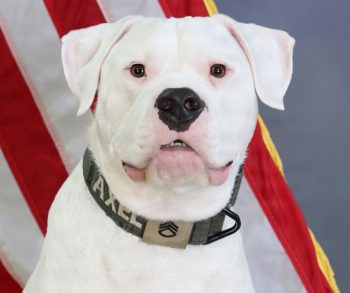
Orgo-Life the new way to the future Advertising by AdpathwayAxel cannot hear boots hitting the ground, engines roaring to life, or voices calling across a busy training field. Yet the 3-year-old Dogo Argentino has found another way to connect with the soldiers around him, relying on watchful eyes, carefully learned hand signals, and an extraordinary bond with his handler. Once surrendered to a shelter because he was deaf, Axel now serves with the Michigan National Guard as a ministry dog and is preparing to deploy alongside the 1st Battalion, 125th Infantry Regiment. His journey has transformed an uncertain beginning into a life filled with purpose, companionship, and service.
 Credit: Facebook
Axel has learned more than 50 hand signals and visual commands, including several based on American Sign Language, according to the Michigan National Guard. His handler, Sgt. Mollie Karazim adapted his training around his deafness, teaching him to look for visual guidance rather than waiting for spoken instructions.
His job is also very different from the work performed by military dogs trained for patrol or detection. Axel’s role centers on supporting the emotional and spiritual well-being of soldiers, offering a calming presence during demanding periods of training and deployment.
From Shelter Puppy to Ministry Dog
Axel’s path to military life began far from a National Guard training field. His previous owners surrendered him to a shelter as a puppy after discovering that he was deaf, leaving his future uncertain at an especially vulnerable age.
Karazim saw something more in him. When she adopted Axel, she understood that communicating with a deaf puppy would require patience and a willingness to approach training differently. Instead of treating his deafness as something that would determine what he could not do, she focused on discovering how he learned best. Their relationship gradually became the foundation of everything Axel would accomplish.
Because he cannot rely on his handler’s voice, Axel must watch Karazim closely and trust the signals she gives him. Karazim has described that trust as essential to their partnership, something they have developed through years of consistent communication and shared experiences.
That connection becomes especially important in unfamiliar environments. Axel needs to remain aware of Karazim even while surrounded by people, vehicles, movement, and countless visual distractions.
Karazim’s own military journey helped create the opportunity for Axel. When she joined the Michigan National Guard seven years ago, she initially hoped to become a canine handler. Because that position was not available in Michigan at the time, she became a religious affairs specialist instead.
In that role, she works alongside chaplains to help address soldiers’ spiritual and emotional needs. Eventually, she found a way to combine her interest in working with dogs with the support work she was already doing.
Axel appeared to have many of the qualities needed for that unusual assignment. Karazim described him as loving, loyal, and comfortable with an active lifestyle, characteristics that could help him adjust to life around an infantry battalion.
Still, she did not assume that he would automatically thrive in a military setting. As Axel matured, she carefully observed how he handled unfamiliar situations and whether he could comfortably interact with the soldiers he might eventually support.
Over the past year, those soldiers have become part of Axel’s everyday world. He has attended drill weekends, traveled in Humvees, spent time in the field, and interacted with service members throughout the battalion.
When Axel is working, he wears a dedicated vest and collar indicating that he is on duty. The gear helps soldiers understand that although he may be friendly and approachable, he is there for a specific purpose. That purpose can sometimes begin with something as simple as getting someone to smile.
Karazim has described Axel as an “icebreaker” who helps create connections with soldiers she might otherwise have difficulty reaching. Some service members may hesitate to immediately discuss stress, uncertainty, or personal struggles with another person, but approaching a friendly dog can feel much easier.
Axel can help create that opening without asking anything in return. A soldier might stop to greet him, spend a quiet moment beside him, or begin talking with Karazim after an interaction that started with the dog.
Those seemingly small encounters can become meaningful during demanding training schedules and periods of uncertainty. Axel’s calm companionship gives soldiers another way to connect with the people responsible for supporting their emotional and spiritual needs.
Preparing him for deployment, however, has required far more than simply getting him comfortable around soldiers. According to the Guard, Axel has completed extensive training and specialized courses. Karazim has also had to ensure their visual communication remains dependable in environments filled with movement and distractions.
Clear hand signals, attention cues, and familiar routines help Axel understand what is expected of him. In places that may feel chaotic to everyone else, his ability to focus on his handler becomes especially valuable.
Much of the financial investment in Axel’s care and training has come from Karazim herself. Her commitment reflects the years of work behind his transformation from a surrendered puppy into a dog trusted to accompany an infantry battalion.
Axel’s contribution is not determined by a soldier’s rank or job. His role is simply to be present and help make emotional and spiritual support feel more approachable.
Military ministry and chaplain programs often involve listening, comforting, and supporting service members through difficult or uncertain moments. Axel adds another layer to that work. His presence can encourage someone to stop for a moment, smile, relax, or begin a conversation.
An Important Asset
Karazim has called the experience “incredibly rewarding” and described Axel as an important asset to the ministry. She has also said he has a way of making people light up, a remarkable outcome for a dog whose earliest circumstances offered no guarantee of what his future might become.
His deafness remains part of who he is, but it has not prevented him from learning, adapting, or forming deep connections. Instead, Axel and Karazim developed their own language built around observation, consistency, and trust. Now the puppy, once surrendered after losing the home he knew, has become a familiar face among soldiers preparing to serve far from their homes.
As Axel prepares to deploy alongside the 1st Battalion, 125th Infantry Regiment, his story shows how dramatically an animal’s path can change when someone recognizes potential where others may see limitations. From shelter kennels to Humvee rides and training fields, Axel has found a place where his quiet presence can mean something deeply personal.
He may never hear the sounds surrounding the soldiers he serves, but he does not need to. Through every hand signal, reassuring interaction, and moment spent beside them, Axel has learned a language that reaches people in an entirely different way.
This content was created with AI assistance and edited by the iHeartDogs team.




















 English (US) ·
  French (CA) ·