

 44 minutes ago
1
44 minutes ago
1
PROTECT YOUR DNA WITH QUANTUM TECHNOLOGY
Orgo-Life the new way to the future Advertising by AdpathwayReform UK denies wrongdoing, and says it will cooperate fully with police inquiry
Reform UK has said it will cooperate fully with the Metropolitan police investigation, the Press Association reports.
A Reform UK spokesperson said:
Reform UK denies any wrongdoing and will fully cooperate with the investigation.
We won’t be commenting further while a live investigation is under way.
Key events
Afternoon summary
-
The Met police will investigate allegations that Reform UK broke electoral law relating to overseas donations as part of a wider inquiry. Commenting on the news, Bridget Phillipson, the Labour chair, said:
Nigel Farage and Reform must stop the desperate deflection tactics and come clean with the police and the British public about their dodgy finances. No stone can be left unturned in getting to the truth over these incredibly serious allegations.
-
The leaders of the Progressive Judaism movement in the UK have stressed that Sir Ephraim Mirvis, the chief rabbi, did not speak for all British Jews when he condemned the sanctions against Israeli settlements announced by the government yesterday. In a statement, Rabbi Josh Levy and Rabbi Charley Baginsky, co-leaders of the Movement for Progressive Judaism, declined to condemn the government’s move. They said:
Holding an Israeli government accountable for its actions does not cause antisemitism. Antisemites cause antisemitism. They may seize upon Israel, Zionism or the actions of an Israeli government as an excuse, but responsibility for their hatred remains theirs. Palestinian rights and international accountability cannot be made contingent upon the good behaviour of antisemites.
The vulnerability of British Jews must not be ignored. Antisemitism is real, dangerous and sometimes deadly. Jewish schools require guards, synagogues are attacked and Jewish people are frightened to identify themselves in public. Policies directed at Israel can affect Jews far beyond it, whatever their stated intention, and language about Israel can carry antisemitic assumptions. We must confront that without equivocation.
But measures directed at Israeli settlements are not the same as an attack on Jews. We should take care not to collapse the distinction between them.
Ed Miliband also said he did not agree with Mirvis’s comments yesterday. (See 8.55am.)
For a full list of all the stories covered on the blog today, do scroll through the list of key event headlines near the top of the blog.
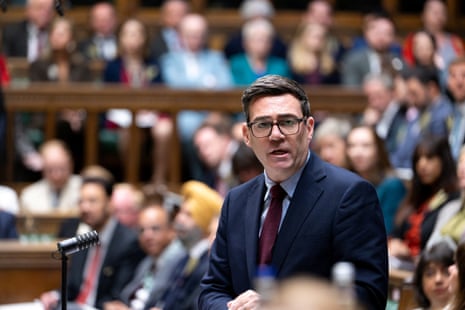
Voters back ban on imports of goods from Israeli West Bank settlements by 3 to 1, poll suggests
YouGov has published polling that helps to explain why Kemi Badenoch did not raise the sanctions on Israeli settlements at PMQs today. (See 1.51pm.) The poll suggests that, by a margin of three to one, people are more likely to approve of the government’s decision (52%) than disapprove of it (17%).
But almost a third of respondents told YouGov they did not have a view.
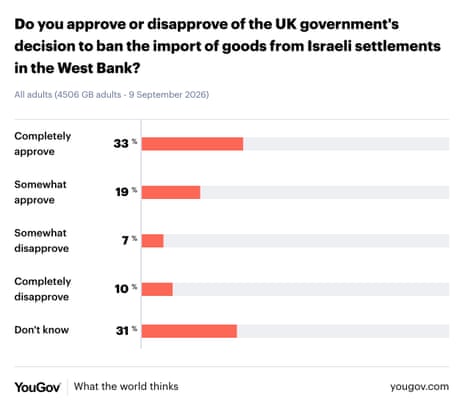
Shabana Mahmood signs information-sharing deal with Belgian counterpart to tackle small boats
Shabana Mahmood, the home secretary, has signed an information-sharing deal with her Belgian counterpart to help both countries tackle small boats and people smuggling.
According to the Home Office, this is the first law enforcement deal of this kind signed with an EU member state since Brexit.
Explaining what it will do, the Home Office says:
The UK-Belgium Law Enforcement Cooperation Agreement (LECA) will enable police officers in both countries to exchange intelligence autonomously and more quickly, helping identify, disrupt and dismantle organised criminal networks, including those involved in migrant smuggling.
Under previous arrangements, certain information exchanges required judicial approval before intelligence could be shared, creating delays at critical stages of investigations and reducing investigators’ ability to develop a timely and comprehensive picture of criminal networks operating across both countries.
The new agreement removes those barriers, enabling officers to share information autonomously and act more quickly against criminals operating across borders. It will strengthen joint investigations and specialist training to detect and disrupt criminal activity linked to small boat crossings, as well as wider organised crime such as drugs and firearms smuggling.
Belgian officers are now also able to join the UK-France Intelligence Cell in northern France, where National Crime Agency (NCA) officers work alongside French counterparts to identify and dismantle organised migrant-smuggling networks operating across Europe.
Transport secretary Heidi Alexander tells MPs cyber-attack ruled out as cause of air traffic control chaos
Heidi Alexander, the transport secretary, has said that a cyber-attack has been ruled out as the cause of the air traffic control disruption that has caused chaos at airports.
Speaking at the start of the debate on the civil aviation bill, Alexander said:
A four-hour air traffic outage yesterday left hundreds of thousands of passengers facing cancellations, diversions, and delays.
I would like to apologise wholeheartedly to passengers for this disruption.
We often take for granted the way in which our aviation system just works, but yesterday that was not the case.
Safety must remain air traffic controllers’ overriding priority, and this morning I have spoken to Nats [formerly National Air Traffic Services] chief executive Martin Rolfe, who informed me this outage was due to a technical issue at their Swanwick site.
So, while my understanding from Nats is that we can rule out a cyber-attack on this occasion, I do not believe this issue was unavoidable.
We also spoke this morning about how Nats responded to resolve and minimise the disruption as quickly as possible, and I am grateful to the airports and airlines who responded straight away.
Tom Ambrose has more on this story on a separate live blog.
No 10 rules out 2nd Scottish independence poll - after Burnham suggests Good Friday agreement precedent could allow one
Downing Street has ruled out allowing another Scottish independence referendum – even though Andy Burnham implied at PMQs that the Scots could have one if a majority were in favour.
In response to a question from the SNP MP Chris Law, Burnham said the situation in Scotland was “exactly the same” as in Northern Ireland, where the law says a referendum on leaving the UK and joining a united Ireland should take place if that’s what people want.
But later No 10 suggested Burnham mis-spoke. At the post-PMQs briefing, the PM’s press secretary said:
The PM’s been repeatedly clear on this. In his call with the Scottish first minister in his first week, the PM stated upfront that another referendum on independence was off limits and as our election manifesto makes clear, Labour does not support independence or another referendum.
At PMQs Law referred to Burnham telling MPs last week that he would stick to every word of the Good Friday agreement. He went on:
[The PM] will therefore know that the Northern Ireland Act 1998 contains a provision for a referendum on leaving the United Kingdom, but no equivalent provision exists in the law for Scotland. Does he recognise that the people of Scotland have an equal right to choose their own future, and that the conditions for a second independence referendum should be set out in law?
Law was referring to a provision in the Good Friday agreement saying the Northern Ireland secretary has to order a referendum on reunification “if at any time it appears likely to him that a majority of those voting would express a wish that Northern Ireland should cease to be part of the United Kingdom and form part of a united Ireland”. Quite how the Northern Ireland secretary would decide this is not specified.
Responding to Law, Burnham said:
[Law] mentions the Good Friday agreement, and I will stick to it 100%.
I remind him, on the question of a border poll, that that is to be considered by the Northern Ireland secretary when there is clear consensus in the country – when public opinion has changed to the point at which the call has to be considered. I would say that it is exactly the same situation in Scotland. I am not aware that there is majority public support for another referendum, and until that changes, there will not be one.
In fact, some recent polls suggest there would be a small majority for independence if a referendum were to take place now.
John Swinney, the SNP leader and Scottish first minister, later claimed that Burnham had made an important concession. He posted on social media:
To go from “off limits” to this is an acceptance of the reality that the people of Scotland will decide their own future – not the UK government.
For the first time since 2014, a British prime minister accepts that majority support for a referendum should mean one takes place.
Yvette Cooper announces £1.5bn to fix-up NHS buildings and boost heat resilience
Yvette Cooper, the health secretary, has announced £1.5bn will be spent to fix urgent problems in crumbling NHS buildings and build resilience to extreme heat, the Press Association reports. PA says:
This money comes from the £6.75bn estate safety fund announced last year, which is set to be distributed over nine years from 2026/27 to 2034/35.
The £1.5bn will cover 950 hospitals and tackle issues like fire safety systems and outdated ventilation, with more than £32m to be spent on cooling and ventilation to prepare for summer heatwaves.
It comes after the UK experienced its hottest summer on record, with five heatwaves and 40 days of temperatures above 30C.
Addressing MPs this afternoon, Cooper said: “In the spending review, we allocated for the first time a multi-year £6.75bn estate safety fund.
“I can announce the first wave of investment from this fund today, covering 950 hospital projects across England, which will receive a share of a £1.5bn investment to fix urgent problems of ageing buildings and facilities.
“Schemes tackling issues including failing fire safety systems, outdated ventilation, ageing electrical equipment that could put patients and staff at risk.
“More than £32m will be spent specifically on projects that include improving cooling and ventilation, helping hospitals cope with extreme heat as well as winter pressures.
“As part of this funding, I can announce 10 major schemes worth £200m: Wycombe hospital in High Wycombe, the Royal Free hospital in north London, the Linden Centre in Essex, the John Howard Centre in London, Lister hospital in Hertfordshire, Southend hospital in Essex, the Stepping Hill hospital in Stockport, St George’s Hospital in Stafford, the Bristol Royal Infirmary, and the Queen Elizabeth hospital in Gateshead.
“I have also asked the NHS to look particularly at extreme weather resilience as part of future waves of capital plans.”
The Department of Health and Social Care has published more details of the projects here.
Reform UK denies wrongdoing, and says it will cooperate fully with police inquiry
Reform UK has said it will cooperate fully with the Metropolitan police investigation, the Press Association reports.
A Reform UK spokesperson said:
Reform UK denies any wrongdoing and will fully cooperate with the investigation.
We won’t be commenting further while a live investigation is under way.
'Potential offences requiring investigation' - Met statement on inquiry being launched into Farage's party after C4 sting
Here is the full statement from the Metropolitan police about the new investigation into Reform UK. (See 2.44pm.)
Following a broadcast by Channel 4 News on Thursday, 3 September, the Met received a number of reports relating to donations and polling involving a political party.
Detectives have assessed the information provided and determined that there are potential offences requiring investigation. The potential offences are similar in nature to matters already under investigation by the Met’s Special Enquiry Team relating to donations made to the same political party. As a result, these matters will form part of that ongoing investigation.
All allegations under investigation relate to potential offences under the Political Parties, Elections and Referendums Act 2000.
As part of enquiries, detectives are seeking to obtain relevant footage relating to the broadcast on Thursday, 3 September.
Detectives continue to liaise closely with the Electoral Commission and Crown Prosecution Service as enquiries progress.
Darren Jones urges PM to push for global treaty on AI regulation following claim it could 'kill all humans' within a decade
Darren Jones, who was chief secretary to the PM in Keir Starmer’s government, is calling for a global treaty to regulate AI. He has written an open letter on this to Andy Burnham, the United Nations secretary general António Guterres and the OECD secretary general Mathias Cormann. It is prompted by a safety researcher at Anthropic declaring that the chance that AI could “kill all humans” within a decade is more than 10%.
Jones says:
I’ve never thought we should ban innovation or scientific endeavour but it’s clear we need a new multinational treaty for the safe and regulated development of superintelligence.
I’ve written to @antonioguterres @MathiasCormann and @andyburnham to ask that the UN, OECD and G7/G20 act now
Met police launch inquiry into alleged overseas donations to Reform UK
The Met police will investigate allegations that Reform UK broke electoral law relating to overseas donations as part of a wider inquiry, Rowena Mason reports.
Ministers to put white working-class people in UK at heart of new equalities unit
The government is putting class at the heart of its equalities agenda by creating a new unit that will make tackling white working-class inequality a priority, Aletha Adu reports.
PMQs - snap verdict
Andy Burnham is striking a welcome new tone at PMQs. He sounds like a man interested in the questions being asked, instinctively minded to be helpful (particularly to backbenchers) and, when confronted with a political criticism, interested in engaging with the argument. By contrast, when Keir Starmer was doing it, as the questions came his mind just seemed to be whirring towards the default ‘line to take’ discussed in advance. Perhaps it’s just because Burnham is new to the job and he has not been burned yet by making too many rash promises (or quasi-promises, like today’s on the Gravesend-Tilbury ferry – see 12.31pm). But he does seem to have some sort of strong, innate desire to win people round that might persist. During the summer, when Patrick Maguire from the Times put it to him in an interview that he worried too much about being liked, Burnham replied: “Isn’t the job to be popular by making people’s lives better? Isn’t that what you should be doing?”
Getting Kemi Badenoch to like or admire him may be too much to ask, but it was notable that Burnham kept stressing his commitment to working with her on issues like defence spending. Badenoch opened her questions with a reference to Burnham’s mini-gaffe last week, when he told Tan Dehsi that he was fully committed to raising defence spending to 3% of GDP by 2030 when he meant 3.5% by 2035. Badenoch could have made this highly embarrassing for Burnham, but he got out of it fairly well – not actually committing to 3% by 2030 while at the same time implying (as Alex Wickham from Bloomberg explains here) that he will get there in the end.
The most interesting comments were about welfare. For at least a year now, the Conservatives have been arguing that the answer to the defence spending challenge (in fact, the answer to every government spending challenge) is just to cut welfare spending. In response to a challenge on this, Starmer would have just attacked the Tories’ record on defence. But Burnham sounded like someone who has actually read the Tory proposals in detail (which wouldn’t take long) and thought about why that might be a bad idea. And he told Badenoch:
I looked at it and I don’t think myself that taking £4bn out of housing benefit is the right consensus around this issue because that would create levels of homelessness in this country that we wouldn’t have seen before, hundreds of thousands of children in temporary accommodation.
He went on:
We do everything to support our national security, but it can’t come at the expense of social security. Having strong national security also depends upon having resilience in our communities. This side of the house will not be forced to choose between the two, and we will set out a plan to get to 3.5% (of GDP spent on defence) by 2035 at the spending review.
The Conservatives clearly think this is a mistake. Before the end of PMQs, a Tory spokesperson had put out a press release saying:
Britain heard it loud and clear today: Andy Burnham will not cut welfare to fund the defence of our country. The prime minister is prioritising the ballooning benefits bill over our national security. Shameful. This is not leadership, it is surrender.
But, if Labour want to win an argument with the opposition about welfare, they are going to have to explain why benefits matter and what happens when you cut them. Today, Burnham made a start.
The second most interesting comments were the ones that Badenoch did not make; she did not say anything about Israel. Maybe that was just because she decided it was yesterday’s story, but it is also possible that that she realises that she is in the wrong place on this issue. Yesterday she published an article on this issue which did not contain a word of criticism of Israel and which accused Burnham of just caving in to Corbynism and antisemitism. The Tories seemed to be eagerly awaiting Donald Trump to lash out. But the White House said very little, it turned out that those well-known Corbynites Emmanuel Macron and Mark Carney were doing exactly the same thing and even the Board of Deputies of British Jews was more critical of settler violence in its response than Badenoch. When a mainstream political leader ends up to the right of Donald Trump and the Board of Deputies on Israel policy, they have probably got it wrong.
Because Badenoch had not raised Israel, Burnham had to save up his global leadership spiel for his final answer. (See 12.19pm.) But it was worth the wait; it was pretty good.
Bernard Jenkin (Con) asks about the risk of the Israel sanctions decision putting cooperation with the Israeli security services at risk.
Burnham says the government took advice from the security services before taking this decision.
He says the risk of the two-state solution collapsing was too high.
He says he agrees with Edward Leigh’s assessment yesterday.
Cat Eccles (Lab) pays tribute to the fire service for their work with the fires at Stourbridge.
Burnham says he will be chairing a summit on wildfires. He says the fire service is not set up to deal with these problems.
Daisy Cooper (Lib Dem) asks about mental health provision in Hertfordshire. Will the PM back her campaign for a new facility there?
Burnham says that is a good question. Cooper is right to point to wasted spending in the health system, when people have to be sent a long way for care. A mental health strategy will be put to the Commons before Christmas, he says.
Chris Law (SNP) asks if Burnham accepts the Scots have the same right to decide there own future as the people of Northern Ireland.
Burnham says the Good Friday agreement says there should be a border poll in Northern Ireland if there is a clear consensus in favour. He says in Scotland there is not majority support for another referendum. Until that changes, there won’t be one, he says.
Liz Saville Roberts, the Plaid Cymru leader at Westminster, asks about a community-owned pub in her constituency.
Burnham says the government does need to “go further to support hospitality”. He says Saville Roberts should wait for the budget.




















 English (US) ·
  French (CA) ·