

 3 months ago
66
3 months ago
66
PROTECT YOUR DNA WITH QUANTUM TECHNOLOGY
Orgo-Life the new way to the future Advertising by AdpathwayRussia is 'on the back foot,' as 'the dynamics of the war are shifting in Ukraine's favour,' EU's foreign policy chief says
Kallas says that “the dynamics of the war are shifting in Ukraine’s favour.”
“Russia is on the back foot, militarily, economically, but also diplomatically, but as the latest strikes on Kyiv have shown, Russia still shows no genuine interest in peace, which was also the clear view of the ministers today.”
She says the ministers had “a really thorough discussion” on what Europe should ask for from Moscow in any potential negotiations.
She adds:
“Europe will never be a neutral mediator between Russia and Ukraine, because we are on Ukraine’s side, and we are defending our own core security interests.”
She says that an unconditional ceasefire is “a prerequisite for any kind of peace negotiations,” and Russia “must stop sabotage operations, cyber-attacks, election interference, airspace violations across Europe” and “there can be no legal recognition of the occupied Ukrainian territory.”
Despite Russia’s Lavrov’s criticism (11:23), she repeats “there must be also limitations” on Russia’s military.
Kallas also says that “too many countries continue to do business with Moscow, while simultaneously enjoying privileged access to European markets and investments, so Europe must use its leverage more effectively when it comes to trade, investment, market access, partnerships.”
The EU is already working on another round of sanctions on Russia, she adds.
Key events 3d ago Closing summary 3d ago Latvian parliament approves new government, confirms Kulbergs as prime minister 3d ago Bulgaria's Radev stresses his reformist agenda with focus on 'catching up' after years of instability 3d ago Bulgaria makes good progress on reforms, EU's von der Leyen says as she welcomes new PM Radev 3d ago Spanish PM’s family affair: the corruption cases involving Pedro Sánchez’s brother, wife and predecessor 3d ago EU fines Temu for failing to stop sale of illegal and dangerous products 4d ago Russia is 'on the back foot,' as 'the dynamics of the war are shifting in Ukraine's favour,' EU's foreign policy chief says 4d ago Russia falsely alleges drone attacks on Russia from Europe are 'increasing' 4d ago Nato's Rutte hosts Bulgaria's Radev for talks on defence, security situation 4d ago Deal 'also on how Sweden can learn from Ukraine,' PM Kristersson says 4d ago 'Diplomacy cannot stop Russia,' Zelenskyy says as he confirms request to US for air defence support 4d ago 'When we support Ukraine, we support Sweden and Europe,' Swedish PM says 4d ago Ukraine to order 'up to 20' Swedish fighter jets; get 16 older models as 'assistance', Zelenskyy confirms 4d ago Talks on relaxing post-Brexit food safety rules 'still ongoing,' EU says despite UK's claims of deal 4d ago EU prepares to make first loan payments to Ukraine next month 4d ago Hungary nearing a deal with EU to unblock funds, PM Magyar says 4d ago 'Technical discussions' between Brussels and Hungary to unblock frozen EU funds still on-going 4d ago Bulgaria's Radev to meet EU's von der Leyen this afternoon, Hungary's Magyar tomorrow 4d ago Brexit rules on food exports to be scrapped, UK government says 4d ago Zelenskyy confirms plans for 'major defence package' deal with Sweden 4d ago Nato's German-Netherlands Corp to take command role in Estonia, Latvia, Germany says 4d ago Russian foreign minister dismisses 'idiotic' demand to 'mirror' army restrictions in any Ukraine deal 4d ago Ukraine's Zelenskyy in Sweden for rumoured talks on air defence, fighter jets 4d ago 'We need to find someone who does not need Nobel Peace Prize,' ministers joke about Russia negotiator 4d ago Morning opening: Don't walk into a Russian 'trap' on talks, EU's chief diplomat warns Show key events only Please turn on JavaScript to use this feature
Closing summary
Jakub Krupa
… and on that note, it’s a wrap for today!
-
EU foreign policy chief Kaja Kallas has said that “Russia is on the back foot” as “the dynamics of the war are shifting in Ukraine’s favour,” as she called for Europe to keep pressure on Moscow (14:23).
-
Her comments come as Ukraine has agreed a major defence deal with Sweden including plans to buy up to 20 Gripen fighter jets (10:41, 11:35, 13:12, 13:22, 13:32), with Zelenskyy insisting that at this stage “diplomacy cannot stop Russia” as he pleaded for more air defence missiles from the US (13:38).
In other news,
-
Hungary’s new prime minister Péter Magyar has suggested that his government is nearing a political deal with the European Commission on an agreed programme of post-Orbán reforms that would unblock billions of euros in EU funds ahead of his meeting with Ursula von der Leyen tomorrow (12:16, 12:21, 12:26).
-
Meanwhile, Bulgaria’s new prime minister Rumen Radev also visited Brussels, holding key talks with Nato’s Mark Rutte (13:58) and EU’s von der Leyen (16:00, 16:10).
-
And over in Latvia, the parliament has approved a new government, led by centre-right opposition lawmaker Andris Kulbergs (16:28), two weeks after the previous administration collapsed over internal disputes over the government’s handling of Ukrainian drones that strayed into Latvian territory from Russia.
If you have any tips, comments or suggestions, email me at [email protected].
I am also on Bluesky at @jakubkrupa.bsky.social and on X at @jakubkrupa.
Latvian parliament approves new government, confirms Kulbergs as prime minister
Meanwhile, over in Latvia, the parliament has approved a new government, led by centre-right opposition lawmaker Andris Kulbergs.
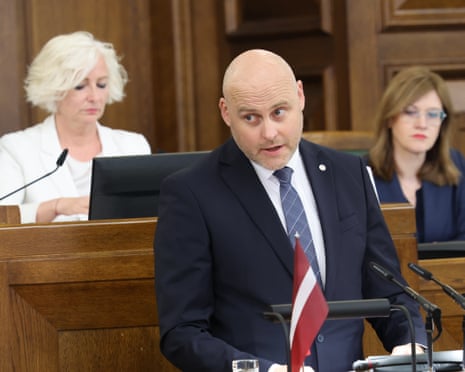
It’s a four-party coalition administration, including two parties from the previous government and two opposition forces, which will take the country to a parliamentary election already scheduled for this October.
The previous government collapsed two weeks ago after the centre-right prime minister Evika Siliņa resigned over internal disputes over the government’s handling of Ukrainian drones that strayed into Latvian territory from Russia.
The Baltic country still remains under pressure over drone incidents, given repeatedly denied and unproven allegations made by Moscow implying some sort of military cooperation with Ukraine to attack Russia.
Reuters noted that security is high on the incoming government’s list of priorities, including for Latvia’s borders, the economy and energy, Kulbergs told parliament ahead of the vote.
“People will very quickly tell us whether we have done well or done poorly, the 3 October [general election] ... will be the verdict on this government,” he said.
Bulgaria's Radev stresses his reformist agenda with focus on 'catching up' after years of instability
For his part, Radev says Bulgaria “has always been a strong contributor” to European security, and “plays a pivotal role for providing stability, security and diversification in energy supply.”
He is keen to stress that his government will stabilise the political situation in the country after years of political chaos.
He says he leads “a stable reform-oriented and energetic government” looking to make the most of opportunities available to Sofia.
Radev says the focus is on “catching up and meeting all the deadlines till the end of August this year.”
He hits all the right tones you want to make in your first meeting with the commission, as he ends with reassurances that – despite fears of critics – “this is just the beginning of fruitful cooperation” with Brussels.
Bulgaria makes good progress on reforms, EU's von der Leyen says as she welcomes new PM Radev
Meanwhile, Bulgaria’s Rumen Radev continues his tour of European institutions in Brussels.
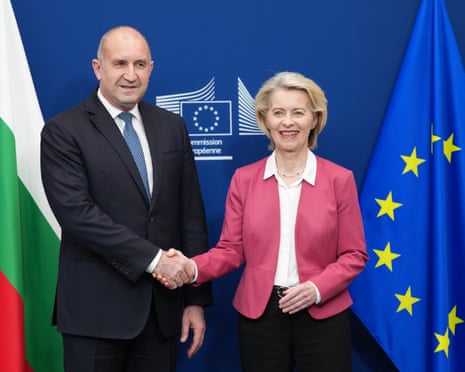
After dropping in to see Nato’s Mark Rutte earlier (13:58), he is now meeting the European Commission’s president, Ursula von der Leyen.
She says the goal is to unlock the remaining available EU funds for Bulgaria before the deadline in August.
“For this, we must maintain momentum on reforms,” she says, particularly stressing the need for continued push to fight corruption, including the independent anti-corruption commission.
She says Bulgaria has made good progress towards unlocking almost €370m in suspended funding.
She also says the commission wants to support Bulgaria on energy reforms to move towards cleaner energy sources. There is €1.2bn in funds for various clean energy investments.
In other issues, the pair also discussed the upcoming budget negotiations in the EU, and on foreign policy, including the Middle East and Ukraine.
Pointedly, she says “Bulgaria has a crucial role to play” in collective defence efforts, guarding the continent from Russia. €3.2bn are available in the EU Safe funds.
Spanish PM’s family affair: the corruption cases involving Pedro Sánchez’s brother, wife and predecessor
Sam Jones
in Madrid
Spain’s prime minister, Pedro Sánchez, is facing a long and difficult summer as corruption cases involving his brother, his wife and his predecessor José Luis Rodríguez Zapatero come before judges over the coming days and weeks.
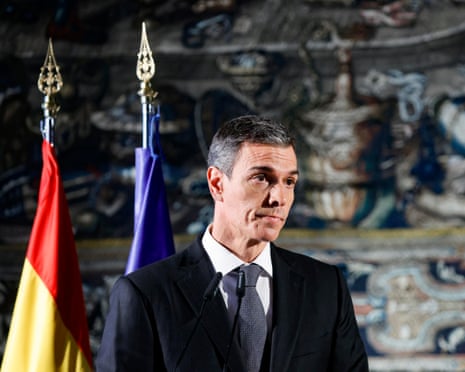
The socialist leader – who took power eight years ago after using a vote of no confidence to topple the corruption-mired government of the conservative People’s party (PP) – has insisted there has been no wrongdoing by his family. He has also defended Zapatero and his right to the presumption of innocence.
But with two of his former right-hand men also accused of corruption and his former attorney general banned from his post for two years after being found guilty of leaking confidential information, Sánchez has a lot to contend with ahead of next year’s general election.
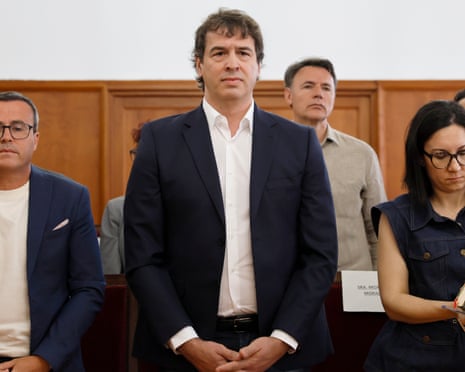
Here’s a rundown of the cases – starting with the prime minister’s younger brother, David Sánchez, who is on trial in the south-west region of Extremadura today, accused of influence peddling and misuse of public office. Ten other people face the same charges.
EU fines Temu for failing to stop sale of illegal and dangerous products

Jennifer Rankin
Brussels correspondent
Meanwhile, EU regulators have fined the Chinese shopping website Temu €200m (£173m) for failing to stop the sale of illegal and dangerous products.
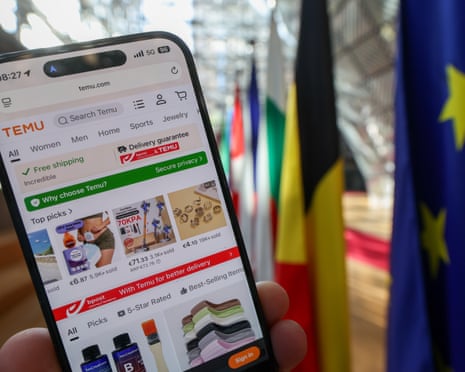
The European Commission imposed the penalty after a 19-month investigation that found consumers were very likely to encounter illegal or unsafe products including baby toys and electronics on the firm’s website.
An unpublished mystery shopping exercise carried out for the commission found a “high percentage” of unsafe baby products and a “very high percentage” of dangerous chargers for sale on the platform, as well as unsafe clothes and jewellery.
Consumer groups across Europe have previously reported baby toys with loose parts presenting choking hazards, dummy chains long enough that they could strangle a child, jewellery laced with dangerous metals including lead, clothes made with banned chemicals and chargers that posed risks of burns, electric shocks or fire.
The commission also criticised Temu over inadequate controls on the design of its website. Recommender systems and influencers’ promotions by influencers “could amplify dissemination risks of illegal products” it said.
The €200m fine is the second and highest-ever imposed under the EU’s Digital Services Act (DSA), which has applied to the world’s biggest tech companies since February 2024. It follows a €120m penalty issued to Elon Musk’s X last December for “deceptive” verification badges and lack of transparency over advertising.
A senior EU official said the commission had found a particularly serious breach of the act related to an inadequate risk assessment on unsafe products that Temu carried out in 2024.
Kallas also says it’s “very important that we push Ukraine and Russia to talk to each other.”
She explains that’s the case “because on there are so many issues where only they can decide, and nobody else.”
“There can be countries that do this shuttle diplomacy, but in the end it has to be them who, who sit down on these issues that only they can decide.”
Kallas also says the EU does not want to get into negotiations “instead of the US,” but to be ready to play a role in a “complimentary” way.
Kallas also gets asked if the ministers progressed the debate on whether the EU should appoint a single lead negotiator to talk to Russia.
She says “the broad consensus” was to focus on the existing European institutions, and she says that “it is much more important to be really ready on the issues” instead.
Cypriot foreign minister Constantinos Kombos, who hosted the meeting, adds that the ministers had “a very, very honest discussion about the principles that should guide our position.”
Otherwise he just echoes Kallas’s statement.
Russia is 'on the back foot,' as 'the dynamics of the war are shifting in Ukraine's favour,' EU's foreign policy chief says
Kallas says that “the dynamics of the war are shifting in Ukraine’s favour.”
“Russia is on the back foot, militarily, economically, but also diplomatically, but as the latest strikes on Kyiv have shown, Russia still shows no genuine interest in peace, which was also the clear view of the ministers today.”
She says the ministers had “a really thorough discussion” on what Europe should ask for from Moscow in any potential negotiations.
She adds:
“Europe will never be a neutral mediator between Russia and Ukraine, because we are on Ukraine’s side, and we are defending our own core security interests.”
She says that an unconditional ceasefire is “a prerequisite for any kind of peace negotiations,” and Russia “must stop sabotage operations, cyber-attacks, election interference, airspace violations across Europe” and “there can be no legal recognition of the occupied Ukrainian territory.”
Despite Russia’s Lavrov’s criticism (11:23), she repeats “there must be also limitations” on Russia’s military.
Kallas also says that “too many countries continue to do business with Moscow, while simultaneously enjoying privileged access to European markets and investments, so Europe must use its leverage more effectively when it comes to trade, investment, market access, partnerships.”
The EU is already working on another round of sanctions on Russia, she adds.
Oh, that was quick.
Kallas is speaking now. I will bring you the key lines here.
We are expecting to hear from the EU’s foreign policy chief, Kaja Kallas, soon with a press conference after the informal meeting of EU ministers any moment now.
Russia falsely alleges drone attacks on Russia from Europe are 'increasing'
Meanwhile, the Russian foreign ministry’s spokesperson, Maria Zakharova, has been raging against all sorts of enemies of Russia over the last hour.
In the latest exchange, she claimed that “drone attacks on Russia from the direction of Europe and northern European states are increasing,” Reuters reported.
It’s important to note that there is absolutely nothing to suggest that this is actually true, but it fits a broader pattern of Moscow’s lies pressure on the Baltics in recent weeks.
Earlier, Zakharova also rejected the allegations that Moscow is jamming GPS signals in Europe demanding “some evidence” to prove it – despite literal examples of defence ministers of Spain or the UK facing GPS disturbances in recent months.
Zakharova also criticised the US decision to deploy additional US forces to Poland, warning it could lead to an escalation of tensions between Russia and the west …
… and also criticised US-Japanese military drills which could apparently threaten Russia’s eastern territories, and even blasted Armenia and Luxembourg for other issues.















 English (US) ·
  French (CA) ·