

 3 hours ago
4
3 hours ago
4
PROTECT YOUR DNA WITH QUANTUM TECHNOLOGY
Orgo-Life the new way to the future Advertising by AdpathwayMore than 8,000 sharks and rays died during South Australia’s toxic algal bloom, the largest known mass mortality globally, with endangered species among the fatalities.
Prof Charlie Huveneers, a shark ecologist at Flinders University, said the bloom had potentially led to the collapse of some local populations.
“The scale of the harmful algal bloom is unprecedented, the number and diversity of shark and ray species impacted is something never seen before.”
Documented losses included about 4,460 southern fiddler rays, 850 Port Jackson sharks, 670 cobbler wobbegongs and 650 western shovelnose rays, according to an analysis of citizen science and government records led by Janine Baker, a marine ecologist.
When people in South Australia think of sharks, they typically have white sharks or bronze whalers in mind, Huveneers said. But there were more than 50 species of sharks and rays found in state waters, including many small endemic species.
In all, 31 species of sharks, rays, skates and stingarees were recorded in the algal bloom death toll, including coastal stingarees (listed as endangered by the International Union for Conservation of Nature) and pygmy thornback skates, two species found only in South Australian waters. Vulnerable Melbourne skates were also among the dead.
While little is known about these smaller, range-restricted species, it was possible that a large proportion of individual creatures were affected by the bloom.
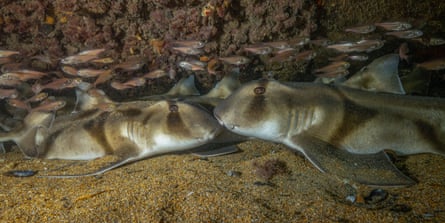
Affected species ranged from skates and stingarees, roughly the size of a dinner plate, to bronze whalers and white sharks that grow to several metres. While benthic species – those living on or near the sea floor – dominated the death toll, even sharks capable of large-scale movements like white sharks were also affected by the harmful bloom.
“People might be aware of the Port Jackson sharks, southern eagle rays, fiddler rays – and there was certainly a lot of them washing up – but we also had a lot of species that people had never seen or heard about, like cobbler wobbegongs,” Huveneers said.
“One of the surprising things with the bloom is that it didn’t just impact a couple of species but a whole range of sharks and rays. And that suggests that sharks and rays are highly susceptible to these blooms.”
In some areas, previously common species were now rarely seen, he said. While Port Jackson sharks on the east coast undertook large migrations, some of the South Australian populations stay put year-round, which put them at greater risk.
Sharks and rays were among more than 800 species affected by Australia’s first bloom of Karenia cristata, a rare and toxic type of algae deadly to marine life. “For many of the sharks and rays impacted, both adults and juveniles showed signs of blood pooling under the skin and blood leakage from the orifices,” the report said.
after newsletter promotion
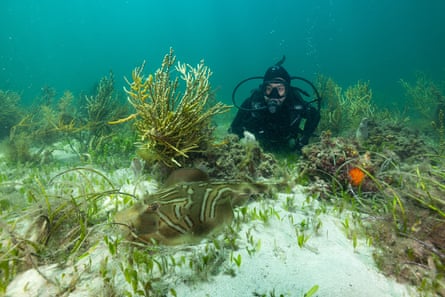
Eighteen months on from the start of the algal bloom’s spread, surveys and reports are beginning to measure the scale of the devastation, including the catastrophic decline in giant cuttlefish and the deaths of thousands of sea dragons, pipefishes and seahorses – research made possible through the contributions of citizen scientists and divers.
The numbers were likely an underestimate, given they exclude shark eggs and animals that died offshore. But understanding the impact was the first step towards supporting the recovery of sharks, rays and their ecosystems, Huveneers said.
The state’s environment department is finalising a comprehensive assessment of the bloom’s impact on nearshore marine biodiversity, including sharks and rays, to guide its recovery efforts. “Citizen science initiatives provide critical information on the ecological effects of the algal bloom that will inform expected recovery timelines and actions, and design of impact monitoring programs,” a department spokesperson said.
Prof Culum Brown, a fish and shark researcher at Macquarie University, said Australia was a hotspot for shark diversity and the algal bloom had “affected pretty much the entire food web, all the way to the top”
There was growing concern for sharks and rays across the board in society, especially in Australia, he said. “To see these deaths at this sort of scale is pretty heartbreaking.”




















 English (US) ·
  French (CA) ·