

 2 months ago
89
2 months ago
89
PROTECT YOUR DNA WITH QUANTUM TECHNOLOGY
Orgo-Life the new way to the future Advertising by AdpathwayIn a discovery that could reshape scientists’ understanding of how photosynthetic organisms capture carbon, researchers have rebuilt a working version of the pyrenoid outside a living cell. The study, published in Nature Plants, shows how a single class of scaffold proteins can organize the carbon-fixing enzyme Rubisco into a dense, specialized compartment. This reconstruction offers a rare view of the molecular forces that create pyrenoids and may help explain how one of nature’s most important carbon-concentrating systems evolved.
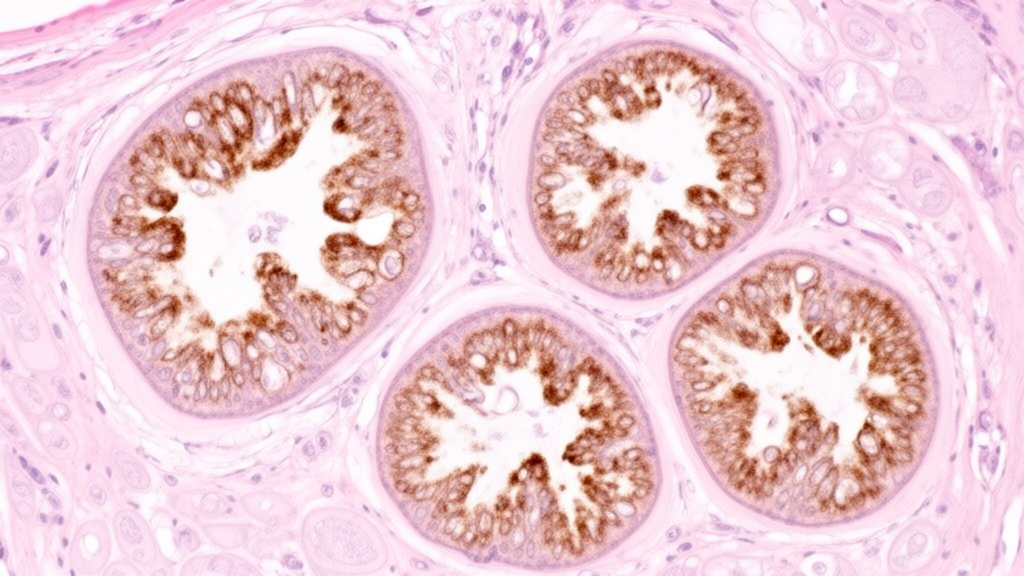
Pyrenoids are microscopic structures found inside the chloroplasts of many algae and some plants. Although they have no surrounding membrane, they act as biochemical hubs that concentrate carbon dioxide around Rubisco, the enzyme responsible for converting inorganic carbon into the organic molecules that fuel photosynthesis. Rubisco is abundant but inefficient: it can react with oxygen as well as carbon dioxide, initiating a wasteful process called photorespiration. By increasing the local concentration of carbon dioxide, pyrenoids help Rubisco favor carbon fixation, allowing algae to photosynthesize effectively even when dissolved carbon dioxide is scarce.
The central architectural component examined in the study is EPYC1, a protein found in the green alga Chlamydomonas reinhardtii. EPYC1 does not function like a rigid structural beam. Instead, it is largely intrinsically disordered, meaning it lacks a single fixed three-dimensional shape. Its flexibility enables it to carry multiple interaction sites that can bind Rubisco molecules at the same time. In this way, EPYC1 behaves like a molecular connector, bringing Rubisco together and creating the dense protein matrix characteristic of a pyrenoid. The researchers set out to determine whether this organizing principle could be recreated with purified components.
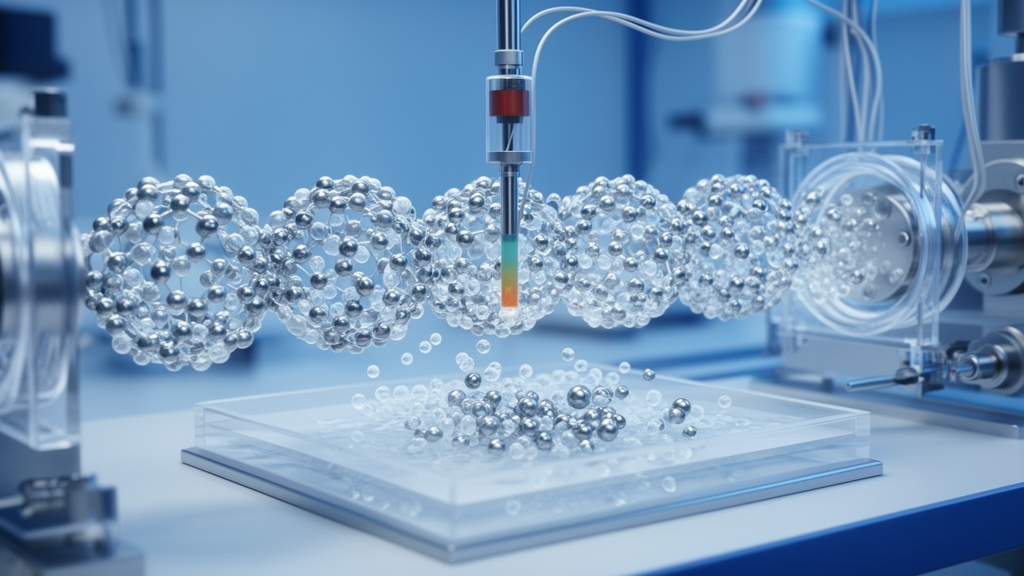
The team used a bottom-up strategy, assembling synthetic pyrenoid-like structures from their molecular parts rather than studying the entire organelle inside a cell. This approach makes it possible to change one component at a time and observe how each alteration affects assembly. When EPYC1 and Rubisco were combined under appropriate conditions, they formed concentrated protein-rich bodies that resemble the internal matrix of natural pyrenoids. Such condensates arise through multivalent interactions, in which many weak contacts collectively produce a stable but dynamic structure. The result is not a conventional membrane-bound organelle, but a phase-separated compartment whose composition and behavior are governed by molecular affinity.
This distinction is crucial because pyrenoids belong to a growing class of cellular condensates that organize biochemical reactions without physical membranes. In a phase-separation process, proteins and other molecules can demix from the surrounding solution, forming a dense phase enriched in particular components. The synthetic structures created in the study provide evidence that the interaction between EPYC1 and Rubisco is sufficient to drive much of this condensation. At the same time, the reconstituted system allows researchers to distinguish between simple aggregation and a regulated condensate. A functional pyrenoid must remain dynamic, permit the movement of metabolites, and maintain a microenvironment that supports carbon fixation rather than merely trapping proteins in an inert clump.
The study also sheds light on how the spacing and arrangement of interaction sites within EPYC1 influence pyrenoid formation. Because the protein is flexible, the number, position, and strength of its Rubisco-binding motifs can affect how efficiently it cross-links enzyme molecules. Small changes in these molecular features may alter the size, density, material properties, and stability of the resulting condensate. The researchers’ reconstruction therefore turns pyrenoid assembly into an experimentally accessible problem: rather than treating the organelle as a black box, scientists can now investigate how specific protein sequences translate into a defined mesoscale structure.
These findings have implications for the evolution of carbon-concentrating mechanisms. Rubisco predates modern algae and is found across photosynthetic life, but the systems that concentrate carbon around it have evolved repeatedly and in different forms. The results suggest that flexible scaffold proteins such as EPYC1 may provide an evolutionarily adaptable solution. A disordered protein can acquire or lose interaction motifs more readily than a tightly folded enzyme while preserving its overall ability to serve as a molecular linker. This could allow different algal lineages to build functionally similar pyrenoids using proteins with distinct sequences and architectures.
The work is also relevant to efforts to improve photosynthesis in crops. Many plants lose a substantial fraction of potential productivity because Rubisco operates slowly and because oxygen competes with carbon dioxide at its active site. Introducing a carbon-concentrating mechanism into plant chloroplasts has long been considered a possible route to increasing photosynthetic efficiency. Synthetic pyrenoids could eventually contribute to that goal, but major barriers remain. A useful engineered organelle would need to assemble reliably in plant cells, receive enough carbon dioxide, allow essential metabolites to enter and leave, and operate without disrupting chloroplast organization or cellular growth. The new reconstruction does not solve those engineering challenges, but it identifies molecular rules that future designs may be able to exploit.
The significance of the study extends beyond one algal protein or one organelle. By rebuilding a complex biological compartment from defined ingredients, Küffner and colleagues demonstrate how cellular organization can emerge from relatively simple physical principles: multivalent binding, molecular flexibility, and phase separation. Their synthetic pyrenoids provide a controllable platform for testing how carbon fixation is spatially regulated and how evolutionary changes in scaffold proteins can produce new biochemical architectures. As scientists continue to move from observing natural systems to reconstructing them piece by piece, the pyrenoid is becoming more than a specialized algal structure. It is emerging as a model for understanding—and eventually redesigning—the molecular organization of photosynthesis.
Subject of Research: Synthetic reconstruction of pyrenoids, EPYC1-mediated Rubisco organization, carbon-concentrating mechanisms, and the evolution of photosynthetic carbon fixation
Article Title: Bottom-up reconstruction of synthetic pyrenoids provides insights into the mechanisms and evolution of carbon concentration by EPYC1 proteins
Article References:
Küffner, A.M., Pommerenke, B., Kley, L. et al. Bottom-up reconstruction of synthetic pyrenoids provides insights into the mechanisms and evolution of carbon concentration by EPYC1 proteins.
Nat. Plants (2026). https://doi.org/10.1038/s41477-026-02349-x
Image Credits: AI Generated
DOI: https://doi.org/10.1038/s41477-026-02349-x
Keywords: pyrenoid, EPYC1, Rubisco, carbon-concentrating mechanism, photosynthesis, phase separation, biomolecular condensates, synthetic biology, algae, chloroplasts, carbon fixation
Tags: Algae carbon fixationAlgal adaptation to low CO2Biochemical hubs in chloroplastsCarbon-concentrating mechanisms in photosynthesisEPYC1 scaffold proteinEvolution of pyrenoid-based carbon fixationMolecular forces in organic compartment formationPhotosynthesis efficiency enhancementPhotosynthetic organelle engineeringPyrenoid structure and functionRubisco enzyme organizationSynthetic pyrenoid reconstruction

















 English (US) ·
  French (CA) ·