

 2 months ago
78
2 months ago
78
PROTECT YOUR DNA WITH QUANTUM TECHNOLOGY
Orgo-Life the new way to the future Advertising by AdpathwayDave Wainwright first surveyed Wallington in Northumberland for a rare custard-and-chocolate coloured moth in 2004. He parked two miles from the site, hauled a moth trap across, and was bitten by a million flies.
He did not find a single dark bordered beauty that night. The ground was heavily grazed by sheep, and the creeping willow the caterpillars depend on was “quite well plucked”.
But he was determined not to give up.
Twenty years later, walking the same Northumberland estate with project officer Charlotte Rankin and National Trust rangers, Wainwright finally found what he had been looking for since he started the job: a population of dark bordered beauty moths, the first recorded at the site since 1952.
“It was a pretty amazing feeling,” he says. “That particular site had been recorded before, but 74 years ago. I surveyed the site about 20 years ago and couldn’t find it … actually finding it after that much effort was really fulfilling.”
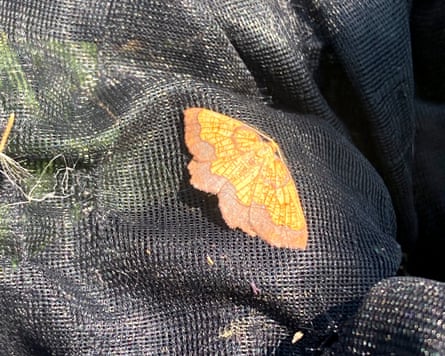
The dark bordered beauty is a moth with lemon-yellow wings and a deep chestnut border, sometimes described as custard-and-chocolate coloured. It is also one of the rarest moths in England.
Until this summer, Strensall Common in Yorkshire was the only known site where it survived in the country, and even that population has been collapsing. Hundreds of moths were recorded 20 years ago. The numbers record last barely reached double figures, hit by climate breakdown and a wildfire that tore through much of the reserve.
Wainwright, who is head of conservation in England at Butterfly Conservation, has spent years chasing that narrow margin across some of the country’s landscapes.
“I’ve been to a lot of remote places, particularly in Northumberland, Yorkshire and Cumbria,” he says. “I always felt the dark bordered beauty would be there. I had a sneaking suspicion, but whether or not I’d actually find it, I didn’t know.”
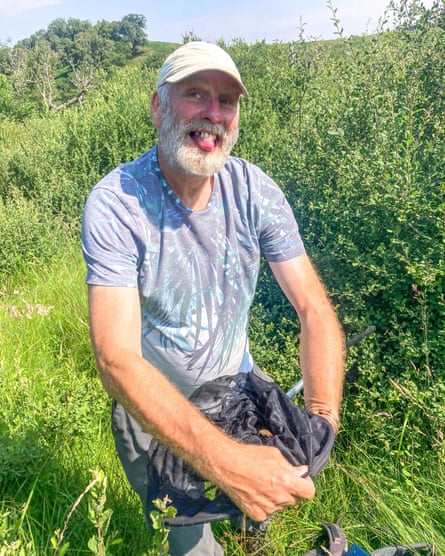
Looking back at that fruitless night in 2004, he now thinks the moth may have been there all along, hidden in plain sight in willow scrub too battered by grazing to support it. “It must have been there,” Wainwright says, “which makes it all the more rewarding.”
The site looks very different now to how it did back then. Where the willow was once cropped bare, there is now lush vegetation and wildflowers. This is the result of years of work between the National Trust and Fiona Goodfellow, a tenant farmer who manages the land as part of a nature recovery project spanning the estate’s 20 sq miles (5,200 hectares).
The discovery came out of a £300,000 grant awarded to Butterfly Conservation last year by the Elgol Fund for Nature to study how rare species across the north of England were coping with climate and human pressures.
For Wainwright, what makes the find matter is not just the science. It is what it means for a species he had feared was running out of time.
“Because I thought we were going to lose [dark bordered beauties] as a species,” he says, when asked why he calls this a highlight of his career.
“You don’t want a species to go extinct on your watch … you feel really powerless. It’s gratifying just knowing that the species isn’t as far down the road to extinction as we feared.”
One of the main challenges in conserving the species is that its caterpillar only eats two plants: aspen and creeping willow.
However, Wainwright still remains wary of moving too fast. The moth has survived at Wallington for more than 70 years without anyone intervening on its behalf, and he would rather understand exactly why the habitat works before anyone starts changing it.
“We wouldn’t want to rush into major changes,” he says. “You could do more harm than good by modifying it without knowing what you’re doing.”
Wainwright explains that as of right now, the work is mostly watching.
Butterfly Conservation is also in the early stages of a captive breeding programme, already planned in partnership with Yorkshire Wildlife Trust at Strensall Common. There is a longer-term hope of introducing the moth to new sites once the right conditions can be created.
Wainwright has spent his career doing the work of finding out what is actually out there and “putting dots on maps”, often in places barely anyone visits. He argues that this is important so that conservation money goes where it is needed most.
It is slow, forensic work, chasing eggs and caterpillars to work out what a moth needs to survive. But every so often, it pays off.
-
It’s invertebrate of the year! Vote here for your favourite before midnight on Sunday 16 August.

















 English (US) ·
  French (CA) ·