

 10 months ago
187
10 months ago
187
PROTECT YOUR DNA WITH QUANTUM TECHNOLOGY
Orgo-Life the new way to the future Advertising by Adpathway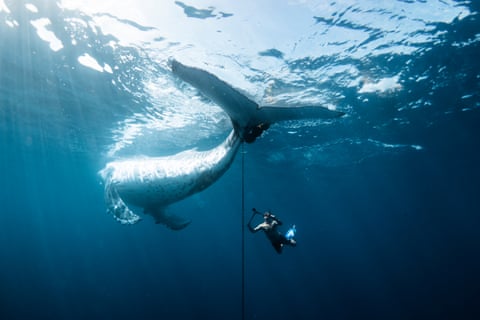
Here are some of the standout images from this year’s Nature Conservancy Australia Oceania photo contest. Winners were chosen from over 3,500 entries from across Australia, Aotearoa New Zealand, Papua New Guinea and Solomon Islands
Overall grand prize winner and people & nature category, first place: Tauhi
‘We answered a call about an entangled humpback whale thrashing in distress. Arriving, we saw a heavy rusted chain cutting deep into her tail. Diving in, we worked carefully and silently to free her.’ Photograph: Miesa GrobbelaarFri 21 Nov 2025 14.00 GMT
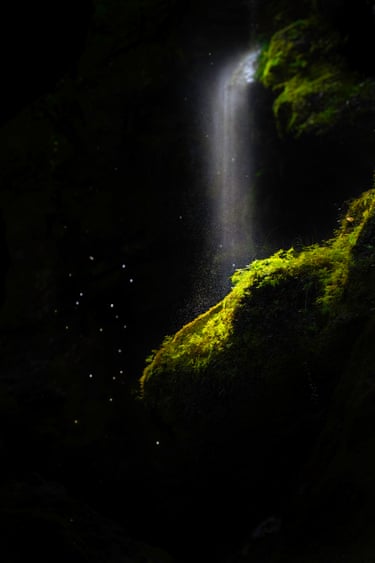
Lands category, third place: Nightfall
‘This photo was taken in Wilson Creek canyon about an hour north of Wanaka, New Zealand. This canyon creates beautiful lighting conditions and has water streaming down from all directions, so creates perfect conditions for these delicate photos.’Photograph: Olivia Wentzell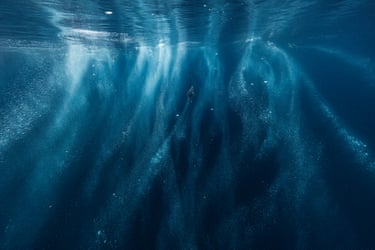
Water category, first place: Rocket
‘After feeding on swarms of krill beneath the Antarctic ocean, rafts of penguins return to the surface rocketing up from the depths leaving trails of bubbles resembling the jetstream of a plane. These bubbles act as a coat around the penguins, allowing them to reach speeds of more than 20km/h underwater, making them the fastest of any diving bird. Their streamlined bodies and strong “flippers” allow them to dive more than 200 metres to feed on swarms of krill in the Antarctic depths.’Photograph: Scott Portelli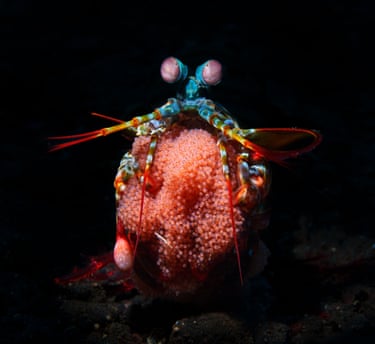
Water category, third place: Peacock Mantis and eggs
‘A female peacock mantis shrimp stands upright surveying the area, while holding her large clutch of red eggs.’Photograph: Peter McGee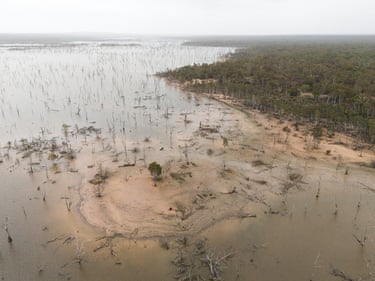
Climate category, first place: The Collapse of Green
‘This drone photography captures the forest fading under the weight of extremes. Floods and droughts have silenced the eucalyptus – some fallen, some standing like ghosts. Green life turns to grey, echoing the slow loss of balance in nature.’Photograph: Cheng Kang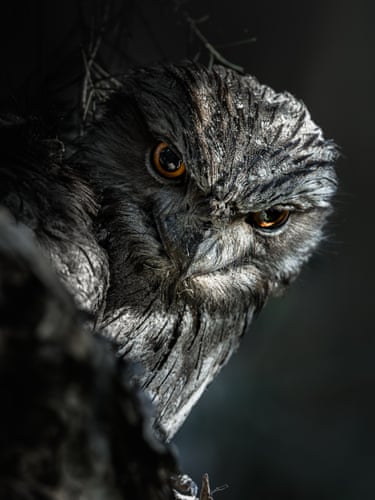
Wildlife category, first place: I’m Watching You
‘A curious young tawny frogmouth keeps a watchful eye on its surroundings.’Photograph: Donald Chin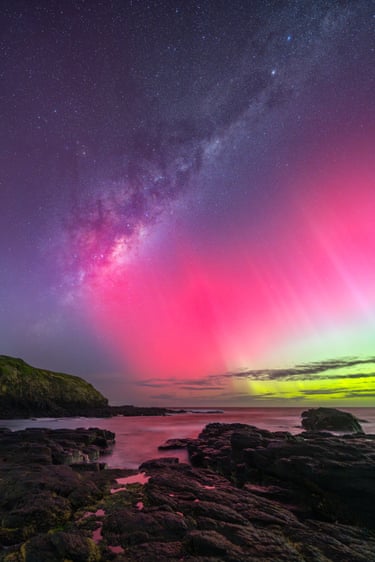
Lands category, second place: Aurora Australis
‘Captured during a once-in-a-lifetime solar storm in May 2024, Lady Aurora danced over the waters of Flinders blowhole.’Photograph: Dylan Giannakopoulos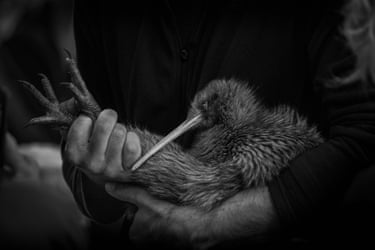
People & Nature category, second place: Return to the Wild
‘I had the immense privilege of attending the pōwhiri at Mākara village hall. After the formal welcome, Capital Kiwi team members gently lifted two large kiwis from their boxes, offering a rare, intimate glimpse of these taonga before release into a 23,000-hectare sanctuary – reclaiming a home unseen for over 150 years. This photo of a precious manu being cradled speaks volumes, capturing the deep care, reverence, and hope.’Photograph: Tony Stoddard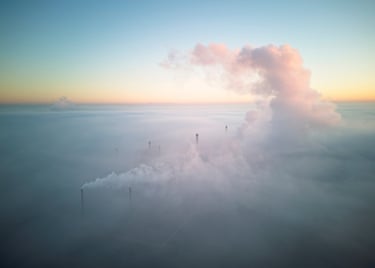
Climate category, second place: New Planet
‘This is a drone photograph taken from the largest petrochemical/plastic production plant at Melbourne suburb Altona. Is this our new future planet? I would like to invite viewers to contemplate our current environmental crisis.’Photograph: Chi Chan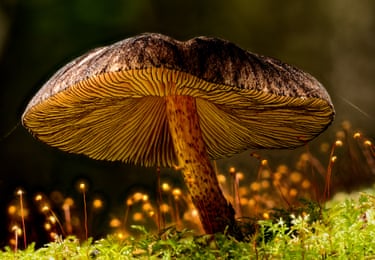
Plants & Fungi category, first place: Pluteus’ Fireflies
‘The endearing species Pluteus Velutinornatus with its velvety, mottled cap, almost animal like with lovely dark lined gills giving them so much dimension. I find myself greeting them with an audible “hello”. A couple of days prior I’d found this one before opening, a fuzzy mound … delighted to find it in immaculate condition on return, just catching the shifting sunlight through the forest. Holding domain over moss heads like tiny firefly.’Photograph: NicWooding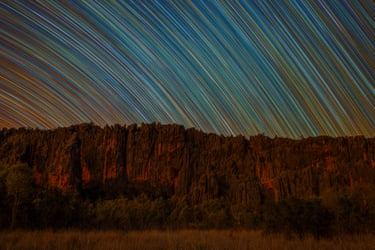
Lands category, first place: Winjana Gorge
‘The clear night skies in Winjana national park of Western Australia are incredible. The landscape is dramatic displaying the vibrant red rocks that overpower the landscape. Looking south to the Polaris star, the night sky moves slowly from dusk to dawn. Capturing the essence of the Australian night sky took more than 600 photos to show the movement of light in the night sky.’Photograph: Scott Portelli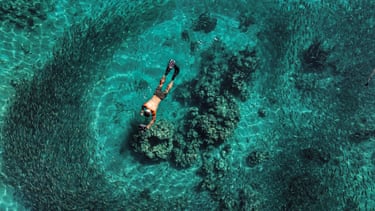
People & Nature category, third place: School Boy
‘While exploring the shallow waters, a school of curious yellowtail surrounded my cousin as he swam around the reef. Together, the fish find safety in numbers, a simple reminder of how together we are stronger. There is a message from all walks of nature.’Photograph: Tiana Reimann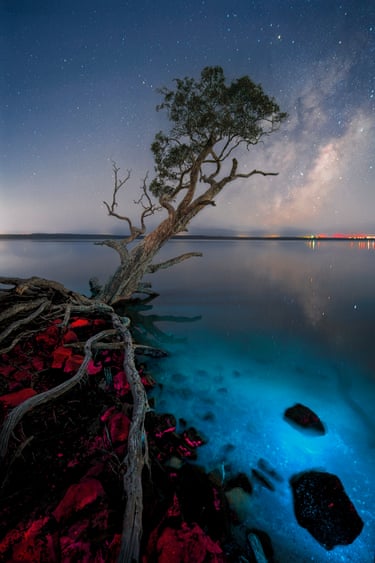
Water category, second place: I C E P O P
‘Would you believe me if I told you that in the natural world, it’s unusual for things to not glow? Everything. You, me, flowers, rocks, your dog, your goldfish – even water. We call the living stuff that does it biofluoresence. This is how much of the natural world sees itself – awash in the most garish and self-indulgent colours, but our weak human eyes never get to experience it. Imagine if we did.’Photograph: Benjamin Alldridge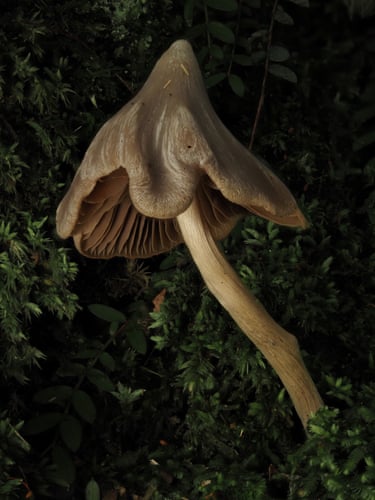
Plants & Fungi category, third place: Witch’s Hat
‘Hocus Pocus! One of the Anderson sisters’ hats is lost in the woods. With the unappealing colour, I almost haven’t taken any shots of this specimen. The one and single shot taken turns out unexpectedly stunning.’Photograph: Chin Kang Chia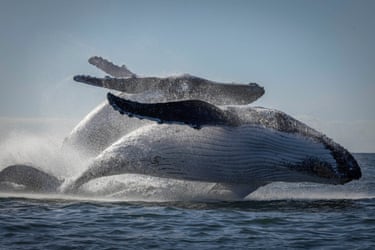
Wildlife category, second place: Double Breach
‘Two giant, school bus-sized, blubbery whales, sometimes weighing up to 40,000 kilograms, coordinated a jump at the same time. I took this image off the coast of Lennox Head, northern NSW, this winter, Saturday 5 July. We call it the humpback highway; every day you can see whales jumping. This was a rare opportunity to capture two at the same time.’Photograph: Danielle Smith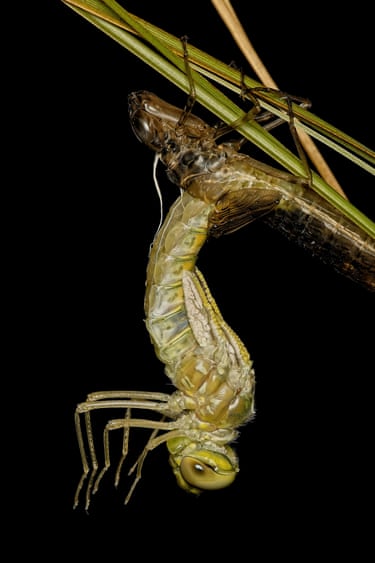
Wildlife category, third place: Emergence
‘On a warm summer’s night along a local lake, perched on reeds, adult dragonfly nymphs were emerging from their exoskeletons. I watched this moulting dragonfly slowly and gently remove itself from its previous skin with care and precision. The process can take hours but in this one single moment, I was able to capture the beauty of its transformation. A spectacular display of nature at its most beautiful in the darkness of night.’Photograph: Christine King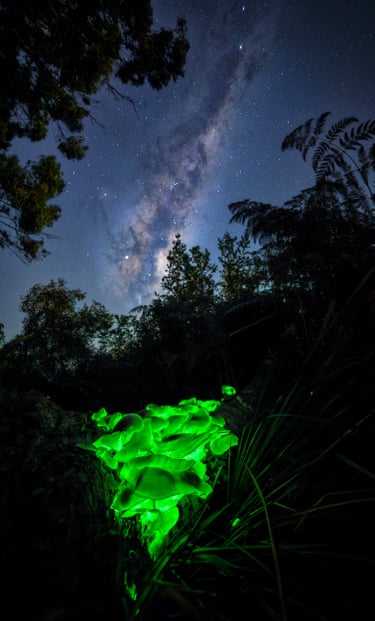
Plants & Fungi category, second place: Galactic Ghost
‘During the autumn months, Tasmania sees a brief explosion of a short-lived bioluminescent fungus, the so-called ghost fungus (Omphalotus nidiformis) in secluded damp forest patches affixed to rotting trees. Owing to their typical low position hidden underneath forest canopies, a view out to the night sky is very rarely afforded, much less on clear nights‚ making this view out to the crown jewel of the night sky, the galactic centre of the Milky Way, a truly once-in-a-lifetime opportunity.’Photograph: Benjamin Alldridge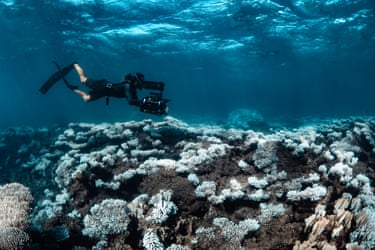
Climate category, third place: Bleached
‘An unprecedented heatwave struck the coast of Western Australia during the summer of 2024-2025. We headed out to document the worst coral bleaching event ever recorded on the Ningaloo reef. White skeletons of suffering corals swept far beyond what our eyes could see. An estimated 60-80% of our reef was bleaching before our eyes.’Photograph: Brooke PykeExplore more on these topics
















 English (US) ·
  French (CA) ·