

 15 hours ago
7
15 hours ago
7
PROTECT YOUR DNA WITH QUANTUM TECHNOLOGY
Orgo-Life the new way to the future Advertising by AdpathwayA satellite no bigger than a small carry on suitcase could help scientists investigate one of the least understood periods in cosmic history: the roughly 150 million years of darkness before the universe's first stars began to shine.
Developed in the UK, the spacecraft is called CosmoCube. An international research team led by the University of Cambridge plans to send it around the Moon, where the lunar far side can block radio interference coming from Earth. In that unusually quiet environment, CosmoCube will listen for an extraordinarily faint signal left behind by the early universe.
Listening for a Signal From Before the First Stars
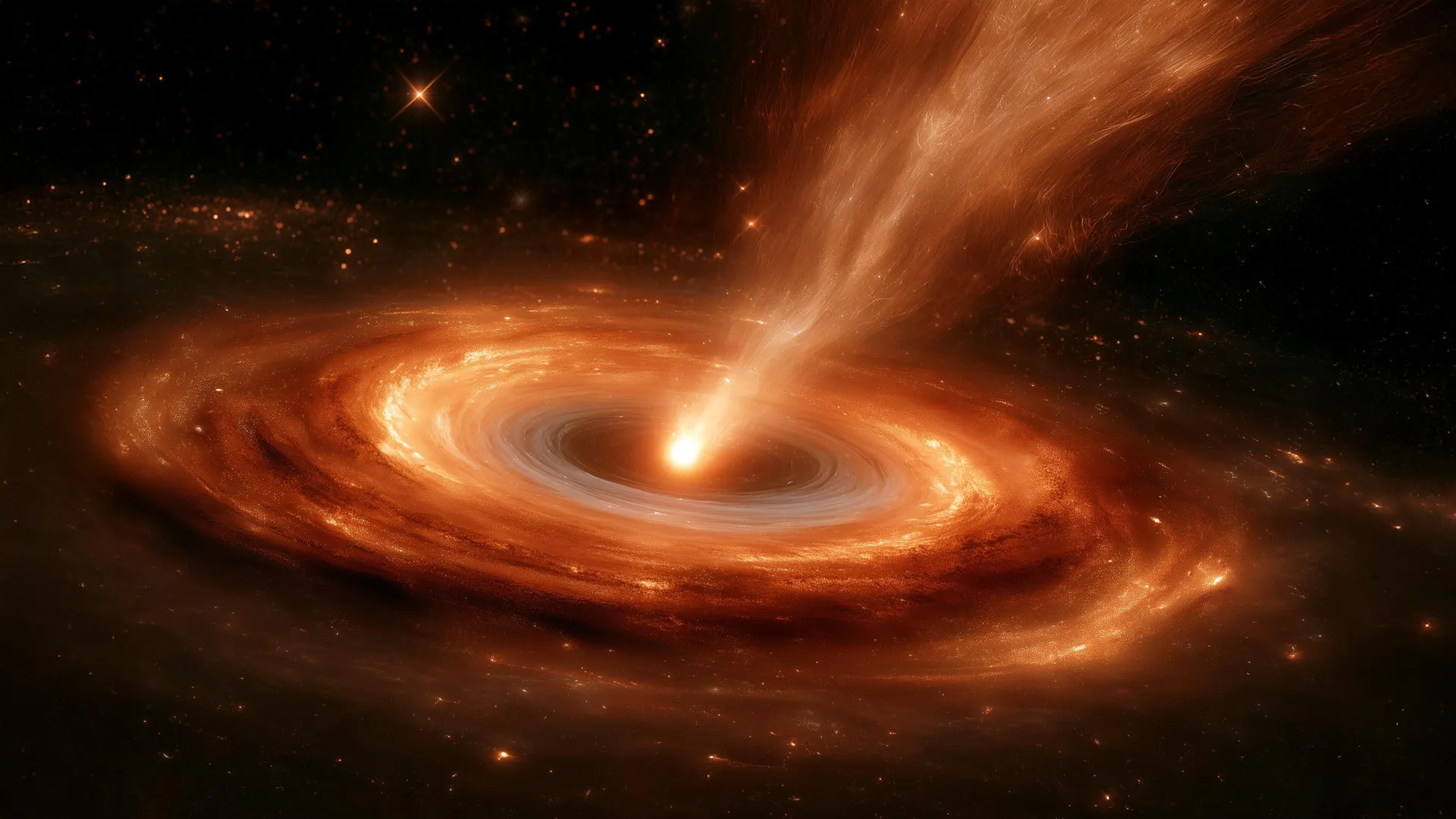
Scientists call this signal the 21 centimeter line. It comes from hydrogen atoms that existed during the period between the lingering afterglow of the Big Bang and Cosmic Dawn, when nuclear fusion switched on inside the first stars.
No one has directly observed this chapter of cosmic history.
The signal CosmoCube will seek originated more than 13.5 billion years ago, but detecting it from Earth is extremely difficult. Our planet's ionosphere prevents the relevant radio frequencies from reaching ground based observatories, while FM broadcasts, satellites and telecommunications produce additional interference that can overwhelm the faint cosmic signal.
The Moon offers a natural solution.
When CosmoCube passes behind the Moon, the lunar body will block radio noise from Earth for about 40 minutes during each two-hour orbit. Over the spacecraft's expected two-year mission, researchers hope to collect about 1000 hours of observations from one of the final largely unexplored eras in the universe.
Those measurements could help explain how the cosmos changed from a dark and relatively empty place into the rich universe of stars, galaxies and other structures seen today.
The project has received funding from the UK Space Agency, and researchers hope CosmoCube can launch within the next five years. Details of the mission have been published in Nature Astronomy.
Searching for Dark Matter's Early Influence
CosmoCube is designed to investigate more than the time before the first stars. Researchers also hope its observations will shed light on dark matter and its influence on the formation of the earliest cosmic structures.
Dark matter cannot be seen directly, but its gravitational effects are crucial for explaining how galaxies and other large structures hold together.
"This emission from hydrogen after the Big Bang, but before the first stars, will hopefully allow us to understand the role of dark matter in the early universe, how it worked to pull together hydrogen into the first stars and galaxies," said lead author Professor Eloy de Lera Acedo from Cambridge's Cavendish Laboratory.
To reach this ancient period, CosmoCube will observe radio frequencies between 10 and 50 MHz. These frequencies are largely inaccessible to telescopes operating from the ground, making the Moon an especially valuable location for the experiment.
"There's no other place where you can get the sort of shielding you need to detect such a faint signal, while at the same time looking at the whole of space," said de Lera Acedo, who is also affiliated with the Kavli Institute for Cosmology. "The far side of the Moon is really the only option: it solves multiple problems at once, opening a clear window to the very early universe."
Turning the Moon Into a Radio Shield
After reaching lunar orbit, CosmoCube will deploy a long, lightweight radio antenna. When the spacecraft moves behind the Moon, that antenna will search for the 21-centimeter hydrogen signal from the early universe while the lunar surface blocks interference from Earth.
Detecting such a weak signal requires extreme precision. CosmoCube will therefore continually monitor and adjust its own electronics using a 'Dicke switched' calibrator. The system will alternate between observing the sky and measuring several internal reference sources.
This process is intended to identify and remove tiny changes or electronic noise generated by the spacecraft itself, which could otherwise be mistaken for a signal from deep cosmic history.
Researchers will perform additional processing after the observations return to Earth. Advanced Bayesian statistical techniques will be used to separate the desired signal from foreground radio emissions, particularly those produced by our own galaxy.
Computer simulations and measurements gathered during the mission will also allow researchers to reconstruct how CosmoCube's antenna responds to different regions of the sky. Scientists can then correct for remaining distortions that might interfere with the results.
"Aside from the science, what makes our mission unique is its size: we're probing the earliest, deepest parts of the dark ages that others don't reach, but with a compact, relatively low-cost platform," said de Lera Acedo.
A Small Satellite With an Ambitious Mission
The radio silence available behind the Moon may become increasingly valuable. The US, India and other countries are also planning missions intended to take advantage of the unusually quiet radio environment on the lunar far side.
CosmoCube itself contains a highly integrated miniature radiometer that combines modern analog and digital technologies using so-called RF Systems on Chip technology (RFSoCs).
The CosmoCube spacecraft platform ('SSTL-21') is being developed in the UK by Surrey Space Technology Limited (SSTL), a company specializing in small satellite manufacturing.
Development of the instrument is already underway. Working laboratory prototypes have been built, environmental tests are being carried out, and researchers are collaborating with industry partners. UK academic partners include Portsmouth University and STFC RAL Space, while researchers from EU countries including Malta are also participating.
The CosmoCube team recently took part in the ESA mini Fast missions Call for Ideas, with the proposed mission targeting a cost below 50 million Euros.
"CosmoCube is aiming to do some ambitious science from a very small satellite in a challenging environment, and to do that requires some clever design techniques," said co-author Dr Will Grainger from STFC RAL Space. "We've worked with the project partners to develop representative models of the satellite and its payload. These have been tested in our facilities to ensure the thermal performance allows the payload to operate and perform the required sensitive measurements under the different temperature conditions it will experience whilst in orbit around the Moon. In the future, we hope to further develop the full payload in preparation for a full mission."
A New Window Into the Cosmic Dark Ages
If successful, CosmoCube could demonstrate that major discoveries about the earliest universe do not necessarily require enormous spacecraft.
Instead, a compact satellite positioned in one of the quietest radio environments available near Earth could provide scientists with access to an era that has so far remained beyond direct observation.
"This could be a real UK success story: the hardware, the software, the implementation and the technology is all being developed here, and it could help us answer one of the most profound questions in the universe," said de Lera Acedo.
The work was supported in part by the UK Space Agency, the Kavli Foundation, and the Science and Technology Facilities Council (STFC), part of UK Research and Innovation (UKRI). Eloy de Lera Acedo is a Fellow of Selwyn College, Cambridge.















 English (US) ·
  French (CA) ·