

 8 hours ago
10
PROTECT YOUR DNA WITH QUANTUM TECHNOLOGY
Orgo-Life the new way to the future Advertising by AdpathwayIn a rock shelter in Kakadu national park in the north of Australia is an image of a being the Bininj people call Namarrkon. His flesh bleached away to reveal the bones beneath, he wears stone axes on his head, elbows and knees, and wields a great band of lightning that runs from his ankles up, over his head.
Namarrkon’s journey from the Arafura Sea to the Arnhem Land escarpment helped shape the landscape, according to the dreamtime stories of the Bininj. And in the great storms that arc and rumble across the landscape during the buildup and the wet season, it is Namarrkon who splits the clouds with his stone axes to create the thunder and lightning and release the life-giving rain.
Around the world there are an average of 60 lightning flashes a second, some extending more than 800km. Each flash can release up to seven gigajoules of energy, the equivalent of 1.67 tonnes of TNT, fleetingly heating the air around it to about 30,000C, five times hotter than the surface of the Sun. This constant discharge of energy plays a vital role in regulating Earth’s electrical field and the ionosphere. It helps drive the nitrogen cycle by cracking open nitrogen molecules in the atmosphere and making them available to plants, aiding in the production of ozone, and helping break down greenhouse gases such as methane. And it underpins the cycles of fire that shape the ecologies of forests, savannahs and grasslands across the planet. Lightning, as the story of Namarrkon captures, is an integral part of life on our planet.
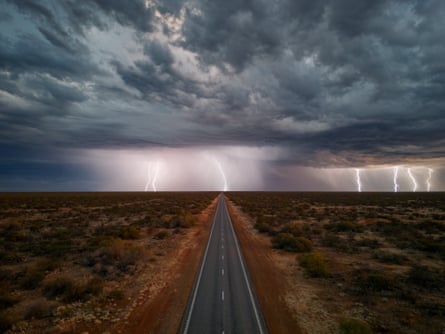
Yet as the planet heats up, not just lightning’s role in these systems but lightning itself may be changing. And the consequences of this could be severe. In July more than 48,000 lightning strikes ignited massive wildfires in Canada and the north-west United States, destroying homes and casting a pall of smoke over cities across North America. During last summer’s British heatwave, nearly 30,000 lightning strikes hit south-east England in a single day.
Already, globally around a quarter of a million people are struck by lightning every year, resulting in about 24,000 deaths. In Australia alone lightning kills five to 10 people a year and injures about 100.
Invisible fluids and cosmic rays
The awesome power of lightning is written deep into human cultures around the world. Frequently it expresses a kind of duality, conjuring beauty as well as terror: from the earliest-known poet, the priestess Enheduanna, describing her goddess as having a “glance like striking lightning” to gods whose domain includes both storms and agriculture in ancient Mesopotamian, Maya and Aztec cultures.
Often those who wield the lightning are protectors of humankind: in the Rig-Veda of ancient India, Indra slays the evil serpent Vritra with a thunderbolt and releases the rains and the rivers, while the Norse thunder god Thor was a guardian of humans. And many Native American cultures across the Pacific north-west, Great Lakes and Great Plains incorporate a powerful being known as the Thunderbird, who safeguards humankind.
Although writers and philosophers have sought a physical explanation for lightning for more than 2,000 years, it was not until the 18th century that the American polymath Benjamin Franklin proved the connection between the discharge of static electricity and lightning. Franklin theorised electricity was an invisible fluid that could be passed from object to object or held in substances such as water vapour.
Scientists no longer speak of invisible fluids. Instead, lightning is understood to be created when warm, moisture-laden air rises into the cold upper reaches of storm clouds. As the temperature falls, the water vapour condenses and forms tiny ice crystals. These collide with particles of soft ice called graupel, passing electrons from the ice crystals to the graupel. Now positively charged, the smaller, lighter ice crystals begin to rise into the upper reaches of the cloud, while the heavier, negatively charged graupel sink. As they move away from each other the resulting electrical field grows more intense, until finally the difference between the two neutralises in a sudden discharge of energy. It’s this discharge we see as lightning.
However, the question of precisely what triggers the discharge is still not yet fully understood. This is partly because the electrical fields generated by this process are only about a tenth as strong as they need to be to generate a spark. Recent research suggests it is cosmic rays that provide the spark, although other studies point to the runaway buildup of “streamers” of ionised air.
More than 80% of these discharges take place over land, and although the distribution of lightning changes with the seasons, it is concentrated in central Africa, parts of South America and the Himalayas. The most lightning-prone place in the world is in Venezuela, in an area known as Catatumbo, or “House of the Thunder” in the language of the Bari people, where warm, water-laden air blowing in over Lake Maracaibo collides with the high ridges of the Andes and can generate thunderstorms on 140 to 160 nights a year. By contrast lightning is extremely rare in polar regions.
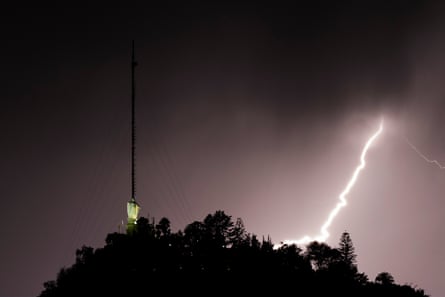
But while the bulk of lightning occurs over land, particularly storm-prone areas of the ocean can achieve far higher densities of flashes: in one 1998 storm in the Indian Ocean lightning flashed eight times a second, so often that to the human eye it would seem the sky was permanently illuminated. And, in a testament to the power of human activity to shape the weather, storms over the ocean are also enhanced over shipping lanes. Aerosol particles emitted in the exhaust of ships appear to be changing the process of cloud formation.
Lightning without storms
As the climate crisis heats the atmosphere it seems reasonable to assume that thunderstorm activity will increase. A warmer atmosphere holds more water vapour and the additional heat provides more energy to drive deep convection within thunderclouds. Yet the reality is more complicated than this suggests.
A recent review of lightning studies now under peer review finds that projections ranged from an 11% decrease to a 44% increase in lightning per degree of global warming, with a mean increase across all projections of 7.5% per degree. Despite considerable uncertainty about how tropical regions will be affected, it also finds broad agreement lightning will increase in high latitudes.
Andrew Dowdy is associate professor in climate science in the School of Geography, Earth and Atmospheric Sciences at the University of Melbourne, and one of Australia’s leading experts on lightning. He says that while “it’s clear that in a warmer world, some of the conditions that are conducive to thunderstorms and lightning can be enhanced”, there are still “large uncertainties” when it comes to understanding how lightning will be affected by climate change.
Some of these uncertainties relate to the difficulty of modelling the fine-scale processes that cause lightning, others to the relative paucity of high-quality, long-term data relating to lightning; until the launch of satellites capable of measuring lightning from space in the 1990s it was necessary to rely on ground-based observations and regional radar. Nonetheless, by combining records relating to cyclones and fronts with thunderstorm data, Dowdy and his colleagues have been able to track the frequency of such events as far back as 1979. This has revealed an increase in such events along the eastern coasts of continents alongside a poleward shift in cyclone activity in the southern hemisphere.
Separate research by Dowdy has found that while thunderstorm activity has increased in eastern and south-easternAustralia, other areas, especially in the tropical north, have experienced a decline.
But lightning can strike without a storm.
Just last week, a report released by the Emergency Leaders for Climate Change in Australia warned that the number of fires started by dry lightning – lightning that strikes the ground without accompanying rain – was increasing. The advocacy group noted that forests in Australia’s south-east recorded 50% more dry lightning strikes in 2000–2016 than in the previous two decades, helping create a “step change in fire conditions”.
“Lightning is the natural ignition source of fires,” says Dowdy, who also notes that “lightning fires tend to burn larger areas on average compared to fires that are ignited by humans. And that’s because lightning can occur in remote places that are hard for response crews to get to, but they can also occur in large clusters.”
The connection between any increase in dry lightning and fire is not straightforward, however. In Tasmania the number of fires sparked by dry lightning events has increased significantly since the 1990s. The fires that devastated Tasmania’s remote north-west in 2025 were sparked by a massive lightning storm that saw more than 1,200 lightning strikes reach the ground in less than 24 hours. Yet while it was lightning that started the fires, the landscape was already primed to burn by a combination of unusually dry conditions, strong winds and high temperatures, a convergence of factors that is rapidly intensifying as the planet heats up.
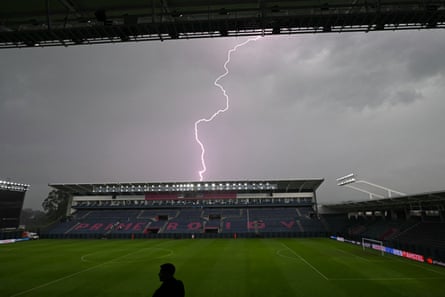
“It’s clear that in a warmer world you get more dangerous conditions for fire weather in many places,” Dowdy says.
Similar mechanisms are at work elsewhere in the world, perhaps most visibly in the United States, where dry lightning is combining with increasingly dangerous fire conditions to create megablazes such as the August Complex blaze, which burned more than 4,000 square kilometres in northern California in 2020.
Lightning in the fire cloud
More intense fires are driving an increase in another form of lightning, however.
When fires grow ferocious enough they can begin to create their own weather, as the heat and moisture they release can combine into giant thunderheads known as pyrocumulonimbus (pyroCb). Turbocharged by the intense heat of the fires, these terrifying formations reach far higher than ordinary storm clouds, often boiling up into the stratosphere, creating a massive vortex which sucks the moisture released by the fire up into the upper reaches of the atmosphere at speeds that can exceed 200 km/h. There, in the swirling darkness of these monstrous structures, this moisture freezes, collides and creates lightning.
Until recently, pyroCb storms were relatively unusual, but in the past decade they have become increasingly frequent, not just in Australia but in the United States, Canada and Russia, and most recently Europe, where one was reported during the fires that devastated France in July and August of this year.
Jason Evans is a professor at the Climate Change Research Centre at the University of New South Wales. He says there has been a “massive increase” in the number of pyroCB events in Australia. In the black summer fires of 2019-2020, he notes, there were almost as many recorded as in the 40 years prior combined.
PyroCb are not just a symptom of our planet’s increasingly deranged fire cycle, they also create feedback loops, spreading and intensifying the fire, as lightning strikes and embers borne by the strong winds they generate start new fires. This process can extend across very wide areas: during Australia’s black Saturday fires in 2009 pyrogenic lightning from a 15-kilometre high pyroCb ignited new fires 100 kms ahead of the fire front.
Evans says that once a pyroCb “kicks off”, it’s “not containable. We can’t control it really at all. All we can do is get out of the way. They’re even too dangerous for the firefighting aircraft to try and get close enough to get their water on to.”
The spectacle of pyroCbs is just one more example of the way human activity is transforming the planet. Whereas we once were at the mercy of the lightning, now we are helping create it. What this will mean for us and our world remains unclear. For as the stories of the Bininj and others remind us, lightning has always embodied an uneasy duality. Simultaneously beautiful and terrible, feared as well as exalted, it can be both life giver and destroyer.

















 English (US) ·
 French (CA) ·