

 2 months ago
102
2 months ago
102
PROTECT YOUR DNA WITH QUANTUM TECHNOLOGY
Orgo-Life the new way to the future Advertising by AdpathwayTomato plants may have gained a new genetic ally in the fight against drought. Researchers from Xinjiang University and the Xinjiang Uygur Autonomous Region Academy of Agricultural Sciences have identified a transcription factor called SlbHLH70 that helps tomatoes survive water shortages and recover after rewatering. Their findings suggest that this gene acts as a regulatory hub, coordinating hormone signals, stress responses, and root growth to help plants remain productive in increasingly dry and unpredictable environments.
The discovery comes at a time when water scarcity is placing unprecedented pressure on agriculture. Drought is one of the most destructive environmental stresses affecting crops, limiting photosynthesis, stunting growth, disrupting development, and reducing yield. Tomatoes, scientifically known as Solanum lycopersicum, are particularly vulnerable because their productivity depends on a reliable water supply throughout the growing season. Although plants possess sophisticated systems for sensing and responding to dehydration, many of the genes that connect these systems remain poorly understood.
SlbHLH70 belongs to the basic helix–loop–helix, or bHLH, family of transcription factors. These proteins bind specific DNA sequences and regulate the activity of other genes involved in plant development and stress adaptation. The research team found that SlbHLH70 was rapidly activated when tomato plants were treated with polyethylene glycol, a compound commonly used to simulate drought in laboratory experiments. The gene also responded strongly to methyl jasmonate, a chemical signal associated with jasmonic acid, or JA, a plant hormone involved in defense and stress responses. Its reaction to abscisic acid, or ABA, was more complex, suggesting that SlbHLH70 is integrated into several overlapping signaling pathways.
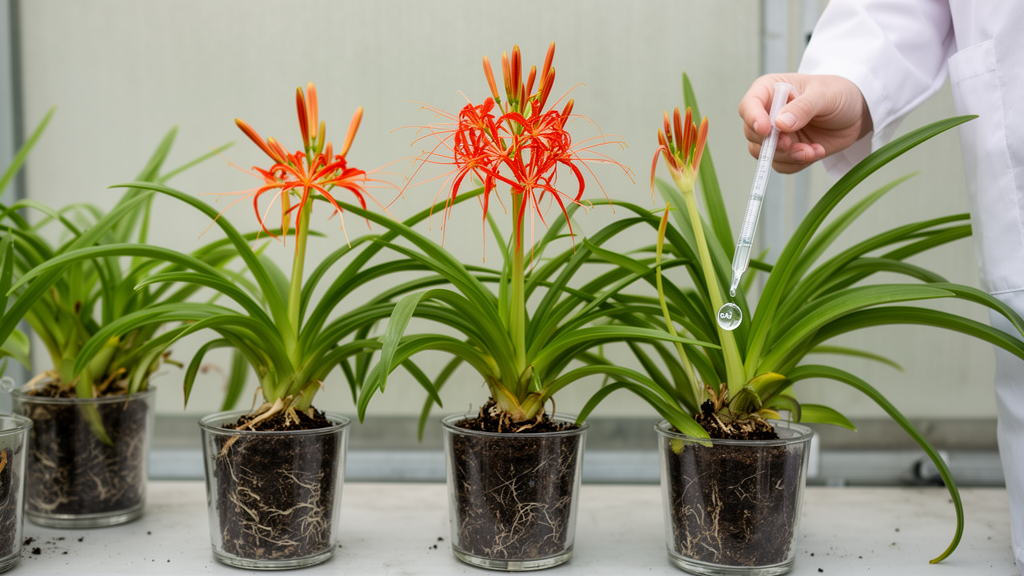
To test whether SlbHLH70 directly affects drought resistance, the scientists produced genetically modified tomato lines with increased SlbHLH70 activity, known as overexpression lines. They also generated knockout plants in which the gene was disabled using CRISPR/Cas9 genome editing. When the plants were exposed to drought and then rewatered, approximately 60 percent of the overexpression plants survived after severe wilting. By comparison, fewer than 40 percent of wild-type plants recovered. The knockout plants suffered more extensive damage and showed a weaker ability to resume growth after water was restored.
The difference between the plant lines indicates that SlbHLH70 is not merely associated with drought tolerance but contributes directly to it. Plants with elevated SlbHLH70 activity maintained greater resilience during dehydration, while those lacking the gene were more susceptible to water loss. The results also highlight the importance of recovery. A plant’s ability to survive a drought is only part of the challenge; it must also rebuild cellular function, restart growth, and resume development after rainfall or irrigation returns.
The researchers used DNA affinity purification sequencing, or DAP-seq, together with RNA sequencing to investigate how SlbHLH70 works at the molecular level. This combined approach allowed them to identify genes that are both physically targeted by the transcription factor and responsive to drought-related changes in gene activity. The analysis revealed 151 drought-responsive genes bound by SlbHLH70. Electrophoretic mobility shift assays, which test whether a protein can attach to a particular DNA sequence, confirmed direct binding to the promoters of several key genes.
Among the targets were SlSnRK2.1, SlPYL8, SlPP2C5, and SlCYP707A2, genes connected to ABA production and signaling. ABA is often described as the central hormone of drought response because it helps plants close their stomata, the microscopic pores that regulate gas exchange and water loss. It also activates protective genes and alters growth patterns during dehydration. By influencing multiple components of the ABA pathway, SlbHLH70 appears to help tomatoes fine-tune both the production of the hormone and the cellular machinery that detects and transmits its signal.
The study also links SlbHLH70 to jasmonic acid accumulation and root architecture. Roots are critical during drought because deeper, longer, or more extensively branched systems can access water reserves that remain unavailable to shallow roots. The researchers found that overexpression plants developed stronger root growth under water-limited conditions. SlbHLH70 directly interacted with promoters of root-development genes including SlCycA2;1 and SlLBD40, providing a possible molecular explanation for the improved root system. The gene therefore appears to connect internal stress signaling with a physical change that can improve water acquisition.
The findings place SlbHLH70 at the center of a broader drought-response network rather than assigning it a single isolated function. By coordinating ABA biosynthesis, ABA signal transduction, JA-related responses, and root development, the transcription factor helps plants link environmental perception with physiological adaptation. The researchers say this type of regulatory integration may be more valuable for crop improvement than targeting only one visible trait, such as leaf color or stomatal behavior. A plant that tolerates drought effectively must adjust its metabolism, conserve water, maintain cellular protection, and continue exploring the soil for moisture.
SlbHLH70 could eventually become a candidate gene for breeding tomato varieties adapted to dry climates, while its downstream targets may serve as molecular markers for screening diverse tomato germplasm. However, the work was conducted primarily under controlled experimental conditions, and field trials will be needed to determine whether increased SlbHLH70 activity improves yield, fruit quality, and long-term performance under natural drought patterns. Even so, the discovery offers a promising genetic route toward tomatoes that can withstand water shortages and recover more effectively when conditions improve. As drought becomes more frequent and severe, understanding how plants coordinate hormones, genes, and root growth could prove essential for protecting future food production.
Subject of Research: Not applicable
Article Title: Transcription factor SlbHLH70 enhances drought tolerance in tomato
News Publication Date: 5 March 2026
Web References: https://academic.oup.com/hr/article/13/6/uhag075/8506996
References: DOI: 10.1093/hr/uhag075
Image Credits: Horticulture Research
Keywords: tomato, drought tolerance, SlbHLH70, bHLH transcription factor, CRISPR/Cas9, abscisic acid, jasmonic acid, root development, plant stress biology, crop breeding
Tags: basic helix-loop-helix transcription factorsdrought tolerancegene regulation in drought-stressed cropsgenetic engineering for drought resilienceimproving tomato yield under water deficitplant dehydration recovery mechanismsplant hormone regulationroot growth under droughtSolanum lycopersicum drought adaptationtomato stress responsetranscription factor in plantswater scarcity and crop resilience


















 English (US) ·
  French (CA) ·