

 5 hours ago
11
5 hours ago
11
PROTECT YOUR DNA WITH QUANTUM TECHNOLOGY
Orgo-Life the new way to the future Advertising by AdpathwayTory plan to cut energy efficiency rule for builders will cost new home owners £1,000 a year, says thinktank
The Tory proposal to get rid of the Future Homes Standard (see 8.51am and 3.33pm) has been described as the equivalent of a £1,000-a-year “new homes tax” for homeowners.
E3G, a climate change thinktank, has made the argument on the basis that, without the rule, which requires new homes to have low-carbon heating, owners will pay at least £25,000 more in running costs over 25 years.
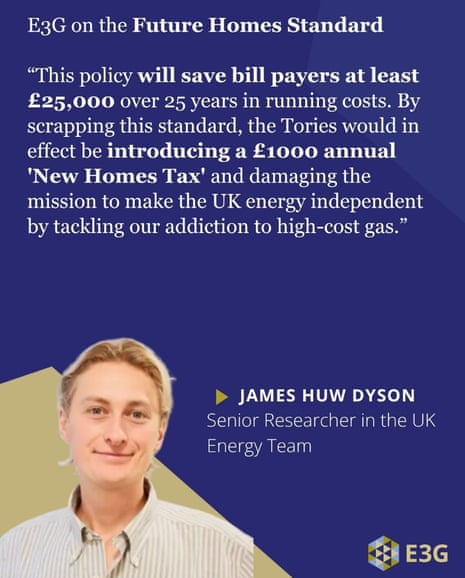
In a post on LinkedIn, James Dyson, a researcher at E3G, said:
The UK’s shadow chancellor will announce today that the Conservative party would axe the Future Homes Standard if elected. This policy cuts energy bills and emissions in new build homes by requiring builders to fit new homes with heat pumps and solar panels instead of gas boilers. Heat pumps and solar panels offer dramatically lower running costs than homes fitted just with gas boilers, to the tune of around £1,000 a year in a 3-bed house.
The small additional upfront cost is quickly recovered by homeowners and protects them from price shocks on the volatile fossil fuel market. If the government builds all its promised 1.5 million new build homes to the Future Homes Standard, this will save bill payers around £35bn on their energy bills over 25 years, and stops 41m tonnes of dangerous carbon dioxide from being released into the atmosphere.
Cutting this policy would be a disaster for first time buyers and businesses working in one of the fastest growing sectors in the UK economy.
Key events 13m ago Early evening summary 16m ago How Tories have become the M&S party 34m ago Voters more likely to oppose than back Tory plan to lift £100,000 cap on eligibility for free childcare, poll suggests 1h ago Tory chair Kevin Hollinrake says voters trust Badenoch, 'but they don't trust us' 1h ago Tory plan to cut energy efficiency rule for builders will cost new home owners £1,000 a year, says thinktank 2h ago Griffith says Tories have duty to offer young people better future 2h ago Griffith says Tories will get rid of Labour's mansion tax 2h ago Griffith says cutting tax will be his main priority 2h ago Griffith says he is comfortable making unpopular decisions 2h ago Griffith says Tories imposed too much regulation when they were in power 3h ago Shadow chancellor Andrew Griffith speaks at Tory conference 3h ago Getting rid of low-carbon rules for new homes 'makes no sense', says trade body 3h ago Former Green co-leader Adrian Ramsay suggests party should change its conference voting rules 4h ago Jeremy Clarkson speaks at Tory conference to highlight difficulties facing farmers 4h ago What impact will Green's party's 'Zionism is racism' vote have on Zack Polanski's byelection prospects? 5h ago Investors criticise Tories for proposing to get rid of regulations making new homes environmentally resilient 5h ago No 10 insists RAF Fairford is safe after US withdraws its bombers 5h ago 'There can be no economic growth on dead planet' - Greens accuse Tories of ignoring reality of climate crisis 5h ago Reform UK says Tories 'treating people like fools' by planning to scrap red tape they introduced 5h ago Head of Jewish Greens says she may leave party over ‘Zionism is racism’ vote 7h ago Scottish government on course to miss its child poverty targets 'by miles', thinktank says 7h ago Britons won't feel safer with US bombers no longer based at RAF Fairford, Griffith says 7h ago Tories will abolish Climate Change Committee, shadow energy secretary Andrew Bowie says 8h ago Tories would legislate to force Scottish government to allow new nuclear power station, shadow energy secretary says 8h ago Tories remain 'broad church' despite Badenoch's candidate vetting, shadow chancellor Andrew Griffith says 9h ago Labour rejects Tory call for Environment Agency and Natural England to be abolished 9h ago Why Tories claim their proposals could cut cost of building new homes by up to £50,000 10h ago Zack Polanski banned from Israel after Green party votes to equate Zionism with racism 10h ago Tories accused of copying Reform UK after shadow chancellor says axing red tape could cut cost of new homes by £50k
Early evening summary
-
The Tory proposal to get rid of the Future Homes Standard (see 8.51am and 3.33pm) has been described as the equivalent of a £1,000-a-year “new homes tax” for homeowners by a thinktank. (See 4.56pm.)
For a full list of all the stories covered on the blog today, do scroll through the list of key event headlines near the top of the blog.

How Tories have become the M&S party
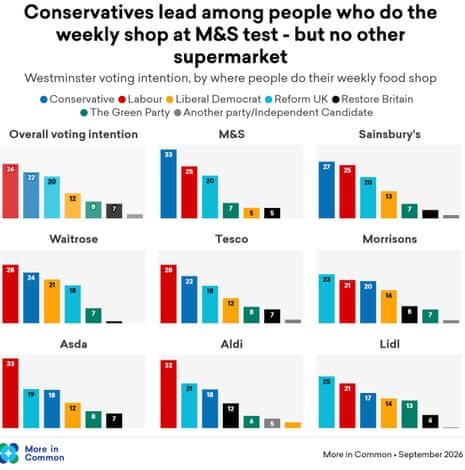
Labour is the most popular party with people who do their weekly shopping at Asda, Aldi, Tesco and Waitrose, according to polling by More in Common. Reform UK is the most popular party with people who favour Lidl and Morrisons. But the Tories have the edge with M&S and Sainsbury’s shoppers, the poll suggests.
This is what More in Common says in a write-up of its polling.
The Conservatives lead clearly among M&S shoppers and narrowly among Sainsbury’s shoppers, but are behind on all other supermarkets. That reflects their voter coalition, which is older, wealthier and concentrated in the least deprived parts of the country.
The only generation where the Conservatives have a lead are the over 75s, at 40%. Their vote share is no higher than 20% with voters under the age of 60, and are polling at just 11% with Gen Z.
If you’re on the right and earn over £40,000, you’re more likely to vote Conservative; if you earn less, you’re more likely to vote Reform.
In the least deprived tenth of wards, the Conservatives won 36% of the councillors up for election in May. In the most deprived tenth, that falls to just 3%.
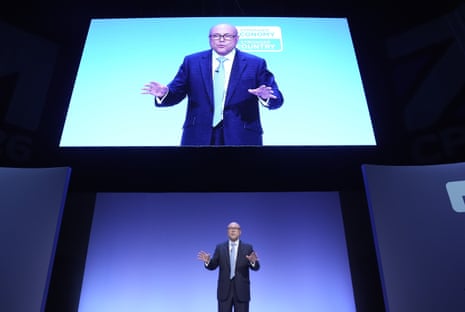
Two leading business organisations have welcomed what Andrew Griffith said in his speech.
This is from John Foster, chief policy and campaigners officer at the CBI.
Andrew Griffith is right to put competitiveness and the conditions for private-sector growth at the heart of the economic debate.
Businesses have been telling us consistently that the cumulative weight of tax, regulation, high energy costs and delays to major investment is making it harder to hire, invest and grow. So it is encouraging to see a number of issues the CBI has been pressing across the political spectrum reflected here — particularly tax simplification, reducing the regulatory burden, support for Heathrow expansion and a determination to accelerate new nuclear.
And this is from Kate Shoesmith, director of policy at the British Chambers of Commerce.
We welcome the shadow chancellor’s pledge to cut taxes and give firms some breathing space on their future bills. This is central to allowing them to plan with confidence and unlock much needed investment in the UK economy.
Voters more likely to oppose than back Tory plan to lift £100,000 cap on eligibility for free childcare, poll suggests
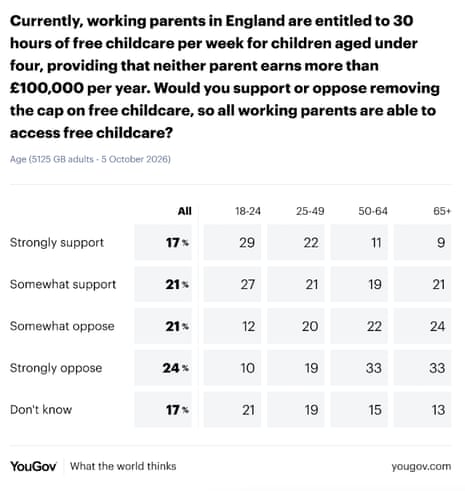
Voters are more likely to oppose (45%) than support (38%) the Conservative plan to get rid of the cap that stops people earning more than £100,000 getting free childcare, according to polling by YouGov.
Prospect, a union representing many of the workers at the the Environment Agency and Natural England, has criticised the Tory proposal to scrap both quangos. Mike Clancy, its general secretary, said:
It is ridiculous for the Conservatives to blame environmental regulators for the housing crisis, especially when its own MPs are often among the most vociferous opponents of new housing developments.
The reality is that Conservative budget cuts have left these regulators struggling to perform their vital functions with “lack of resources” the most common reason for planning delays. The solution is to restore their funding to adequate levels, not scrap vital safeguards, as both the Corry and Fingleton reviews recommended.
This announcement is further proof that the politics of deregulation are a dead end, offering no solution to the challenges this country faces while putting safety and the environment at risk.
Tory chair Kevin Hollinrake says voters trust Badenoch, 'but they don't trust us'

Rowena Mason
Rowena Mason is the Guardian’s Whitehall editor.
Shadow cabinet ministers have been told by polling expert Luke Tryl that Kemi Badenoch has broken through but the Conservative party as a whole has not.
He said people who seen clips of Badenoch in PMQs have a 20-points higher opinion of her than those who have not, and that the Conservatives were doing a lot better with women than men.
However he said the conundrum for the Tories was how to convert voters who like Badenoch into Conservatives backers - as only a third of those who like her would support the Tories at the moment.
Tryl also described a demographic split for the Tories, saying they “held the M&S vote” but had “lost the Waitrose vote” to more liberal-left parties.
Listening to the challenging news at the More in Common fringe at Conservative party conference were shadow cabinet ministers Chris Philp, Nick Timothy, and Victoria Atkins.
Kevin Hollinrake, the party chairman, acknowledged the Tories had lost trust and said he does not believe Andy Burnham will call an election soon when it “doesn’t look winnable”.
“People do trust Kemi but they don’t trust us,” he said.
But he said he took cheer from the fact the Tories were “the least hated political party in the country”, which could be good for tactical voting.
Philp, the shadow home secretary, said Burnham was impressive on one level but disappointing on another as he was “not addressing problems today” and had “retreated to his comfort zone” on the EU and electoral reform.
Ruth Davidson, the former Scottish Tory leader, said one of the best things about Badenoch was that she had rejected the idea of “uniting the right” and there was a dividend to be won from tactical voters on the right and left who might support the Tories to keep another party out.
The Campaign to Protect Rural England has also criticised the Tory plans to scrap many building regulations. (See 8.08am.)
In a statement, Roger Mortlock, its chief executive, said:
Although the shadow chancellor is right that new homes can cost too much and take too long to build, his plans put at risk important protections for the countryside that we know the public value.
Scrapping the Future Homes Standard means more solar panels on green fields, not on new roofs. It isn’t ‘anti-aspirational’ to want homes that are warm, cheap to run and built in the right places, and decades of experience show big developers won’t deliver them without government intervention.
We welcome a simpler infrastructure levy that gives local communities real power over where the money goes. But cutting red tape is no silver bullet. If it were, the new 800,000 homes that already have planning permission would already be housing young families.
Tory plan to cut energy efficiency rule for builders will cost new home owners £1,000 a year, says thinktank
The Tory proposal to get rid of the Future Homes Standard (see 8.51am and 3.33pm) has been described as the equivalent of a £1,000-a-year “new homes tax” for homeowners.
E3G, a climate change thinktank, has made the argument on the basis that, without the rule, which requires new homes to have low-carbon heating, owners will pay at least £25,000 more in running costs over 25 years.
In a post on LinkedIn, James Dyson, a researcher at E3G, said:
The UK’s shadow chancellor will announce today that the Conservative party would axe the Future Homes Standard if elected. This policy cuts energy bills and emissions in new build homes by requiring builders to fit new homes with heat pumps and solar panels instead of gas boilers. Heat pumps and solar panels offer dramatically lower running costs than homes fitted just with gas boilers, to the tune of around £1,000 a year in a 3-bed house.
The small additional upfront cost is quickly recovered by homeowners and protects them from price shocks on the volatile fossil fuel market. If the government builds all its promised 1.5 million new build homes to the Future Homes Standard, this will save bill payers around £35bn on their energy bills over 25 years, and stops 41m tonnes of dangerous carbon dioxide from being released into the atmosphere.
Cutting this policy would be a disaster for first time buyers and businesses working in one of the fastest growing sectors in the UK economy.
And here is Griffith’s peroration.
The time is coming when Britain decides it’s had enough of mortgaging its future, where hard work triumphs, where people will no longer be used as cash machines for the benefit of others, while their own hopes and dreams slip from their grasp …
When the story of Britain’s next economic comeback is written, it will be a Conservative story. Every generation has its destiny. This is ours.
Griffith says Tories have duty to offer young people better future
Griffith says he wants young people to feel hope.
What those speeches and banners in Liverpool last week failed to understand. Labour thinks hope is something you can hand out, like a type of food stamp.
But hope is something people find for themselves when they believe their lives are getting better, that they have more choices, more freedom.
A society that cannot offer hope to its young people has little hope for its own future.
As parent of lockdown generation children myself, I feel this strongly.
I sometimes see the uncertainty in the eyes of that generation, their worries whether things will really be OK.
Too many are already voting with their feet.
Last year, an average of 350 young people left Britain to live elsewhere every single day, the equivalent of a jumbo jet, taking with it their hopes, dreams and ambitions.
Because, like all young people down the generations, they are looking for better jobs, a better life because they see other societies offering hope, while Britain under Labour offers more of the same.
Many Labour MPs spend their time talking about safe and legal routes for asylum seekers to come here.
Well, what about safe and legal routes for our own young people to get a job, buy a home, have a good life? Does that not count?
What kind of government is so passive in the face of its young people leaving?
And what kind of future would it be where grandparents must travel across continents just to spend time with their grandchildren?
Conference, it’s our duty to offer those young people a better future.
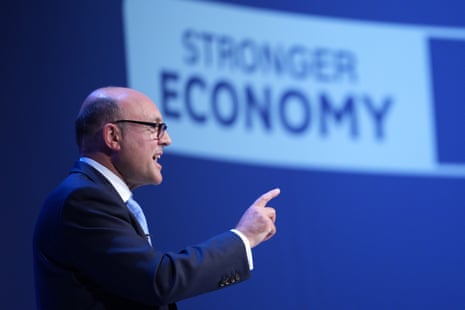
Griffith confirms his plans to cut red tape announced overnight. (See 8.08am.)
And he confirms the Tories will get rid of the “job-destroying” Employment Rights Act.
Griffith says Tories will get rid of Labour's mansion tax
Griffith says the Tories would get rid of Labour’s proposed council tax surcharge for expensive homes, also known as the “mansion tax”.
Andy Burnham is recruiting an army of snoopers. That’s right. In Labour’s Britain, they don’t use satellites and drones to defend our country, but to spy on citizens to see if you’ve a particularly well-kept garden.
It’s an anti-growth tax that will distort the housing market and remove the incentive to make home improvements.
So, conference, today I can announce that we will scrap Labour’s family homes tax.
On the subject of the packing tax, Griffith cites this as an example of how the last Tory government took the wrong approach.
It’s a tax that most people have never heard of, but I include it to make a much bigger point.
It’s the sort of thing the old Conservative party went along with. They would have said, don’t make a fuss or it’s only a couple of billion.
Well, conference no more.
We are unafraid to tell the truth.
And when we see Labour inflicting economic self-harm, doing damage to businesses or adding extra costs on families, we will never hesitate to call them out.
Griffith confirms he is cutting what he calls Labour’s packaging tax.
(Labour points out that this tax was introduced by the Tories – see 9.22am.)





















 English (US) ·
  French (CA) ·