

PROTECT YOUR DNA WITH QUANTUM TECHNOLOGY
Orgo-Life the new way to the future Advertising by Adpathway






Latest Posts
- Sabin 33 #29 - Are wind turbines noisy?
- Volcanic cooling
- 2025 SkS Weekly Climate Change & Global Warming News Roundup #20
- Fact brief - Did Viking settlers enjoy a warm beach climate in Greenland?
- Making fact briefs available as videos on Youtube
- Skeptical Science New Research for Week #20 2025
- How climate change is raising your electricity bill
- Sabin 33 #28 - How reliable is wind energy?
- How to deny climate change using the IPCC report
- 2025 SkS Weekly Climate Change & Global Warming News Roundup #19
- Fact brief - Is the climate as unpredictable as the weather?
- Skeptical Science New Research for Week #19 2025
- World’s cargo ships to pay more for dirty fuel under new rules
- Sabin 33 #27 - What is the effect of wind turbines on property values?
- Visualizing daily global temperature - part 2
- 2025 SkS Weekly Climate Change & Global Warming News Roundup #18
- EGU2025 - How the week in Vienna unfolded
- Skeptical Science New Research for Week #18 2025
- Make China great again!
- Sabin 33 #26 - Is wind energy good or bad for jobs?
- EGU2025 - Presentation about our collaborations
- 2025 SkS Weekly Climate Change & Global Warming News Roundup #17
- Fact brief - Do the 31,000 signatures of the OISM Petition Project invalidate the scientific consensus on climate change?
- EGU2025 - Presentation about our translation activities
- Skeptical Science New Research for Week #17 2025
- Inside my quest for a climate-friendly bank
- Sabin 33 #25 - Are wind projects hurting farmers and rural communities?
- A worse-than-current-policy world?
- 2025 SkS Weekly Climate Change & Global Warming News Roundup #16
- Fact brief - Is climate change a net benefit for society?

Volcanic cooling
Posted on 19 May 2025 by Zeke Hausfather
This is a re-post from the Climate Brink
The climate has warmed by around 1.4C over the past 170 years as a result of human emissions of CO2 and other GHGs that have accumulated in the atmosphere. However, GHGs are not the only thing that has an impact on the climate system.
Major volcanic eruptions can result in cooling that lasts a couple of years after the eruption, by emitting large amounts of light-reflecting sulfur dioxide aerosols high into the atmosphere.
The precise climate impacts of an eruption are determined by a number of factors. These include:
-
How much sulfur is emitted. Some volcanic eruptions are more or less sulfur rich, with the total sulfur content determining the potential magnitude of cooling resulting from the eruption.
-
How explosive the eruption was. Sulfur dioxide is relatively short-lived in the lower atmosphere (the troposphere) where it falls or rains out on the order of days to weeks. Its only when it is lofted into the upper atmosphere (the stratosphere) by a highly explosive eruption that it can contribute to sufficiently long-lived cooling to meaningfully alter the global climate.
-
How close the volcano is to the tropics. If an eruption occurs in higher latitudes (e.g. the Laki eruption in 1783 in Iceland) the resulting aerosols will be concentrated in one hemisphere and have a smaller global impact (though a big regional one!). In contrast, eruptions near the tropics result in aerosols being distributed in both hemispheres.
We can use a simple climate model (FaIR) to simulate the global surface temperature impacts of recent volcanic eruptions, removing other factors (e.g. El Nino and La Nina events) that might complicate the interpretation of surface temperature records alone. Models also allow us to go further back in time to 1750, though for periods in the more distant past we have to infer the size of volcanic eruptions and their sulfur content through records in sediments and ice cores.
Here we’ve run 841 variations of the FaIR model across the parameter space to match the range of climate sensitivity and response identified as “very likely” in the recent IPCC 6th Assessment Report. This lets us both identify the median response and the 5th-95th percentile uncertainty interval.
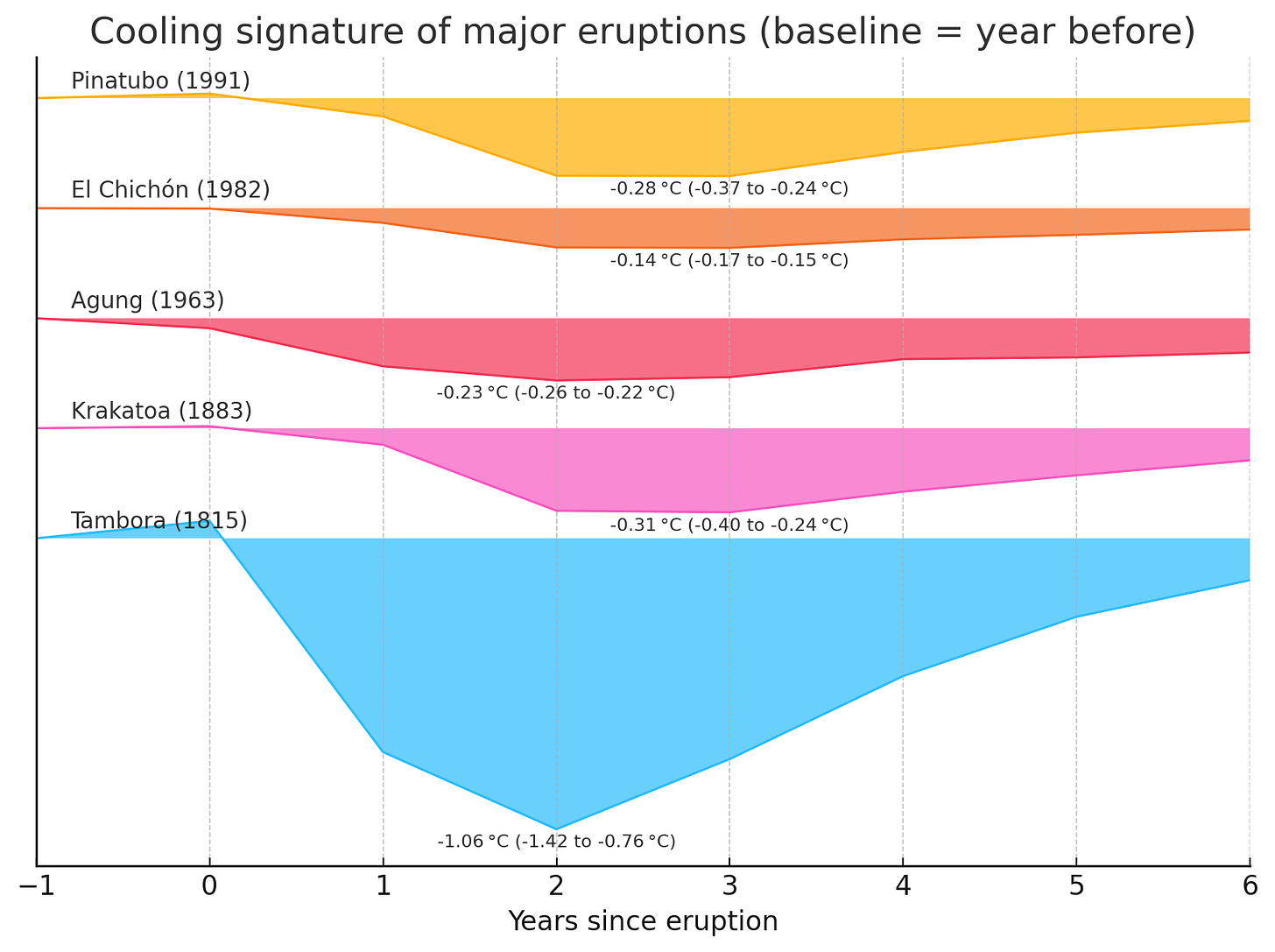
Tambora stands out as the strongest eruption in modern history by a large margin. Tambora was followed by the “year without a summer” where a haze hang over the sky for several years, many crops failed, and there were a number of severe famines worldwide.
We can also include Laki in this plot (though Tambora is so big it overlaps!). Note that this shows the global temperature effect, so it will understate the magnitude of Northern Hemisphere response to that eruption:
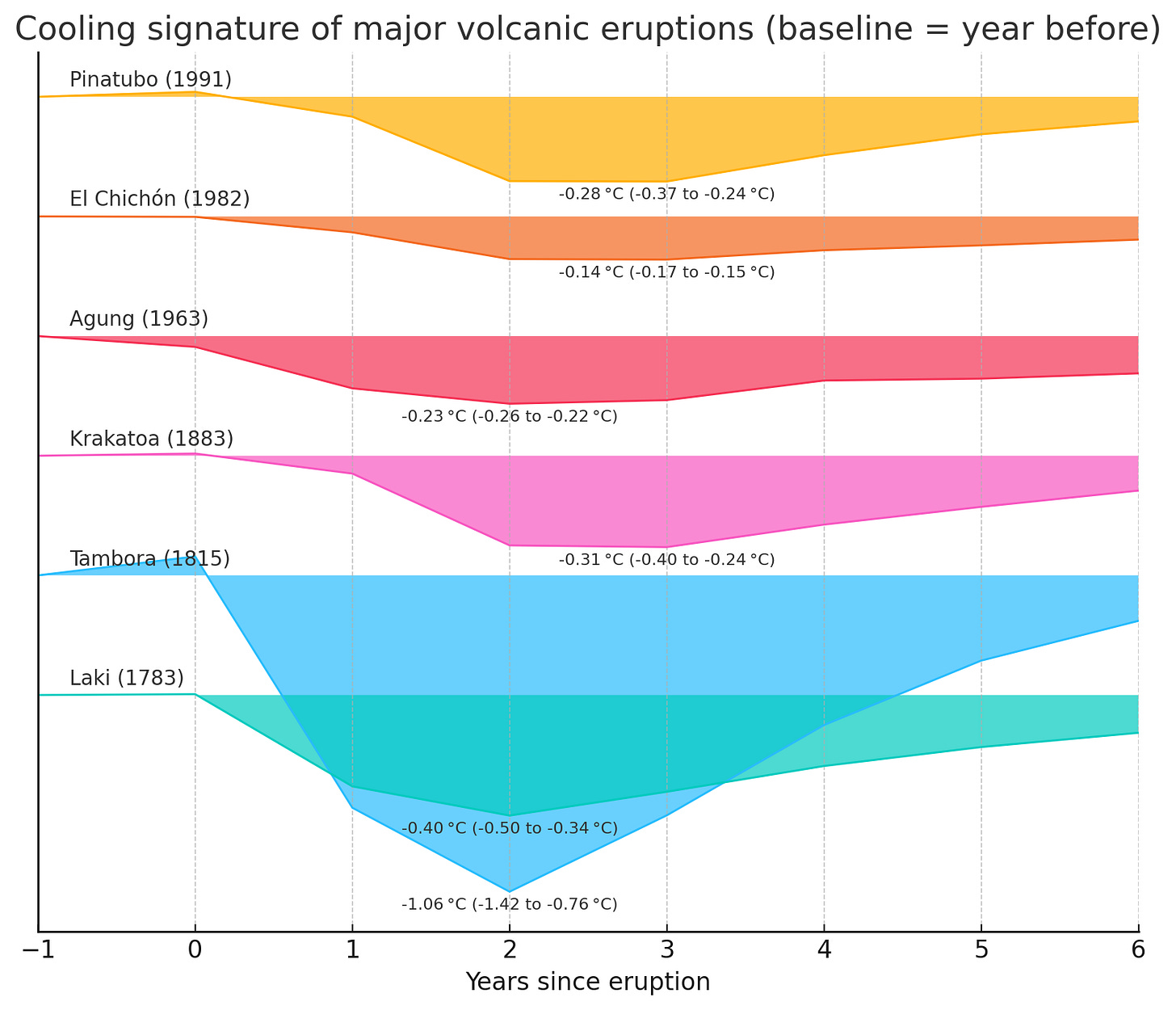
After the Laki eruption, Benjamin Franklin reflected that:
”During several of the summer months of the year 1783, when the effect of the sun's rays to heat the earth in these northern regions should have been greater, there existed a constant fog over all Europe, and a great part of North America. This fog was of a permanent nature; it was dry, and the rays of the sun seemed to have little effect towards dissipating it, as they easily do a moist fog, arising from water… Of course, their summer effect in heating the Earth was exceedingly diminished. Hence the surface was early frozen. Hence the first snows remained on it unmelted, and received continual additions. Hence the air was more chilled, and the winds more severely cold. Hence perhaps the winter of 1783–84 was more severe than any that had happened for many years.”
He even suggested that the cause might be “the vast quantity of smoke, long continuing, to issue during the summer from Hekla in Iceland, and that other volcano which arose out of the sea near that island, which smoke might be spread by various winds, over the northern part of the world.”
We cannot predict when the next large climate-cooling volcanic eruption will be; the recent Hunga Tonga-Hunga Ha’apai (HT) eruption in 2022 was quite explosive, for example, but occurred underwater, emitted less sulfur than Pinatubo, and added a massive amount of water vapor to the stratosphere that counterbalanced aerosol cooling.
 0
0  0
0






THE ESCALATOR

(free to republish)














 English (US) ·
  French (CA) ·