

 2 weeks ago
12
2 weeks ago
12
PROTECT YOUR DNA WITH QUANTUM TECHNOLOGY
Orgo-Life the new way to the future Advertising by AdpathwayA set of roughly 3.1-billion-year-old lavas in Western Australia contains a chemical signature that should not be there if the conventional story of early Earth is right. Analysis of the Whundo volcanic sequence in the Pilbara Craton indicates the mantle that melted to produce these rocks held water at levels approaching those beneath modern subduction zones, far more than the dry primitive mantle most ancient volcanic rocks point to.
The interpretation, published in Nature Communications by an international team led by Adelaide University geochemist Eric Vandenburg, is careful, and that is worth stating before anything else: the authors do not claim these rocks record the start of modern plate tectonics. They propose a different and more limited mechanism, and they acknowledge that their mantle models are not the only possible fit for the data.
That restraint is the reason the finding is interesting rather than just loud. The timing of plate tectonics is one of the genuinely unsettled questions in the earth sciences, and arc-like chemistry on its own has long been an unreliable guide because similar signatures can form without subduction.
Dripduction, Not Subduction
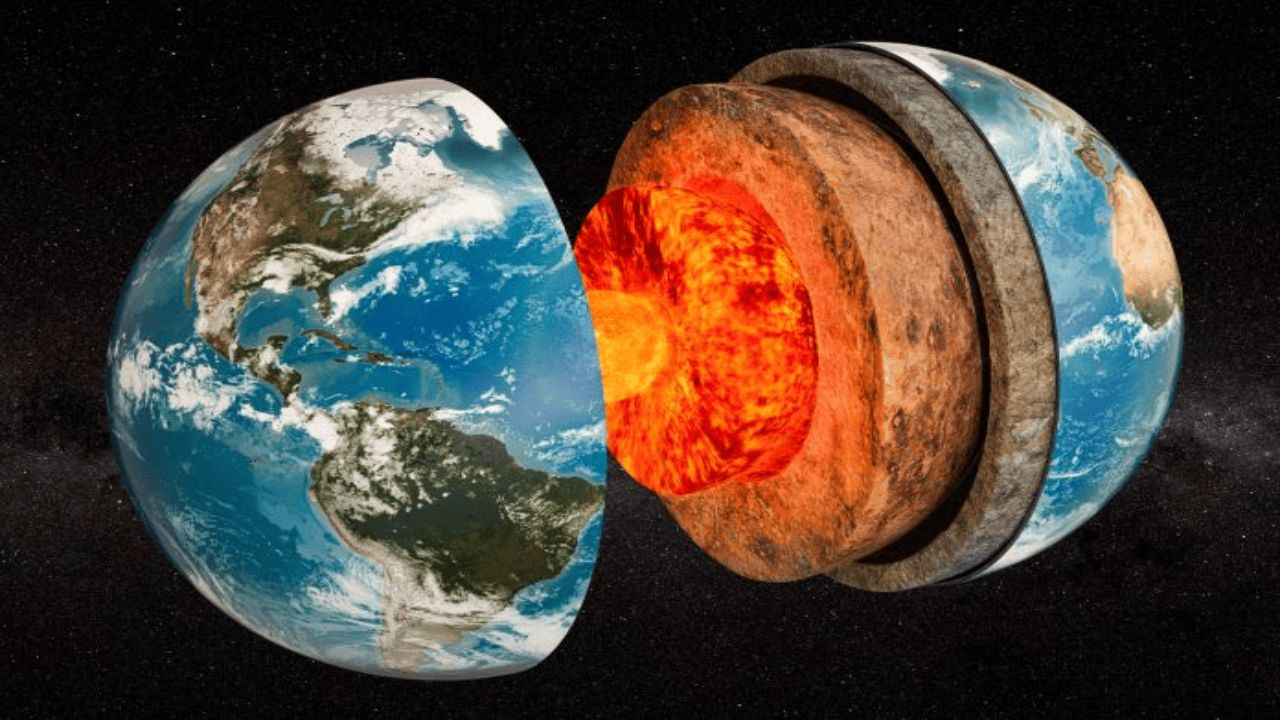
On today's Earth, water gets into the deep interior at subduction zones, where one plate slides steadily beneath another and drags hydrated rock down with it. That water lowers the melting point of the overlying mantle and drives the volcanism of arcs like the Pacific Ring of Fire. Vandenburg described the underlying idea in an explainer written by the study's lead author: seawater seeps into oceanic crust and becomes chemically bound inside minerals, and adding that water to mantle rock works like salt on an icy street, lowering the temperature at which melting begins.
The early Earth was hotter, and a hotter planet makes rigid plates harder to sink. So the team proposes what they call dripduction: short-lived, inclined foundering of hydrated lithosphere without laterally continuous plate boundaries. In plainer terms, dense waterlogged slabs of cool crust sagged and dripped into the hotter mantle in localized bursts rather than sliding down as coherent plates, as described in the release announcing the findings. No lasting boundary formed. Each drip released water into the surrounding mantle, triggering the melting that produced the arc-like magmas.
"These rocks formed more than three billion years ago, when Earth was a very different place," Vandenburg said in a statement from Adelaide University. He framed the conclusion as partial rather than sweeping: "The Earth wasn't operating exactly as it does now, but it appears some of the key processes were already in place."
Three Lava Types, and the One That Carries the Argument
The Whundo sequence, dated to between about 3.13 and 3.10 billion years ago, records three primitive lava series typical of modern arcs: tholeiitic, calc-alkaline and boninitic. The third is the most revealing. Boninites form when water is forced into hot mantle rock, typically during the early stages of a subduction zone, and the Whundo examples are the oldest stratigraphically extensive genuine boninites known.
The team presented high-resolution major and trace element data for a 10-kilometre-thick chemostratigraphic succession spanning roughly 30 million years. Geochemical modelling indicated that the melt diversity requires at least two mantle sources with distinct depletion histories, and that the water content needed for fluid-assisted melting substantially exceeds primitive mantle values, approaching the water-saturated solidus of modern mantle wedges.
The Pilbara is one of the few places on Earth where rocks this old survive in usable condition. It is a craton, the stable ancient core of a continent, and it has remained largely intact through billions of years of erosion and tectonic reworking. Critically, the Whundo succession sits in a region of thin, relatively undeformed mafic crust and retains fluid-mobile element concentrations consistent with primary magmatic values, which is what makes the water estimate possible at all.
Where the Interpretation Is Contested
An earlier study of these same rocks read them as clear evidence of modern-style subduction. This team reaches a different conclusion from overlapping material, and that disagreement is the honest state of the field rather than a resolved question.
Other recent work complicates the picture in both directions. Experiments on 3.5-billion-year-old Pilbara rocks have suggested Earth's oldest continental crust could have grown in shallow settings as readily as in subduction-like ones. Separately, University of Wisconsin-Madison researchers reported in Nature earlier in 2026 that zircon chemistry from the Jack Hills of Western Australia is consistent with subduction and extensive continental crust more than four billion years ago, alongside stagnant-lid behaviour recorded elsewhere. These are different rocks, different methods and different inferences, and they have not been reconciled.
The dating also deserves a note for readers who encountered this study recently. The paper was published in July, and a widely shared summary of the findings circulated again in September, which is why versions of it have been appearing in feeds this month. The science has not changed since summer.
What the study supports is narrower than a redating of plate tectonics. It supports the conclusion that surface water was reaching the mantle and driving arc-like volcanism about 3.1 billion years ago through a proto-tectonic process, and that deep water recycling did not have to wait for the modern plate system.
Why the Timing Question Matters Beyond Geology
The reason earth scientists argue about this so persistently is that the recycling of surface material into the interior governs how the planet became habitable. Subduction builds continental crust, re-enriches the mantle, and regulates the long-term carbon cycle that keeps surface temperatures in a livable range. Push that machinery earlier, and you change the timeline for when Earth could have supported life, and you change how the missing early crust is explained.
The authors offer a possible answer to that second puzzle as well. Thin, chemically evolved crust formed in these off-plateau dripduction settings could have been recycled back into the mantle later, leaving only rare surviving scraps in places like the Pilbara.
For readers in the United States, the relevance is indirect but real. The same geochemical reasoning used to interpret 3.1-billion-year-old lavas is used to interpret modern arc volcanoes in the Cascades and the Aleutians, where water content in the mantle wedge influences how explosive an eruption can be. Sharpening what arc-like chemistry does and does not prove improves the interpretation of both.
Nothing here changes any volcano alert level or hazard assessment. What to watch for is follow-up work testing whether the dripduction model reproduces the observed chemistry better than competing interpretations, and further analysis of water storage in the early Earth. Anyone encountering a version of this story framed as proof that plate tectonics began 3.1 billion years ago is reading a stronger claim than the authors made.
What Readers Want to Know
What did the study find? That the mantle source of roughly 3.1-billion-year-old lavas in the Pilbara Craton contained water at levels approaching those of modern subduction zones, far above primitive mantle values.
Does this prove plate tectonics started 3.1 billion years ago? No. The authors explicitly do not claim these rocks record the onset of modern subduction, and they note their models are not unique solutions.
What is dripduction? A proposed process in which dense, water-rich slabs of cool crust sagged and sank into the hotter mantle in short, localized bursts, without forming lasting plate boundaries.
Why does the Pilbara matter? It is one of very few places where rocks this old are preserved well enough to retain the chemical signatures this kind of analysis requires.
When was the research published? The paper appeared in Nature Communications in July, with a summary recirculating in September.
Do other scientists agree? Not fully. An earlier study of the same rocks interpreted them as evidence of modern-style subduction, and the timing of early plate tectonics remains actively debated.
Does this affect volcano hazard monitoring today? No. It does not change any alert level or hazard assessment, though the same geochemical methods inform how modern arc volcanoes are studied.
© 2026 NatureWorldNews.com All rights reserved. Do not reproduce without permission.


















 English (US) ·
  French (CA) ·