

 2 months ago
122
2 months ago
122
PROTECT YOUR DNA WITH QUANTUM TECHNOLOGY
Orgo-Life the new way to the future Advertising by AdpathwayWhen I carried my beautiful two-month-old puppy into our home for the first time, I couldn’t have imagined the scene six months later, as I led her through my local park experiencing such a toxic cocktail of emotions – guilt, regret, powerlessness – that I had tears in my eyes. It was a walk that many dog owners will recognise as having “gone badly”. My exuberant dog, Dusty, had approached another dog that did not wish to play with her. This shouldn’t have happened. I should have been able to call her back. Maybe I should have just kept her on the lead. Maybe I shouldn’t have got a dog in the first place.
Dusty started barking, jumping and circling the owner and her dog at high speed. “Do you want to have a dogfight?” the owner asked curtly, while I lunged around on the ground, all dignity jettisoned. “My dog just wants to play with yours,” I protested. “But mine doesn’t want to play,” she replied. “If you just let yours off the lead for a moment,” I countered, “I think mine would calm down. I promise you, she’s not aggressive.” Her reply: “So what do you call this?” Checkmate. As the seconds and then minutes passed, with Dusty still evading my reach, I began to wonder how long this might go on. Would the police have to be called?
I can’t remember the precise lunge that successfully brought Dusty back under my control but eventually I managed it, attaching her lead and heading for home, determined never to put myself or anyone else in that situation again.
As any parent of a toddler knows, being morally liable for something that is incapable of moral liability is a fraught and stressful business. It forces one to develop a range of imperfect techniques that are all fundamentally about one thing: control. Controlling a dog, like controlling a small child, requires a mixture of training, routine, incentives, rewards and physical constraints. Sometimes you just need to pick the darn thing up. There is no shortage of advice on how to do it, but little of it recognises the hardest aspect: the feelings of desperation, frustration, shame and resentment that an adult feels when it all goes wrong.
We are all familiar with the cliches of Britain as a “nation of animal lovers”, but we often overlook quite how weird and remarkable it is that we have, for the most part successfully, integrated a vast number of autonomous, non-human entities into a human system of rights and wrongs. As I tried to integrate Dusty into that system, however, I discovered how difficult and fraught the process is. I also began to see how much of what I write and think about in my professional life as a sociologist – power, behaviour and control – reflected what goes on in the world of dog training.
Control is a watchword of our times. The Brexit referendum, which took place 10 years ago this week, was famously won on a promise to take it back. Apps and smart devices are sold as ways of extending control over the minutiae of our time, households, finances and bodies. People are increasingly controlled at the workplace by intrusive systems of surveillance and behavioural intervention, while the AI revolution poses an even greater challenge, of how to bring powerful post-human agents under human control. But the amount of time and money we spend striving for control is indicative of how close we feel to losing it. And nowhere is this more true than with dogs.
We made a mistake: we got a boxer. These are some of the unsolicited comments you receive from strangers in the street when walking a boxer. “Aaaah, boxers – they’re all mad!” “Don’t worry, mate, she’ll calm down – when she gets to 10!” “Give up, mate, boxers have got minds of their own!” Old-timers will come up to you with a faraway look in their eye and tell you that they “grew up with boxers”, but “you don’t see them much these days”, something for which they don’t know the reason, but I suspect I now do. Dog experts and trainers will tell you that a boxer is not a good first dog (Dusty was our first dog). There aren’t many breeds that are the focus of their own specialist training programme as boxers are (for example, Bombproof Boxer).
It was a bold decision. My wife said she preferred bigger dogs, which ruled out many of the obvious breeds for a family living in London. My grandmother had had a boxer, Folly, with whom I’d forged a deep emotional bond as a child. On paper, boxers have certain tangible advantages: they’re roughly mid-size and don’t require any expensive grooming. They have the most beautifully expressive faces, once compared to the look of a man who has just opened his credit card statement after a shopping binge. We began to research the breed online and discovered a whole subculture of boxer lovers whose adoration for their pets seemed unarguable. What we hadn’t reckoned with was that these people were also all mad (lesson learned: if someone mentions that they sleep in a bed with two 30kg animals, do not take their judgment as a benchmark of any kind).
The reason why people love boxers so much is the same reason why no sane person should ever own one. Their relation to the world – other dogs, people running, people standing still, moving objects, non-moving objects, long grass, short grass, mud and so on – is one of inexhaustible, irrepressible enthusiasm. This is at once a joyful and an impossible problem to manage, experienced by the walker in having their arm nearly pulled out of its socket and by strangers in being jumped on. Boxers were originally bred as German hunting dogs, and their size, strength and speed can make them appear scary to the uninitiated. What makes them special – repeat boxer owners often say that they could never have any other dog – is their emotional sensitivity, a feature that was understood during the first world war when they were used as “mercy dogs”, trained to go into no man’s land to find the injured and the dead, recognise the difference, and sometimes to sit with soldiers for comfort as they died.
What boxers struggle with more than most dogs is impulse control. Any animal, including a human one, comes into this world expecting immediate gratification of its desires, before gradually learning that it is possible to wait for good things to arrive. But what if the impulses are simply bigger and more intense for boxers than they are for other animals? One thing you learn in the struggle to achieve control is that, from a practical point of view, the difference between “good” impulses (love) and “bad” ones (aggression) is less important than the intensity of the impulse itself. As I discovered on that afternoon in the park, a dog that desperately wants to play with another one is no easier to control, and may not look very different, than a dog that desperately wants to attack it.
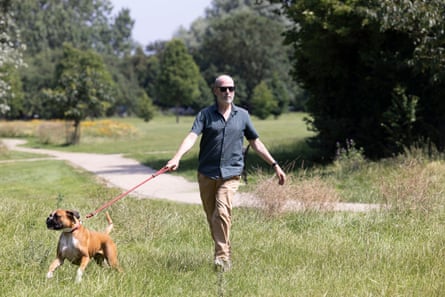
We didn’t realise how hard it would be. New dog owners often go through an initial period of “puppy blues”, in which regrets kick in as the quantity of chewed household items rises. But when we took Dusty to a puppy class aged four months, there was only one dog that spent the hour straining desperately to get to the other puppies while ignoring its owner, and it wasn’t the labrador, the corgi, the terrier or the cockapoo.
Elite dog handlers and trainers will tell you they love “working dogs” (the class that includes boxers, along with dobermans and great danes) because of the challenge they pose, their intelligence and independence. Our choice of a boxer was the equivalent of someone who thinks they might try their hand at sailing, and instead of buying a dinghy comes back with a racing yacht. We were now going to have to work out how to sail it. I had little choice but to become a Dog Person.
Many parents will be familiar with the name Penelope Leach, the psychologist and author of such books as Your Baby and Child. Many dog owners will be equally familiar with the collected works of Steve Mann, including Easy Peasy Puppy Squeezy, Easy Peasy Doggy Squeezy, Easy Peasy Doggy Diary and Easy Peasy Awesome Pawsome. Mann claims to have worked with more than 100,000 dogs worldwide, and has vicariously shaped the behaviour of many more, having founded the Institute of Modern Dog Training, which describes itself as the largest registered membership and accreditation body for dog trainers in the world. In addition to books, Mann produces podcasts and videos (including a “BBC Maestro” training course), while his minions crawl the Earth selling his behavioural wisdom.
At various points over the past two years, I have scoured these books, watched the videos and paid hundreds of pounds to Steve Mann-accredited trainers, all in the desperate hope that some Mannite genius might finally solve the riddle of Dusty’s undesirable, occasionally intolerable behaviours. Dog training is a lot about confidence and body language, and figures such as Mann possess a kind of aura, like a Pentecostal healer or an infant-sleep trainer, whereby the desperate layperson is willing to give up all autonomy, if only the guru will rescue them from their torments.
The holy grail of dog training is focus, whereby the dog stares unerringly at their handler, waiting for instruction, regardless of distractions around them. The websites and YouTube videos of celebrity trainers feature images of smiling men and women sitting casually at picnic tables or standing in high streets while a seemingly hypnotised doberman or vizsla (never, I’ve noticed, a boxer …) stands stock still beside them – irrefutable evidence of the trainer’s powers of control. Like an Instagram financial influencer leaning on his Ferrari, the message is: if I did this, you can too. But how?
Over recent decades, Mann has been at the forefront of a revolution in dog training that contradicts assumptions about discipline and ethics elsewhere in our lives. His guiding principle is that of behaviourism, an approach to the control and prediction of human and non-human activity that deliberately discards all moral language in favour of rewards. As the American psychologist BF Skinner, the high priest of behaviourism, argued in the 1950s and 60s, people and animals are fundamentally alike: what they do is a consequence of their immediate environment and past experiences, rather than of values or intentions. Any behaviour can be explained (and thereby controlled) as a response to a stimulus of some kind.
The starting point of Mann’s approach is that dogs have suffered over centuries by having their behaviour described in moralising human language. When dog owners call their pets “bad” or “naughty” – or say that “she’s ignoring me on purpose” or “looking guilty” – they are gearing themselves up to deliver the most obvious response: punishment. The standard way to get a dog under control, through most of the history of human-canine relations, has been to restrain or hit it, often with a shout of “bad dog!”

On first encountering dog trainers shouting and yanking on leads, Mann wondered: “Why don’t we just focus on what we do want, rather than only looking for the ‘bad’?” This is the insight that became the basis of “positive reinforcement” methods: every time your dog does something you want it to do, you reward it with food as quickly as possible. If the reward is high enough (and, crucially, quick enough), your dog will obey you, and from there you simply have to reinforce the behaviour through repetition. Your dog is never “ignoring” you or “doing it on purpose”, because – as Skinner might have observed – they don’t do anything on purpose: they just respond to cues. The term “reactive” has become the modern catch-all term for any dog that behaves aggressively (usually interpreted as a symptom of fear), another attempt to cleanse dog training of anthropocentric language.
As I navigated this literature, I began to recognise elements of a more infamous critique of morality – the one, surprising as it may sound, found in the work of Friedrich Nietzsche. Moralising and punishing don’t work for dogs, modern trainers argue, for the same reason that they do work for humans, according to Nietzsche. If a dog breaks a rule and then gets punished two minutes later, it has no understanding of how one led to the other. All it knows is that it has been harmed. For Nietzsche, humans become moral creatures once they understand how transgression A leads to penalty B, even when there is a substantial delay – potentially years – between the two. Humans are disciplined, punished and educated until they acquire that internal capacity that Nietzsche believed was most repressive of all: a guilty conscience, the most ingenious instrument of control ever invented. Freedom from guilt would mean living in the moment and forgetting one’s sins: in other words, becoming more like dogs.
To what extent is “positive reinforcement” a viable alternative to morality and guilt? It seems very simple on paper, until you have to incorporate it into your everyday life. If a dog can’t be held accountable for its actions, then the finger of suspicion turns towards its entire environment instead: maybe it’s the wrong treats, the wrong harness, the wrong time of day to be walking, the wrong owner. I even know of a case of a couple moving house, because they became convinced that this was the key to improving their dog’s behaviour.
There is a darker side to the behaviourist worldview, the one explored in the gruelling experiments undertaken on the ethically abhorrent protagonist of A Clockwork Orange. If an animal doesn’t have the capacity to connect behaviour and punishment when there is a delay between the two, what happens if you eliminate the delay? I’ve sometimes wondered how my grandmother could possibly have handled a boxer, but then remember that Folly wore a choke collar. If my gran pulled on the lead, a chain tightened around her neck. Remote control electric shock collars expand the reach of punitive conditioning. The ethics and effectiveness of these collars is a matter of heated controversy, and legislation was introduced under the last Conservative government to ban them in England (Wales is the only place in the UK where they are banned), but never made its way through parliament.
I would never use an electric shock collar or choke collar, and understand the futility of punishing Dusty for deeds that she’s long forgotten about. My commitment to “positive reinforcement” is pretty unwavering. I even try to avoid shouting “no!”, which Steve Mann assures me doesn’t work on a dog. But when nothing seems to be working, I have fantasised about doing some far worse things, and never more so than when Dusty hit the so-called “teenage” phase.
Everyone’s search history contains a litany of guilty secrets. I confess that mine includes the words “boxer dog rehoming”. I’ve never done much more than Google it, mull it over, then shudder in horror at the imagined sight of Dusty’s droopy face as I walked away from her for the last time. But, yes, I have looked into it. The websites of dog rescue charities provide heartbreaking galleries of dogs that have been given up for one reason or another, often accompanied by the explanation that they find themselves there “through no fault of their own” (code for “they’ve not bitten anyone”). When scrolling through the websites of boxer rescue charities, what stood out was the commonest age of the dogs: 14 months.
Dogs, like humans, go through an adolescence as they enter sexual maturation. Symptoms can include a surge in energy, an independent streak in which they appear to have unlearned basic commands, and various other forms of behavioural regression, only now accompanied by an almost-adult body size. Around Dusty’s first birthday, our barely controllable dog became more than we could bear. If I had to pinpoint my lowest moment, it was probably at exactly 14 months.
Owners of small or unusually calm dogs barely notice their dog’s adolescence. Owners of larger, excitable breeds experience adolescence as the period when their dog becomes a complete arsehole, sprinting to random objects in the distance, seeming to develop a sixth sense for what you least want them to do and then doing it. In more paranoid moments, it’s possible to believe that your adolescent dog has a vendetta against you. Trainers recommend going “back to basics”, which in Dusty’s case meant trying and failing to reacquaint her with the word “sit”, before she tore off in pursuit of a passing pigeon.
Where do you go once moral discipline is not on the menu and “positive reinforcement” feels inadequate? As in so many other areas of human and non-human life today, such queries eventually end up at nature’s greatest control centre, the brain. It turns out that the adolescent dog’s brain is a rich site for neurological speculation – of varying credibility. I’ve read that during this phase, synapses are being “rewired”, that the part of the brain dealing with impulse control is temporarily weakened, that sexual hormones have thrown the brain into disequilibrium. None of this is necessarily enough to discredit the notion that one’s dog is actually an arsehole, but it does provide some help in getting to the end of another day without losing one’s temper, which is maybe its real value.
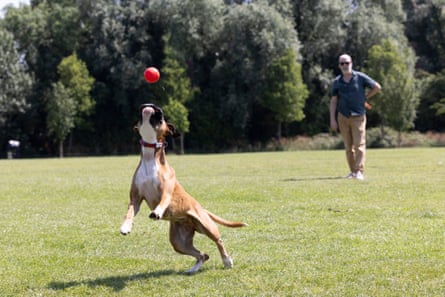
The appeal of dog neuroscience is not limited to understanding their adolescence, indeed it kicks in as soon as you take a new puppy home. Vets, trainers and dog charities all recite in unison that a puppy must encounter every sight, sound and sensation imaginable by the time they are 16 weeks old, or there is a risk that they will never get used to the experience in question. This includes: vacuum cleaners, people in hi-vis clothing, pushchairs, people in funny hats and so on (various checklists exist to work through systematically). A legacy of Covid is the surge in canine behavioural problems (including dog attacks) resulting from the large number of households acquiring puppies for the first time over 2020-21, which then had far less access to the outside world and other dogs.
I was filled with anxiety by the strictness of this 16-week window. Would I need to take Dusty to every pub and cafe in east London before the cut-off? Might I find a Village People tribute band, through which I could acquaint her with a full range of uniforms and hats all at once? But I was also a bit dubious. After a bit of research, I discovered that the precision of 16 weeks derived originally from one landmark study in the 1960s. The magic number of 16 arose initially because the scientists had chosen (for reasons of experimental convenience) to split the puppies into an over-16-week group and an under-16-week group in order to compare them, and not because of any neurological discovery.
The rule of 16 weeks does at least have the virtue of being a consensus. But in other cases where physiology and behaviour is concerned, part of the difficulty is the sheer range of conflicting opinions, products, theories and services, many of which are attached to lucrative businesses. As Dusty’s behaviour deteriorated, we began to consider more veterinary explanations. Was she in pain? Was her brain being overwhelmed by urban life, as psychiatrists have wondered about human neurology at various points over the past 150 years? Turning to neurons as explanations has one indubitable merit: it relieves us of those feelings of responsibility and guilt that otherwise accompany a lack of control.
There is no shortage of businesses willing to speculate on physiological drivers of canine behaviour. Vet behaviourists will charge as much as £700 for a consultation. Neurological diagnoses produce pharmaceutical solutions, and prescriptions for “Puppy Prozac” (fluoxetine) have increased tenfold over the past decade. Britain’s vet industry has belatedly become the focus of a Competition and Markets Authority investigation, no surprise to anyone who has paid £23 for one monthly anti-flea tablet.
Dog ownership offers a glimpse of a society without universal, state-funded healthcare. It’s not just the extraordinary expense that is draining, but the paranoid sense that there may be a solution out there, you just haven’t yet paid enough for it. Unable to speak for themselves, animals force us to adopt the approach of behavioural experimentation: we have nothing else to go on but what we can observe. Of course we project our own lay interpretations and explanations on to that behaviour but when we remain baffled, stories about the brain fill the void.
“Positively reinforcing” desirable behaviour is hard. It is time-consuming and extremely repetitive – more like going to the gym than teaching students, and I know which one I find more fulfilling. But if your food treats are (in the jargon) “high value” enough, and you put in the hours, it does work. Dusty now comes back to us when called, most of the time. She’s still a very excitable dog, but I’m now able to avoid situations like the one in the park that fateful day.
Getting to this point requires grasping an additional key difference between dogs and humans: the absence of a moral psyche also means an inability to generalise from one situation to another. Dogs can become controllable and predictable in one context, and then behave entirely differently in another. And while it is possible to control the environment in your kitchen, you can never be sure what novelty might suddenly appear in the park. The Steve Mann answer to this problem is simple: don’t put your dog in situations that you can’t control or which have provoked bad behaviours in the past. This ultimately is how most dog owners cope, not training their dog to behave well in every situation, but striving to avoid those situations when they know they won’t.
But as much as we seek to leap wholesale into a world in which control is perfected through manipulating rewards, environmental cues and neural pathways, my experience with Dusty suggests that what humans are really looking for in all of this is an escape from their own guilt. Many dog owners never have to pick up a training manual because their dogs are so placid (or small) that they never feel the need. But others never do so because the anger of other people doesn’t bother them very much.
The exit from morality into a world of “positive reinforcement” and brain chemistry is only ever partial, for the simple reason that none of us ever achieves perfect control. Learning not to judge and punish your own dog is relatively easy to do. I’ve learned the hard way that the difference between a frustrating walk and an emotionally disastrous one is about something else altogether: whether or not other dog owners judge me. What we most crave, once control is in the balance, is not scientific facts or diagnosis, but kindness and understanding – things that only another human being can provide.
In Dusty’s early days, when we felt quite lost, I used to occasionally encounter a friendly bedraggled stranger, who would always comment on what a lovely dog I had, which meant a surprising amount to me. On about the seventh occasion I saw him, he was sitting in a churchyard smoking crack. Dogs transcend social boundaries better even than sport and childcare, those usual mainstays of community expansion in secular societies. Since then, we’ve become accepted into various loose, overlapping communities of local dog owners, who offer what can best be described as solidarity. Sometimes you just need another person to tell you that they’ve been there, and you’re doing OK. As for Dusty, she remains as beautiful and blameless as ever.



















 English (US) ·
  French (CA) ·