

 4 hours ago
1
PROTECT YOUR DNA WITH QUANTUM TECHNOLOGY
Orgo-Life the new way to the future Advertising by AdpathwayTwenty years ago, Germán Flores decided to start preserving the Mexican donkey, an endangered species with about 300,000 remaining in the whole country. Flores was inspired to take care of donkeys after learning that the donkey population in Mexico had decreased by about 60% between 1994 and 2010.
It was a natural decision for him: the donkeys are part of the identity of his town, Otumba in Mexico State. But while the annual national donkey fair purports to celebrate the animal, around the country they are also routinely mistreated.
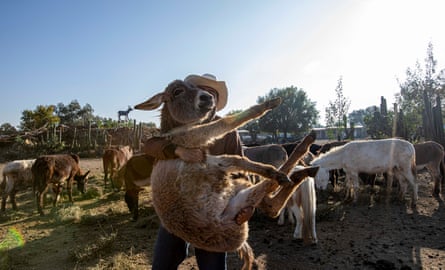
-
Flores carries a young donkey at his sanctuary
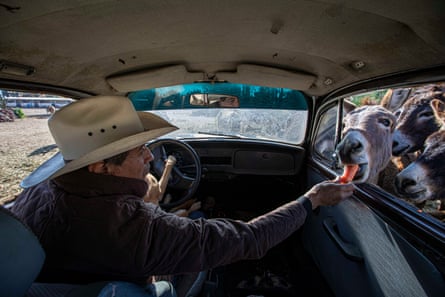
-
Flores feeds carrots to Pancho and other donkeys. ‘They love carrots, it’s their favourite food and they can’t resist it,’ he says as he drives his car around the fields while playing Zacatecas march music. ‘When they listen to this song, they know food is coming.’
In 2006, after trying to convince the local government to take action without receiving a response, Flores decided, along with his wife and children, to pursue their “crazy” idea of protecting, caring for and preserving Mexico’s donkeys. This is how Burrolandia was born: to give dignified living conditions to about 100 burritos that come mostly from situations of exploitation and abuse around Mexico.
Even though these animals are a legacy of colonisation, brought from Africa by the Spanish, they became essential for Mexicans. As the years passed, this species adapted to different environmental conditions and developed a unique genetic identity. The donkeys became deeply connected to the development of Mexican society, since they were used for several tasks such as agriculture and construction, especially in rural areas.
Nowadays, their decline is primarily due to mechanisation replacing traditional work animals, which is why they have been abandoned or mistreated by people who previously employed them. Burrolandia receives several reports of neglected donkeys, but as an independent organisation it does not have the resources to do all the rescues it would want to.
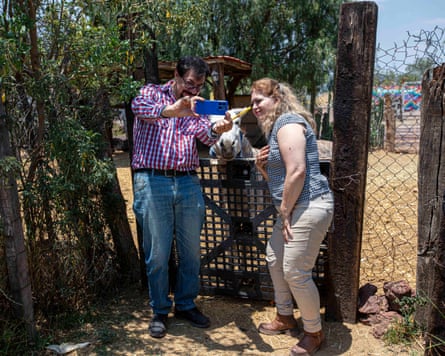
-
Eduardo Romo and Dulce María take a selfie with one of the male donkeys at Burrolandia. Visitor numbers fell during the pandemic but the sanctuary is returning to its usual weekend activity
The donkey population has also decreased because of the clandestine slaughterhouses that kill them to sell their meat, passing it off as cheap beef or to produce chitos, dried salted marinated meat sold as a snack in parts of the country.
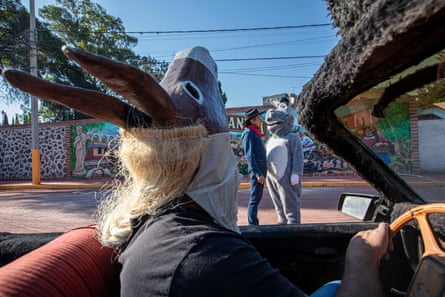
-
Flores and a costumed mascot talk while Daniel, a sanctuary worker, drives by wearing a donkey mask. Burrolandia makes an effort to be present at the donkey fair to show that burritos can be treated differently
-
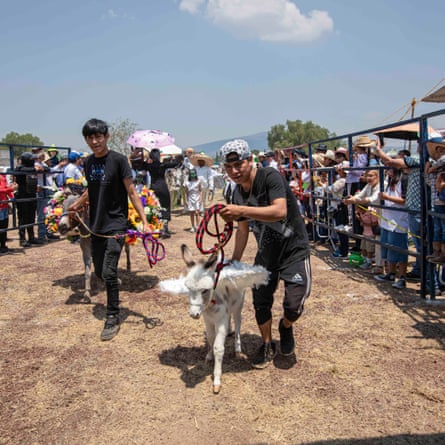
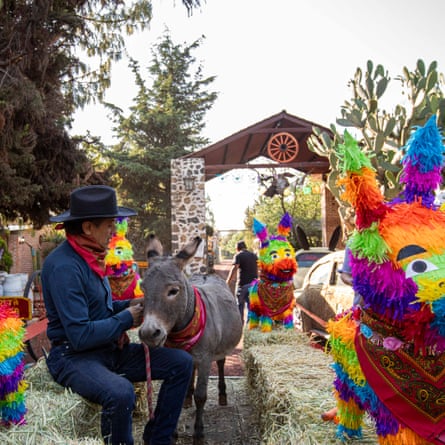
Above left: People from around the area bring their burritos in costumes for a competition for the most original disguise. Above right: Flores pets Tribilin after getting on the truck that will take them to the donkey fair
-
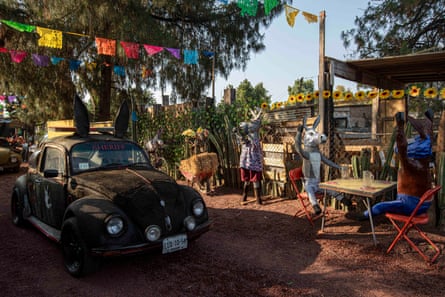
A customised VW waits before leaving for the inauguration parade of the donkey fair. Flores has customised several cars to resemble donkeys in an effort to show fairgoers they can have races without using the animals
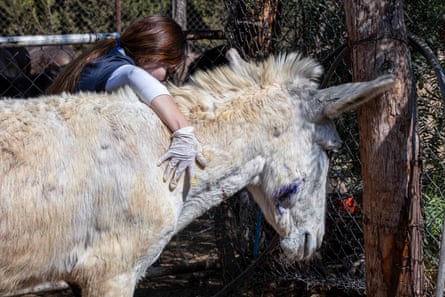
Campeón (Champion) is one of the donkeys living in Burrolandia who has been rescued at the fair. After losing the traditional costume contest at the fair, his owner decided to sell him to the slaughterhouse. Flores was able to stop him, making an exception to his rule that he does not usually pay.
-
Michelle Hernández, a veterinary student, takes care of Campeón. This donkey was rescued by Flores from the abattoir. His previous owner took him there after losing a donkey fair contest
The third threat to the donkeys is the exportation of their skin for producing ejiao, a traditional Chinese product considered a blood tonic. According to the donkey sanctuary, Mexico is one of the main exporters in an industry that uses about 5.9m skins every year.
There is no formal or public information in Mexican government sources about this trade. Rural conditions in Mexico also make it difficult to have a trustworthy census that sheds light on the real size of the donkey population.
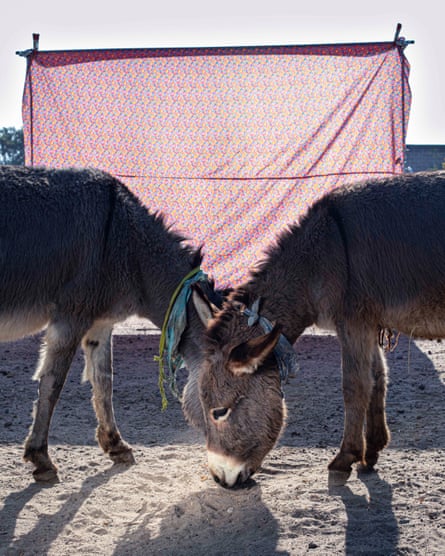
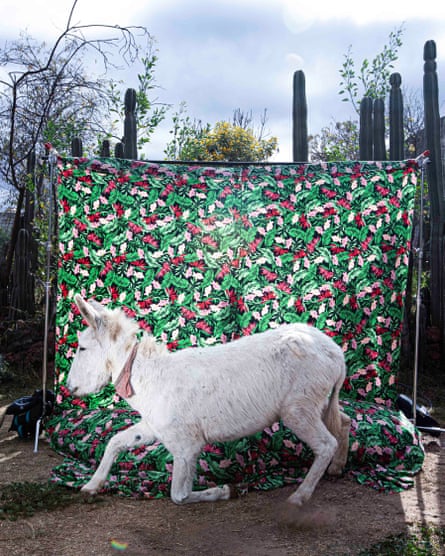
-
Left: Gotita and another donkey. Right: Relámpago
Flores is in love with these animals. “They are incredibly grateful little animals, very noble, and they awaken tenderness in you,” he said. “They awaken a spiritual peace when you are with them; they give you balance, balance in body, mind and spirit.”
It’s common to see him preparing a raffle, selling something he owns or promoting the sanctuary. He says all of this is worth it because when he was a 13-year-old boy he had a donkey named Roberto, who transported him to buy groceries for other people so he could earn a little bit of extra money while being part of a poor family.
“I was the Uber of the neighbourhood, I would deliver to them the list of things they wanted, and they would give me a tip. In that way, I was able to buy my uniforms, my sneakers, and pay for my school supplies.”
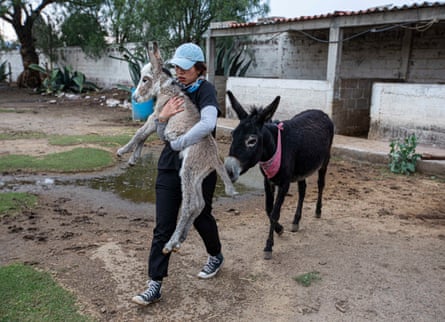
-
Paola Hernández, a vet, carries Quetzalli’s new baby to their barn as Quetzalli follows closely behind. The baby suddenly appeared in the middle of the female garden, so they immediately separated her from the other animals to make sure she was safe
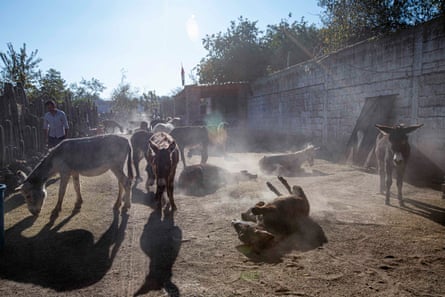
-
Male donkeys take their morning sun and dust bath outside the Burrolandia stables. Every morning, the 96 donkeys that live in the sanctuary go out from their resting places to eat, play and walk around while the stables are cleaned
The sanctuary is located in Otumba, the same area where the contrasting national donkey fair takes place every year on 1 May, with different activities where donkeys, instead of being honoured, are mistreated in costume contests and donkey races.
To feed the donkeys, he and his family need to give them 400kg of oats and alfalfa daily, which translates to about $6,000 every month, which is why they open their space to the public every weekend and ask people to support them.
-
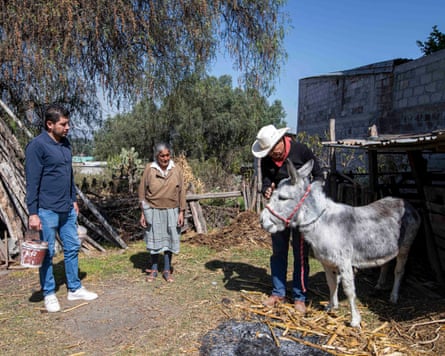
Flores calms down Toribia while his son Raúl holds buckets with carrots and oats to encourage her to leave her stable. Doña Catalina Aguilar watches on while saying goodbye to the donkey she took care of for about four years at her house. ‘I am sick and my hand hurts, so I can’t take care of her any more,’ says Aguilar, but she has asked if she can visit the sanctuary to visit her donkey
Taking care of the donkeys has been very difficult. Flores’ son Raúl is now also working at Burrolandia. “I think it is very, very important, because it is a symbol of all the work, all the effort that we have had here in Mexico: this little animal has supported us for a very long time for different activities of carrying loads, transportation, development, not only of our locality, of the country but even of the world, so it is something very worrying that the little donkey is disappearing.”
This story is not only about Burrolandia but about one man’s passion for rescuing these animals, and the unique world he and his family have created in pursuit of that dream.

















 English (US) ·
 French (CA) ·