

 2 months ago
83
2 months ago
83
PROTECT YOUR DNA WITH QUANTUM TECHNOLOGY
Orgo-Life the new way to the future Advertising by AdpathwayNew York city’s council chamber was packed, the debate wide-ranging and heated, but lacked one component – a talking horse. Many of the 200 people packed into the debating hall last week felt only they could speak for the interests of the equine species.
In one passionate camp, stable hands and drivers who attend to 160 horses that draw 68 carriages in the park, a business, they say, that has been operating since Central Park was created in 1858. On the other, a vigorous gathering of animal rights advocates who voiced that the carriage horse industry was a representation of man’s broad subjugation of animals.
At issue: a bill before the council that would see Central Park’s famous carriage horse trade phased out by June 2028. The issue has been simmering for years, but the support for a ban has gained traction since an 18-year-old tourist, Romanch Mahajan, visiting with his family from India, was fatally injured last month when he fell from a carriage after its horse, Samson, spooked and bolted while the driver was taking a photo of the family.
Last week, the council heard from members of Mahajan’s family and their lawyers. Romanch’s father, Deepak, speaking from India via Zoom, said he could not “properly describe to you the real true fear inside that carriage. It was shaking. It was speeding. There was no one holding the reins, and we could do nothing but hold on to each other and scream.”
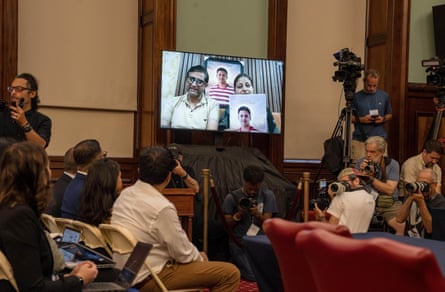
The bill has since been renamed “Romanch’s law” and comes up for a vote in August. Advocates for the industry sense the ground is shifting against them, particularly since the council speaker, Julie Menin, voiced her support for a ban. Menin said she came around to the activists’ argument following the death of Mahajan.
The industry has seen this before and as with most things New York celebrities get involved. Under the progressive mayor Bill de Blasio, the Oscar-winning actor Liam Neeson came out as a strong supporter of the carriage business. “It has been my experience, always, that horses, much like humans, are at their happiest and healthiest when working,” Neeson wrote in the New York Times.
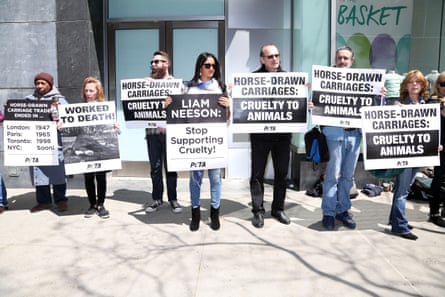
But in this go-around, animals rights activists have marshaled the support of the Sopranos actor Edie Falco. She told the assembly she was “here for the horses” and that she was speaking for horses because “the horse can’t say it” … they “ have the right to a God-given, if that’s what you believe, life, just as we do”.
At the meeting, the bill’s supporters brought up the case of a carriage horse named Dennis that died in June after ingesting toxic Japanese yew that is part of the Central Park Conservancy planting program.
In a hearing last year, Christopher Marte, the bill’s sponsor and representative in the council for much of lower Manhattan, said that if a human or another animal like a cat or a dog was forced to pull a carriage, “we would call it inhumane”.
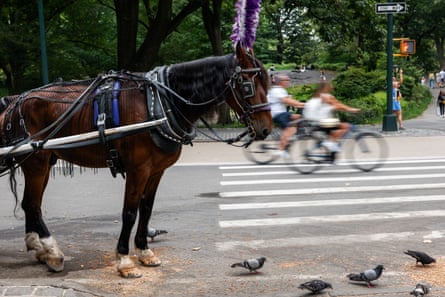
But the Transport Workers Union (TWU), which represents the carriage horse industry, accused the council of following Marte, “an absolutely unserious person”, who equates 1,600lb horse pulling a carriage to asking “a chihuahua, cocker spaniel, or a Siamese cat to pull a carriage”.
The debate has touched a nerve over the rights of workers in the city. Mayor Zohran Mamdani has said he supports the “spirit” of the legislation but has voiced concern that carriage drivers will be left without income or work alternatives. Supporters of the bill have promised a “workforce development program”, including in the hospitality sector.
John Chiarello, president of TWU Local 100, said most of the workers in the carriage horse industry in the park were immigrant laborers. “What about my members’ American dream?” he asked.
Chiarello pointed to accidents involving pedicabs, food delivery services and electric Amazon tricycles – city data shows 28 people have died between 1 January and 28 June this year in accidents involving various forms of motorized two-wheelers, up about 20% from the same period last year.
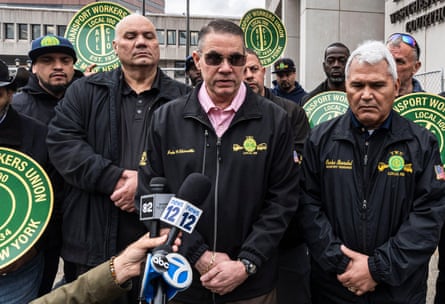
“Nobody’s talking about them,” he said. “There’s a 165-year history of transportation that I would put up against any other means of transportation, and I would guarantee that others have done worse. What about Uber? Pedestrians are run down all the time.
“The animal rights activists talk about the horses not being treated fairly. But that’s a misrepresentation. They get fed and they get five weeks of vacation. The horse and carriage business has been around since before the city was incorporated. It would be a shame to annihilate them.”
Angel, a driver originally from Mexico, said he had invested all his savings in the carriage horse business. “I own horses and they say they want to help all the immigrant people. But this isn’t going to help me at all.”
Conner McHugh, a second-generation driver, stable manager and carriage horse medallion owner for 40 years, said that over the past two decades there had been a battle to drive people like him off land and buildings in Manhattan that coincides with the rezoning of the area where are stables are located.
“When politicians get their hands on things and say how they’re going to make everybody happy … well, the road to hell is paved with good intentions,” McHugh added.
“Intimidation has taken various forms,” he said, including “reporting us to ICE and the IRS, keyboard warriors trashing us on social media, animals rights volunteers who have come to Central Park to harass our drivers and create an unsafe situation”.
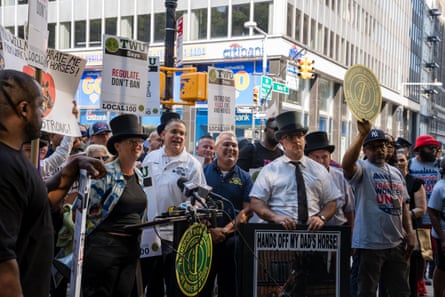
At times, the discussion over carriage horses descended into farce. A proponent of a ban suggested that non-English-speaking drivers, including those from Tajikistan, may have trouble being understood by English-understanding horses.
Driver Alanna said she felt the “fix is in” for the carriage horse industry. “We’re up against the billionaire donors to Central Park,” she said. “Menin has a $22m house in the Hamptons. She’s married to a real estate guy. They want the stables, they want the park drives. They want everything.”
Then it came to the horses themselves. Almost all are working Standardbred and draft horses from the Amish settlements in Pennsylvania or upstate New York that have spent their lives working. Drawing carriages in Central Park is comparatively light work compared with ploughing.
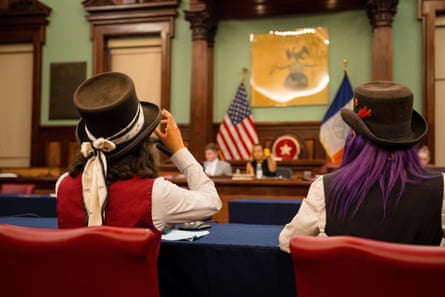
But since the pandemic, the number of visitors to the park has soared to 43 million a year. Unlicensed pedicabs compete with horse-drawn carriages for customers. Some carriage owners believe they drive too close, often with bright lights and loud music. Central Park is not the sedate place it once was.
For the park’s quarter horses, the alternative to drawing carriages would probably be the slaughterhouse. Animal rights activists say they have a network of sanctuaries to take in out-of-work Central Park horses. But drivers like Hansen doubt that, given the pressure on land and the expense of boarding.
Her horse, 12-year-old Sherman, whose prior work for an Amish family was to bring vegetables in from the fields and was sold when he got too slow to take the family to church on Sundays, was heading for dog food when she bought him. Without work, she says, “he’d be bored out of is mind. He loves being around people, and he loves the water trough in Central Park.”
Edita Birnkrant, executive director of New Yorks for Clean, Livable, and Safe Streets (Nyclass), said the carriage horse businesses had no retirement plan for their horses, unlike the NYPD, which keeps 35 to 55 horses in its elite mounted unit.
The stables on the West Side, she said, were torture for a horse “to be living in a cell with no grass. They should be retired and we have a network of sanctuaries and rescue farms. Right now, they have no retirement plan and that’s irresponsible.” She called claims that her organization was a front for real estate interests “crazy”.
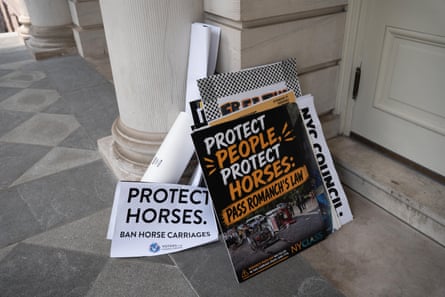
Wayne Pacelle, president of Animal Wellness Action, said the horse carriage industry had been offered a sweet deal to end their practice and recent accidents had shown it was not interested in reforms. Offers to replace the carriages with electric versions had been rebuffed.
The effort to ban carriage horses, Pacelle said, “was part of a larger ethical framework that we should not countenance cruelty. Mistreatment is a vice and here we have a vestigial practice with no practical value. When we had horses in the 19th century, it was to get from A-to-B or pull commodities and other goods.”





















 English (US) ·
  French (CA) ·