

PROTECT YOUR DNA WITH QUANTUM TECHNOLOGY
Orgo-Life the new way to the future Advertising by AdpathwayLouis Lefebvre’s book A Bird’s IQ: Innovation, Intelligence, and Problem Solving in the Avian World is engrossing, not to mention highly entertaining, by virtue of the many examples he gives, over many bird species, of things they learn to do, not necessarily as nestlings inheriting innate talents, but rather later in life – how they innovate.
You probably already knew this, but hungry (or homeless, or otherwise needful) birds can be quite inventive, charmingly so, such as the New Zealand sparrows flapping around the motion sensors to a bus terminal’s doors, so they can gain entry to the food courts.
The primatologist Jane Goodall defined “innovation” thus: “a solution to a novel problem, or a novel solution to an old one,” or “a new ecological discovery such as a food item not previously part of the diet of the group.” In the avian world, scientists have uncovered some 4,000 instances of such innovations.
It is not necessarily obvious that “innovation performance and brainpower go together,” but Lefebvre’s case for this appears solid. His book is not merely anecdotal: he provides much research evidence from his years of research and that of many others, including a number of his students (he’s a professor emeritus of biology at McGill University). Some of the technical arcana – e.g., a discussion of “the size of the pallium (the nidopallium and its neighbor, the mesopallium)” in some bird species, and the like, may require the lay reader to make good use of his or her diligence or patience or both.
The book’s start is where one might expect, with Charles Darwin’s finches. Their varying beak shapes are well known, but they were also, Lefebvre shows, quite innovative: islands like the Galapagos are demanding environments, and island birds have bigger brains than their mainland counterparts.
Why is innovation in birds important? It can, after all, involve both benefits as well as costs, the latter category including such perils as birds who learn to eat human food and thereby suffer an increase in cholesterol levels. As Lefebvre puts it, “the farther afield a bird ventures, the wider the variety of food sources it experiments with, and the more it invents novel techniques that give it access to new food sources, the higher its chance of encountering pathogens.” As he concludes his discussion on this point, “if innovation were cost-free, then why would it be so unusual and surprising?”
As to the benefits of innovation, the advantages accrued, Lefebvre says they come down to these three: (1) Survival under extreme conditions, (2) the ability to feed more young, and (3) the choice of smarter mates.
The book has ten chapters, each concerning a different aspect of bird brains, each centering on a few species to illustrate the subject: hawks, owls, and caracaras for Chapter “Killer Innovators: Raptors”; parrots for Chapter 8, “The Biggest Brains of All”; and gulls and pigeons for Chapter 5, “City Birds,” (the latter of which, pigeons, have learned to graze on kibble in a Spanish town’s cat park – but only in the afternoon, when the cats are usually asleep):
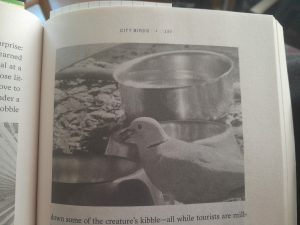
Chapter 4, titled “One Intelligence or Many?”, addresses the controversy over “general intelligence” – the thing that may enable innovation — in all bird species. Is there one “G,” or are there multiple intelligences for different needs? All fine and well, except that Lefebvre feels obliged, apparently, to end the chapter with a long disclaimer about how “what we have found in birds . . . has nothing to tell us about cognitive differences between present-day groups of humans.” His point is that such speculation would be racist, and we can’t have that. But his coda has little to do with the meat of the rest of the chapter, and doesn’t really belong in the discussion at all; it’s virtue-signaling, nothing more.
There have been a number of good books published in recent years on bird brains, intelligence, and cognition, including by Candace Savage, and several by the fecund, seemingly inexhaustible Jennifer Ackerman, as well as others. So it is noteworthy praise to say that A Bird’s IQ merits a place on the same shelf with those. It does.
The book was originally written in French, which I ordinarily consider, for books on any subject, a two-strikes sort of thing, but this translation, by Pablo Strauss, is an able one, and the reader of moderate literacy or better will not be too often confused, perplexed, or addled. Again, for a book originally written in French, this is noteworthy praise.
Finally, I will include here, under the reviewer’s prerogative, a postscript possibly of interest to no one except the reviewer: A recent review on this blog concerned a terrific new book, Cormorant, one of the themes of which was (to greatly simplify) the cultural identity of certain birds such as the pelican and the cormorant, the former being considered, by virtue of certain supposed and/or real behavior, Christ-like, and the latter (again, because of supposed and/or real behavior), Satanic – though sometimes the roles are, weirdly, switched. (Remember, I said I was simplifying.)
Imagine my surprise, then, to learn from this book, A Bird’s IQ, that a pelican innovation, over the last few decades, is to feed, not gliding gracefully above the waves, but on land, fighting now not with hapless fish but with their warm-blooded brethren:
In cormorant colonies, pelicans shove parents aside to attack the young tucked beneath them; parents that refuse to leave the nest are themselves swallowed by killer pelicans.
Not particularly Christ-like, nor something that the author of Cormorant had addressed; I wish he had. This may be a partial proof of the supposition that if you read enough books, like an infinity of them or just short of that, everything becomes connected or comprehensible, in a way that would otherwise never be. Maybe this should be the subject of a story by Jorge Luis Borges, or maybe it already is — I haven’t read much of his stuff, so I wouldn’t know.
________________________________________________________________________________
A Bird’s IQ: Innovation, Intelligence, and Problem Solving in the Avian World, by Louis Lefebvre. Greystone Books, Vancouver, Berkeley, London. May 12, 2026; 298 pp., $28.


















 English (US) ·
  French (CA) ·