

PROTECT YOUR DNA WITH QUANTUM TECHNOLOGY
Orgo-Life the new way to the future Advertising by AdpathwayThere are birds you hear before you see, birds that announce themselves with a familiar call or a burst of movement. And then there is the Western Tanager (Piranga ludoviciana). A flash of yellow, black, and red that can seem to materialize among the pines and disappear just as quickly.
In the mountains of Northern Arizona, Western Tanagers are a welcome sign of summer. They move through higher-elevation forests where ponderosa pines, mixed conifers, and open meadows provide food and shelter. For a photographer, they can also be wonderfully frustrating subjects: colorful, active, and rarely inclined to sit still for long.
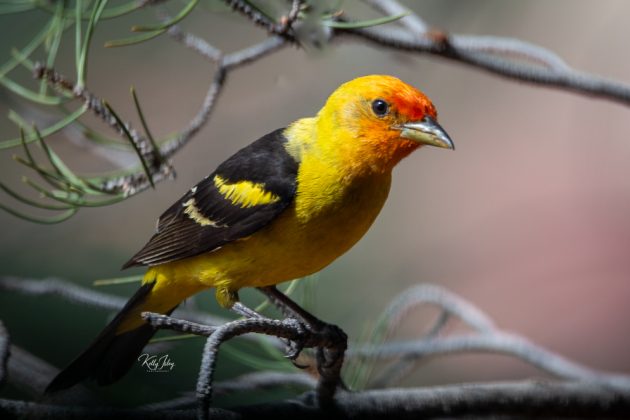
The male is especially striking. His body is bright yellow, his wings and back are marked with black, and his face is accented by a vivid red-orange forehead. Females and immature birds are more subdued, with yellow-green plumage that can make them considerably harder to spot against sunlit foliage.
That camouflage is part of the fun. Rather than searching randomly through the trees, watch for movement in the canopy and listen for the bird’s distinctive calls. Western Tanagers often forage methodically through branches, picking insects from foliage and occasionally dropping to the ground for fruit. During migration and the breeding season, a quiet stretch of forest can suddenly become much more interesting when a tanager appears.
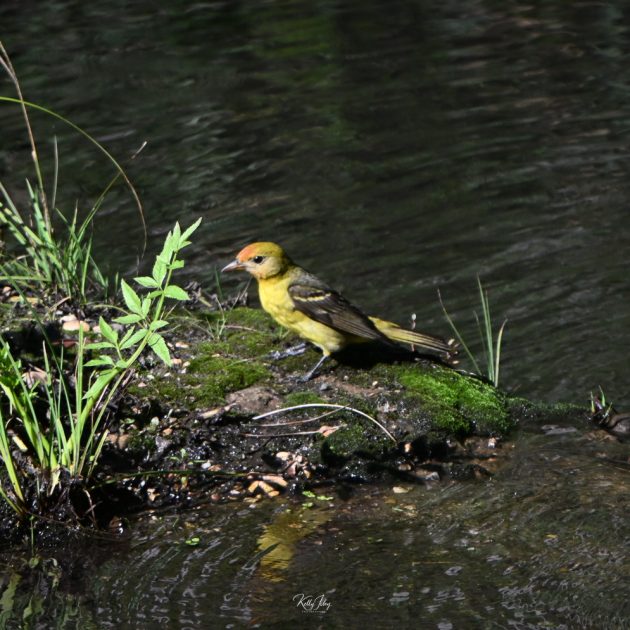
And while these birds spend much of their time high in the treetops, don’t overlook the places where water meets the forest. Western Tanagers regularly visit streams, natural pools, springs, and birdbaths to drink and bathe. During migration and summer, riparian areas the green corridors along rivers and creeks, can be especially attractive because they provide both water and an abundance of insects.
For a photographer, this can create a wonderful opportunity. Catching a Western Tanager down near the water, perhaps along Oak Creek, can be a lucky and beautiful moment. I personally think these may be some of the best opportunities to photograph these beauties, but having a long lens can be an advantage. Of course, getting close enough is another matter entirely. They are quick, wary, and perfectly capable of disappearing back into the trees before you can get the shot.
Here’s a photography tip: avoid chasing the bird and watch the perch instead.
Once you spot a Western Tanager, resist the temptation to follow every hop through the branches. Instead, observe where it repeatedly returns. Find a clean branch with a pleasing background, pre-focus or place your focus point there, and wait. This way not only produces calmer photographs; it also gives you a better chance of getting the bird in a natural pose without twigs tangling across its face.
The same idea applies when you’re photographing near water. Rather than following the bird from tree to tree, watch the water’s edge and the nearby branches. If the tanager has visited a particular pool, creek bank, or perch before, it may return. Patience may turn a momentary encounter into a photograph worth keeping.
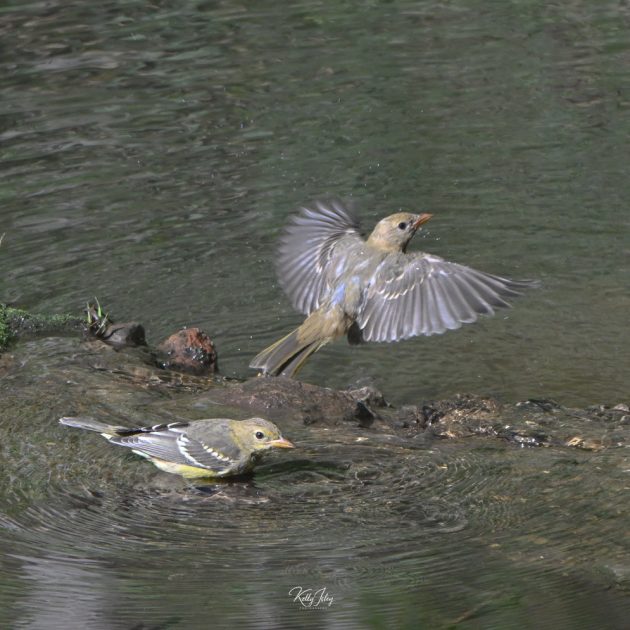
Light matters, too. The Western Tanager’s yellow plumage can easily become overexposed in harsh afternoon sunlight. Early morning or late-day light brings out richer color and softer shadows. If the bird lands in a patch of bright sky, watch your exposure carefully—the camera may try to brighten the scene and wash out those brilliant yellows. A slightly darker exposure can preserve feather detail that is difficult to recover later.
One of the neatest facts about Western Tanagers is that their red forehead isn’t simply a fixed splash of pigment. The red coloration comes from pigments called carotenoids, which the birds obtain from their diet. In other words, that fiery forehead is partly a reflection of what the bird eats.
That seems fitting for a species that spends so much of its life moving through the forest canopy in search of insects and fruit. The Western Tanager is colorful without being conspicuous, common without always being easy to find, and fast enough to challenge even a patient photographer.
Across their range, Western Tanagers are most closely associated with open conifer forests during the breeding season, but migration can take them far beyond the places where birders normally expect to find them. Scattered sightings have been recorded well outside their core range, a reminder that the boundaries on a range map don’t always express the full story.
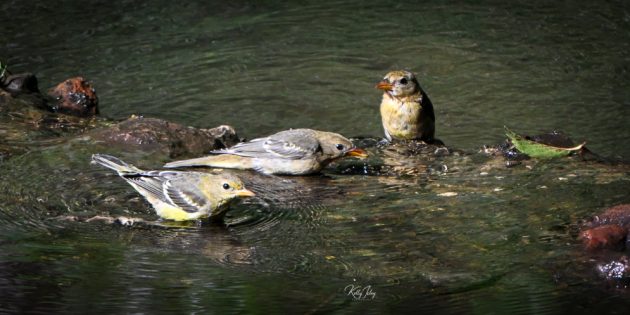
Here in Northern Arizona, that means keeping your eyes in the treetops—but keeping an eye on the water, too. Along Oak Creek and other riparian areas, a flash of gold may suddenly appear at the water’s edge before vanishing back into the pines. And if you happen to catch one there, camera in hand, consider yourself lucky. These are beautiful birds, but they rarely make the photographer’s job easy.
Look for that distinct combination of gold, black, and red—and when the spark of color appears, be ready. It may be there for only a heartbeat.




















 English (US) ·
  French (CA) ·