

 3 months ago
55
3 months ago
55
Quezon City – The bright streak of light captured over Mayon Volcano by the Philippine Institute of Volcanology and Seismology (PHIVOLCS) Ligñon Hill camera at 10:33 PM on 25 May 2026 was caused by a meteor entering the atmosphere, a phenomenon that often produces a brilliant flash.
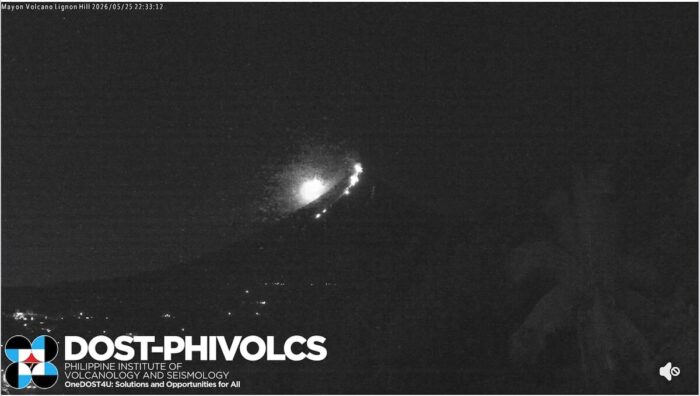
Meteor Observed Over Mayon Volcano on May 25
While meteors or space rocks enter Earth’s atmosphere daily, the vast majority disintegrate completely before reaching the ground. These meteors typically burn up at altitudes ranging from 60 to 100 kilometers above sea level. As they plunge through the dense layers of the atmosphere at incredible speeds—sometimes tens of kilometers per second—the friction between the meteor’s surface and the air molecules generates intense heat.
This extreme heat causes the meteoroid to vaporize, leaving behind a luminous trail in the sky. The process also ionizes the surrounding air, creating a bright, glowing streak known as a “shooting star.” These streaks are often observed as fleeting flashes of light darting across the night sky. The brightness and duration of a meteor depend on its size, speed, and composition. If a fragment of the meteoroid is large enough to withstand the fiery descent and reach Earth’s surface, it is classified as a meteorite. Such fragments can range from tiny grains to large blocks. The study of meteorites provides valuable insights into the early solar system, as they are considered extraterrestrial relics that have remained largely unchanged for billions of years.
The event was visually striking, prominently featuring the majestic Mayon Volcano in the foreground of PHIVOLCS’ video footage. Its symmetrical, almost perfect cone shape stood out clearly against the bright sky, creating a breathtaking backdrop for the scene. The volcanic landscape, with its rugged slopes and hints of volcanic activity, added an element of awe and natural beauty. Tracking meteor trajectories is a complex scientific endeavor.
Across the globe, scientists rely on an intricate network of radar installations and optical cameras to detect and monitor meteors as they streak through the Earth’s atmosphere. These instruments work in tandem with advanced data analysis techniques and sophisticated computational models to accurately trace the paths of these fleeting celestial objects. Such efforts help researchers better understand meteors’ origins, behaviors, and potential impacts, contributing to our broader knowledge of space and planetary defense.
(Photo credit: DOST–PHIVOLCS)
Please follow #TeamOutofTown on Facebook, Twitter, Instagram, and Pinterest for more travel ideas.


















 English (US) ·
  French (CA) ·