

 7 months ago
332
7 months ago
332
PROTECT YOUR DNA WITH QUANTUM TECHNOLOGY
Orgo-Life the new way to the future Advertising by AdpathwayDisclaimer: This site is not affiliated with the National Hurricane Center, Hurricane Hunters, Storm Prediction Center, or National Weather Service. ALL forecasts herein are the result of my analysis, (to which you will see me at times, insert excerpts from various agencies due to the nature of the importance of the information) and I am solely responsible for the content. As ALWAYS, follow the National Hurricane Center, National Weather Service, and your local Emergency Management officials for emergency decisions. In addition, this is strictly a FORECAST OFFICE. I CANNOT make decisions regarding travel plans, etc. My purpose, is to provide you the information, based solely on information I analyze, and the accuracy of the information at hand of the time of analysis, so you may make informed decisions.
(T. F. “Storm” Walsh)
For those who have donated to my site, your help has been greatly appreciated. If you are not aware, donations to my site help pay for subscriptions to sites I use as well as software updates, which provide all the models and information used in my forecasts. To donate, please click the DONATE button to the right side of the page, or on the graphic of the dog. Any help you provide is immensely appreciated!
DONATIONS ACCEPTED AND APPRECIATED


I will reiterate, my forecasts are based on the available information at the time of analysis, and are only as accurate as the information analyzed and the solutions provided.
The Storm Prediction Center (SPC) has issued a SLIGHT risk for severe thunderstorms in the current DAY 2 Outlook: FOR MUCH OF CENTRAL AND SOUTHERN ILLINOIS AND INDIANA…PARTS OF WESTERN AND NORTHERN KENTUCKY AND SOUTHWESTERN OHIO…
…SPC SUMMARY…
Severe thunderstorms, with potential to produce a few tornadoes and damaging wind gusts, are possible across parts of the middle Mississippi into lower Ohio Valleys Thursday afternoon into early evening.
SPC DAY 2 SEVERE THUNDERSTORM OUTLOOK (LINKED FOR OUTLOOK TEXT)
TORNADO PROBABILITY
Probability of a tornado within 25 miles of a point.
HAIL PROBABILITY
Probability of one inch diameter hail or larger within 25 miles of a point.
DAMAGING THUNDERSTORM WIND PROBABILITY
Probability of damaging thunderstorm winds or wind gusts of 50 knots or higher within 25 miles of a point.
The following is the current CSU – MLP severe weather forecast map and NSSL ML probability forecast:
CSU – MLP DAY 2 FORECAST (CLICK FOR LARGER IMAGE)
NSSL ML DAY 2 SEVERE PROBABILITY 

DAY 2 PROBABILITY CONVERSION TABLE
SPC DISCUSSION EXCERPT:
…Middle Mississippi/Lower Ohio Valley…
It appears that warming aloft, associated with subsidence to the south of the trailing mid/upper jet, will tend to eventually overspread the better (but still relatively modest) low-level moisture return to the evolving warm sector across the lower Ohio Valley. However, to still differing degrees, the latest runs of the various model output indicate a window of opportunity for strong to severe thunderstorm development, perhaps beginning by early afternoon, aided by daytime heating and subtle mid-level cooling/forcing for ascent accompanying the lead jet streak.
The consensus of latest guidance, supported by the High Resolution Ensemble and related machine learning output, suggests that this may initiate across portions of Illinois, near or to the north and east of the Greater St. Louis area, with strongest activity tending to develop eastward and perhaps peak while spreading across east central and portions of southeastern Illinois through portions of central and southern Indiana by early Thursday evening.
Forecast soundings across this corridor remain generally characterized by at least modest convective instability, and CAPE on the order of 500-750+ J/kg, in the presence of strong deep-layer shear. Sizable clockwise-curved low-level hodographs, beneath 40-50+ kt south to southwest flow in the 850-700 mb layer, may promote supercells capable of producing severe hail and a few tornadoes, and activity may eventually grow upscale enough to support increasing potential for damaging wind gusts before convection wanes late Thursday evening.
NADOCAST maps will not be available until the SPC DAY 1 outlook.
Based on my analysis of the preliminary severe weather indices, the forecast calls for a marginally unstable atmosphere at the moment. Indices and current outlook maps indicate ALL severe weather threats are possible. Although hail is in the forecast, any severe hail should be fairly isolated. Based on analysis of strong deep layer shear, 0 – 3km SRH, and EHI values, tornadoes will be possible and should remain within the weaker range of EF0 – EF1. Although SRH values would support an isolated EF2, the current EHI values do not support anything stronger than EF1. Currently, strongest severe weather indices should be within the SLIGHT risk, 5% TORNADO, and darkest area of the NSSL ML probability outlines. Some indices will most likely change between issuance of this synopsis, and by the onset of the DAY1 outlook, so this forecast should not be taken as absolute.
CAPE VALUES FORECAST
DEW POINT FORECAST
NAM 3KM FORECAST RADAR ANIMATION (3:00 P.M. CST – 9:00 P.M. CST FEB 19.)
Based on analysis of model animations, the current outlook, and analysis of indices, the strongest convection and indices should occur by early afternoon on Thursday,through early evening. I will continue to monitor the situation and intend to update the forecast upon issuance of the SPC DAY1 outlook, and continued updated model runs.
Indices were analyzed from the NAM 3KM, CIPS DETERMINISTIC, and SPC SREF model guidance.
The following were the forecast parameters and indices analyzed this morning. Bear in mind, indices recorded below are for the time of peak intensity. Some indices meanings are posted below the indices themselves, and the NWS page containing a more extensive explanation can be accessed further on in the synopsis:
SBCAPE: 500 – 750 j/kg-1
MLCAPE: 250 – 750 j/kg-1
MUCAPE: 500 – 1000 j/kg-1
SRH 0 -1 km: 150 – 300 m2/s2
SRH 0 -3 km: 250 – 450 m2/s2
SRH EFFECTIVE: 100 – 300 m2/s2
L. I.: -1 to -3
SCP: 1 – 6
STP: 0.9 – 1.9
0 -6 km SHEAR: 75 kts – 85 kts
EFF. SHEAR: 50 kts – 60 kts
MID LEVEL LAPSE RATE: 6.0C – 7.5C
DEWPOINT: 54F – 62F
EHI: 0.6 – 1.6
TOTAL TOTALS INDEX: 48C – 49C
K INDEX: 23C – 32C
SWEAT INDEX: 425 – 465
THOMPSON INDEX: 24 – 35
CRAVEN – BROOKS INDEX: 10,000 – 20,000
CAPE 
ENERGY HELICITY INDEX
K INDEX
TOTAL TOTALS INDEX
STORM RELATIVE HELICITY
LIFTED INDEX
SWEAT VALUES
THOMPSON INDEX
Craven SigSvr Parameter:
The simple product of 100mb MLCAPE and 0-6km magnitude of the vector difference (m/s; often referred to as “deep layer shear”) accounts for the compensation between instability and shear magnitude. Using a database of about 60,000 soundings, the majority of significant severe events (2+ inch hail, 65+ knot winds, F2+ tornadoes) occur when the product exceeds 20,000 m3/s3.
A little fact on SRH values and tornadoes from NOAA / NWS
Storm Relative Helicity (m2 s-2)
SRH (Storm Relative Helicity) is a measure of the potential for cyclonic updraft rotation in right-moving supercells, and is calculated for the lowest 1-km and 3-km layers above ground level. There is no clear threshold value for SRH when forecasting supercells, since the formation of supercells appears to be related more strongly to the deeper layer vertical shear. Larger values of 0-3-km SRH (greater than 250 m2 s-2) and 0-1-km SRH (greater than 100 m2 s-2), however, do suggest an increased threat of tornadoes with supercells. For SRH, larger values are generally better, but there are no clear thresholds between non-tornadic and significant tornadic supercells.
STP ( Significant Tornado Parameter) EXPLAINED:
A majority of significant tornadoes (EF2 or greater damage) have been associated with STP values greater than 1, while most non-tornadic supercells have been associated with values less than 1 in a large sample of RAP analysis proximity soundings.
SCP (Supercell Composite Parameter) EXPLAINED:
A multiple ingredient, composite index that includes effective storm-relative helicity (ESRH, based on Bunkers right supercell motion), most unstable parcel CAPE (muCAPE) and convective inhibition (muCIN), and effective bulk wind difference (EBWD). Each ingredient is normalized to supercell “threshold” values, and larger values of SCP denote greater “overlap” in the three supercell ingredients. Only positive values of SCP are displayed, which correspond to environments favoring right-moving (cyclonic) supercells.
The following are the SCP (Supercell Composite Parameter) and STP (Significant Tornado Parameter) forecast maps from the NAM 3KM model. Generally, the higher the values and brighter the color, indicates a greater probability of strong thunderstorm and / or tornadic activity over an area:
NAM 3KM SCP FORECAST 3:00 P.M. CST FEB. 19 – 9:00 P.M. CST FEB. 19
NAM 3KM STP FORECAST 3:00 P.M. CST FEB. 19 – 9:00 P.M. CST FEB. 19
I have provided the SPC homepage link below, so you may get the updated information regarding any changes to the outlook:
SPC HOMEPAGE
https://www.spc.noaa.gov/classic.html
The SPC does not indicate any severe weather for the remainder of the week. However, the CSU – MLP and NSSL ML probability models are hinting at a possible MARGINAL risk for Friday.
CSU – MLP AND NSSL ML DAY3 PROBABILITY MAPS

The following sites will explain most of the severe weather and tornado values listed above, and will give you an idea of what to expect:
ENVIRONMENTAL INDICES AND PARAMETERS NWS
https://www.weather.gov/lmk/indices
THE WEATHER PREDICTION
http://www.theweatherprediction.com/severe/indices/
The following links will connect you to the Excessive Rainfall probabilities and River Flood Outlook:
EXCESSIVE RAINFALL
https://www.wpc.ncep.noaa.gov/qpf/excessive_rainfall_outlook_ero.php
SIGNIFICANT RIVER FLOOD OUTLOOK
https://www.wpc.ncep.noaa.gov/nationalfloodoutlook/index.html
The following NWS Watch / Warning map will provide local NWS information for your area. Click the image, then once it refreshes, click on your area of interest to view any forecasts, special weather statements, hazards or advisories for your area.
NWS WATCH / WARNING DISPLAY (LINKED…CLICK MAP, THEN YOUR AREA)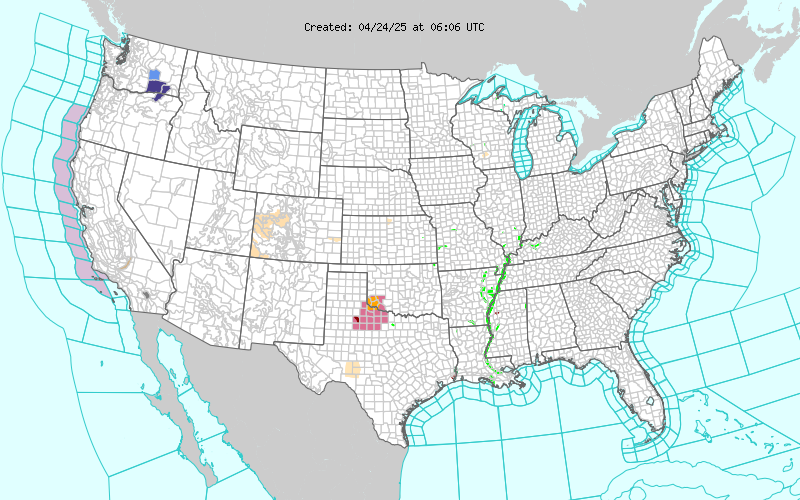
NWS DOPPLER RADAR LOOP (LINKED, CLICK RADAR MAP)
RAP RADAR (CLICK IMAGE THEN GO TO LOOP DURATION AND PICK LENGTH OF LOOP, THEN CLICK RADAR SITE)
WUNDERGROUND RADAR SUMMARY MAP (CLICK FOR UPDATES)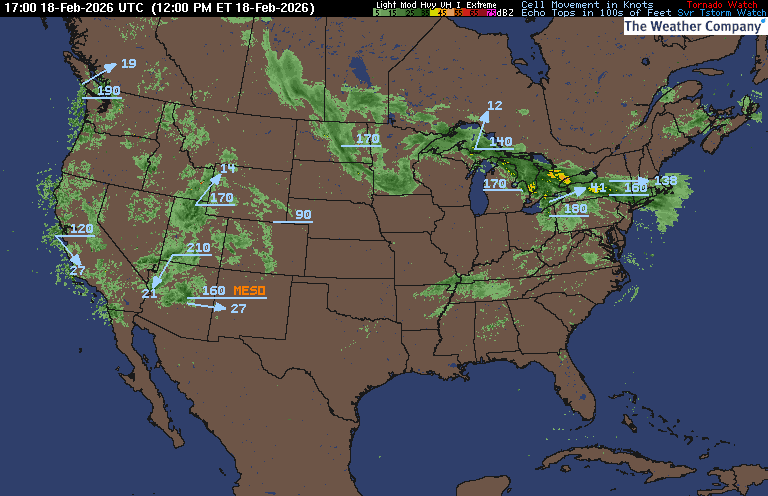
PRECIPITATION TYPE (CLICK TO ACCESS ANIMATION FEATURE)
CARIBBEAN RADAR (CLICK IMAGE TO ACCESS ANIMATION)
You may direct any questions by contacting me personally, ANYTIME, at: [email protected]
Have a blessed day!
T. F. “STORM” WALSH III
GMCS, USCG (ret)
METEOROLOGIST / HURRICANE SPECIALIST /SEVERE WEATHER SPECIALIST















 English (US) ·
  French (CA) ·