

 19 hours ago
4
19 hours ago
4
PROTECT YOUR DNA WITH QUANTUM TECHNOLOGY
Orgo-Life the new way to the future Advertising by AdpathwaySarah Le Berre, Institute of Silviculture and Forest Protection (Technical University of Dresden), discusses her article: Identifying future climate refugia in central European mountain forests
Mountain forests can seem timeless. Yet their tree communities are continuously changing in response to human pressures, natural disturbances, and shifts in climate. As temperatures rise and disturbance patterns become less predictable, concerns are growing about the future of these forests.
In our study, we asked a deceptively simple question: where might present-day mountain forest communities persist under future climate change, and why?
Why are refugia important?
Refugia are places where species or communities persist despite unfavourable environmental changes in the surrounding landscape. By providing shelter during changing periods, they can reduce the risk of local extinction and allow species to recolonise surrounding areas when conditions become more favourable.
Forest refugia have long served as critical sanctuaries for biodiversity. During periods of climatic upheaval, such as the last Ice Age, these areas provided stable conditions where species could persist, ensuring their survival and enabling later recolonization as the climate warmed again.
Tree distributions, however, do not depend on climate alone. Local conditions, such as soil properties and topography, can interact with competition, seed dispersal, and tree growth capacity. Disturbances such as storms and insect outbreaks (e.g. bark beetles) reshape forest stands, while past management can leave ecological fingerprints lasting for centuries.
We developed a “refugia capacity” index that identified potential future forest refugia by comparing today’s tree communities with future communities using a forest landscape model. If a community remains stable, especially communities with rare species, they are particularly valuable for conservation and considered to have high refugia capacity.
Looking into the future
Our study focused on Berchtesgaden National Park, Germany’s only Alpine national park. Its steep landscape includes low-elevation beech forests, mixed montane forests, and high-elevation stands containing Norway spruce (Picea abies), European larch (Larix deciduaI), and Swiss stone pine (Pinus cembra).
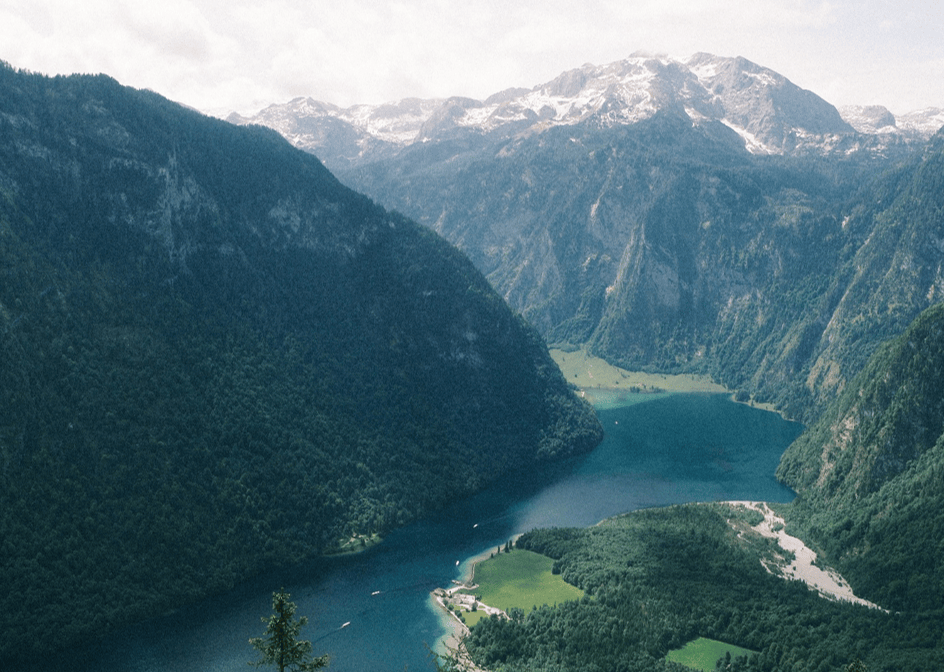 Berchtesgaden National Park, Germany. Photo by Rupert Seidl.
Using the individual-based forest model iLand, we simulated tree growth, mortality, and regeneration alongside seed dispersal, competition, wind disturbance, and bark beetle outbreaks. We compared simulated forests under historical climate conditions with moderate and severe climate-change scenarios. The simulations of future climate change are not forecasts of exactly what the park will look like; instead, they reveal possible pathways of long-term ecological change.
A mosaic of persistence and change
We identified a mosaic of potential refugia across the park, although no community remained entirely unchanged.
Refugia capacity declined across 64.6% of the study area under the moderate climate-change scenario and 68.8% under the severe climate-change scenario. Forests at intermediate elevations generally had the greatest refugia capacity, while forests at both low and high elevations experienced stronger changes.
Swiss stone pine had the highest species-specific refugia capacity, but its refugia were few and spatially restricted. A reminder that persistence in a small number of places does not mean that a species is secure across the wider landscape.
The strongest driver was history
Our most striking result was that past forest management mattered more than climate, topography, or disturbance in explaining where communities persisted. Centuries of timber harvesting and other land uses favoured spruce-dominated stands and shifted parts of the park away from their potential natural vegetation.
Although management ceased in much of the park decades ago, its legacy remains visible in the forest’s future trajectories. Forests closer to natural conditions generally had greater refugia capacity.
Functional redundancy was also important. In simple terms, forests were more likely to retain their communities when several species could perform similar ecological roles. This ecological “insurance” may allow a forest to absorb the decline of one species without losing essential functions. Under the most severe climate change scenario, precipitation became increasingly important. In contrast, wind and bark beetles were less influential than expected over the millennium-long timescale.
From refugia maps to conservation choices
Our results do not suggest that managers should freeze forests in their current state. Change is inevitable and may be profound. Instead, refugia-capacity maps can distinguish between areas where conserving existing communities is realistic and places where supporting adaptation or guiding transformation may be more appropriate.
Protecting refugia hotspots, restoring forests affected by past management, and maintaining diverse species and ecological functions could strengthen mountain-forest conservation. Climate refugia therefore deserve a place in protected-area planning: in a rapidly changing landscape, even small pockets of persistence may become starting points for future recovery.
Forests remember. Decisions made centuries ago still shape how they respond today and the decisions we make now will echo far into their future.




















 English (US) ·
  French (CA) ·