

 5 hours ago
3
PROTECT YOUR DNA WITH QUANTUM TECHNOLOGY
Orgo-Life the new way to the future Advertising by AdpathwaySTAR physicists found about 20% suppression of high-energy particles in oxygen collisions recorded in 2021, evidence that even small nuclei can briefly form a quark-gluon plasma.
Even the smallest drops of the hottest matter ever made in a lab appear thick enough to slow down the particles shooting through them. Physicists with the STAR experiment at Brookhaven National Laboratory's Relativistic Heavy Ion Collider (RHIC) reported about a 20% suppression of high-energy particles in collisions of oxygen nuclei, a sign known as jet quenching, according to Brookhaven's announcement of the study published Oct. 20 in Physical Review Letters.
The finding matters because it points to quark-gluon plasma, the soup of particles believed to have filled the universe in its first microseconds, forming in collisions far smaller than the gold-on-gold smashups RHIC was built for.
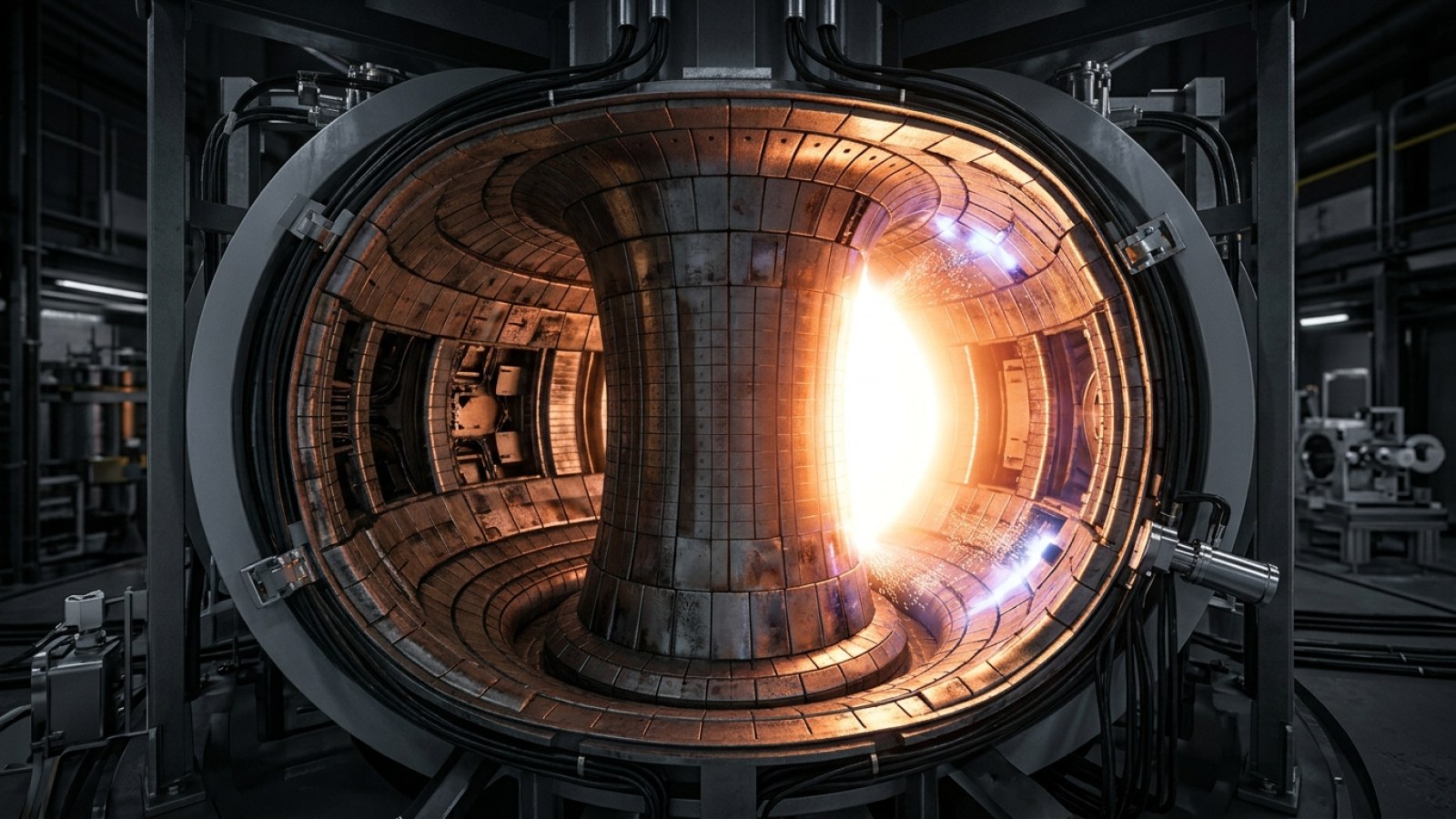
It is also a late result — from a machine that no longer runs. RHIC, on Long Island in Upton, New York, fired its final beams Feb. 6 after about 25 years of operation, and its tunnel will be reused for the planned Electron-Ion Collider.
A Bullet Through Water, at Nearly the Speed of Light
When two nuclei slam together head-on at RHIC energies, they can melt protons and neutrons into their building blocks, quarks and gluons, for a tiny fraction of a second. Brookhaven says a drop of quark-gluon plasma formed this way is smaller than a single atomic nucleus and lasts less than a billionth of a billionth of a second.
Some collisions also send out jets, sprays of particles kicked out by a hard hit between quarks or gluons. If a jet has to plow through plasma on its way out, it loses energy.
"You can think of it like shooting a bullet through, say, water," said Li Yi, a physics professor at Shandong University who oversaw the analysis. "Because of the resistance, the bullet will slow down."
To see that slowing, the team compared head-on oxygen collisions, which produce the most particles, with glancing ones in which the nuclei barely strike each other, and no plasma is expected. Head-on events showed fewer high-energy particles, consistent with jets losing energy.
Why Small Oxygen Nuclei Were a Surprise
Oxygen has 16 protons and neutrons, compared with 197 in gold. In big gold collisions, jet quenching has been seen for years, and RHIC data showed by 2005 that the plasma behaves like a nearly perfect liquid, according to CERN Courier.
Small systems have been harder to read — and more contentious. Flow patterns that hint at plasma have turned up in small collisions at RHIC and at Europe's Large Hadron Collider, but quenching has not been seen clearly. "We haven't seen any unambiguous signal, so it's still kind of under debate in these small systems," said Rongrong Ma, a STAR physicist at Brookhaven.
The new result, from oxygen data recorded at 200 billion electron volts in 2021, adds a clear quenching signal in a small system. The suppression was weaker than in gold collisions, as expected for a smaller drop of plasma, but still a clear sign that one formed.
Evidence Check: Strong Signal, Open Questions
The work is peer-reviewed and was first posted as a preprint on arXiv earlier this year. It is one measurement at one energy from one experiment, and physicists still debate the minimum conditions needed to create quark-gluon plasma.
Oxygen is the only nucleus besides protons that has been collided at both RHIC and the Large Hadron Collider, which runs at energies above 5,000 billion electron volts. That allows an apples-to-apples comparison, and Yi expects the quenching signal "should be bigger at LHC compared to RHIC" because higher energy should produce hotter, denser plasma.
The team also plans to look at pairs of jets produced near the edge of the collision zone. "That means we can more easily look for signs of asymmetric quenching of di-jets," said Maowu Nie, an associate professor at Shandong University.
A Collider's Legacy and the Next Machine on Long Island
The research was supported by the Department of Energy's Office of Science, the National Science Foundation and international agencies, and it used computing resources at Brookhaven and Lawrence Berkeley National Laboratory.
For most readers, the practical meaning is about knowledge and investment rather than daily life. RHIC's data will keep producing results for at least another decade, CERN Courier reported, and much of the hardware will carry over to the Electron-Ion Collider, which will collide electrons with protons and nuclei to map how quarks and gluons are arranged inside matter.
Students and researchers at Brookhaven and partner universities will analyze that legacy dataset for years. The scale is huge: the sPHENIX detector alone recorded more than 200 petabytes of raw data, including 40 billion gold collisions, more than all previous RHIC datasets combined, according to CERN Courier.
The oxygen result itself was a training ground. Sijie Zhang did the work for her master's thesis at Shandong University and is now a Ph.D. student at Yale University, while former Shandong student Yang He set up the analysis framework. RHIC's earlier experiments also found that gluons carry a significant share of the proton's spin, one of several discoveries the Electron-Ion Collider is designed to build on. Readers who live near Brookhaven can follow the lab's public updates on the Electron-Ion Collider as construction moves forward.
The bottom line is that a retired American collider has shown jet quenching in tiny oxygen collisions, strengthening the case that early-universe matter can form in small drops, and comparisons with the Large Hadron Collider will test that conclusion next.
What Readers Want to Know
What is jet quenching?
It is the energy loss of jets, sprays of high-energy particles, as they pass through quark-gluon plasma, much like a bullet slowing in water.
What did the STAR experiment find?
About a 20% suppression of high-energy particles in head-on oxygen collisions, evidence that a quark-gluon plasma formed.
Why is this surprising?
Oxygen nuclei are small, and physicists have debated whether such small collisions can create quark-gluon plasma at all.
When were the data collected?
The oxygen collisions were recorded at RHIC in 2021, and the study was published Oct. 20, 2026.
Is RHIC still running?
No. RHIC's final beams circulated Feb. 6, 2026, and its tunnel will be reused for the planned Electron-Ion Collider.
What comes next?
Comparisons with oxygen collisions at the Large Hadron Collider and further studies of jet pairs.
© 2026 NatureWorldNews.com All rights reserved. Do not reproduce without permission.


















 English (US) ·
 French (CA) ·